You are using an out of date browser. It may not display this or other websites correctly.
You should upgrade or use an alternative browser.
You should upgrade or use an alternative browser.
To full length resize?
- Thread starter #49
- Start date
Very good luck with neck sizing the 6.5x55. Full length sizing with Lee collet done at 10 firings when brass gets tight in chamber. Brass at 13 firings with moderately stiff loads shows no signs of wear. Looking to get a collet neck die for the .243 now.

hometownhero
CGN Ultra frequent flyer
- Location
- Toon Town, Sk
I use my full length die and bump shoulders .002". Everything chambers and never have to worry about when I will need to size brass that has been neck sized. Also if you neck size eventually you will have to full length size then fire form again to get your load the same as before sizing.
Last edited:

I use my full length die and bump shoulders .020". Everything chambers and never have to worry about when I will need to size brass that has been neck sized. Also if you neck size eventually you will have to full length size then fire form again to get your load the same as before sizing.
You mean 0.002"
hometownhero
CGN Ultra frequent flyer
- Location
- Toon Town, Sk
You mean 0.002"
That would be the one lol. I will edit
I too like the "partial resizing" method of just bumping back the shoulder enough that the cases will chamber in the gun for which they are intended. Minimal re-working of the brass, but I believe I'm getting better concentricity than I do from neck sizing dies.

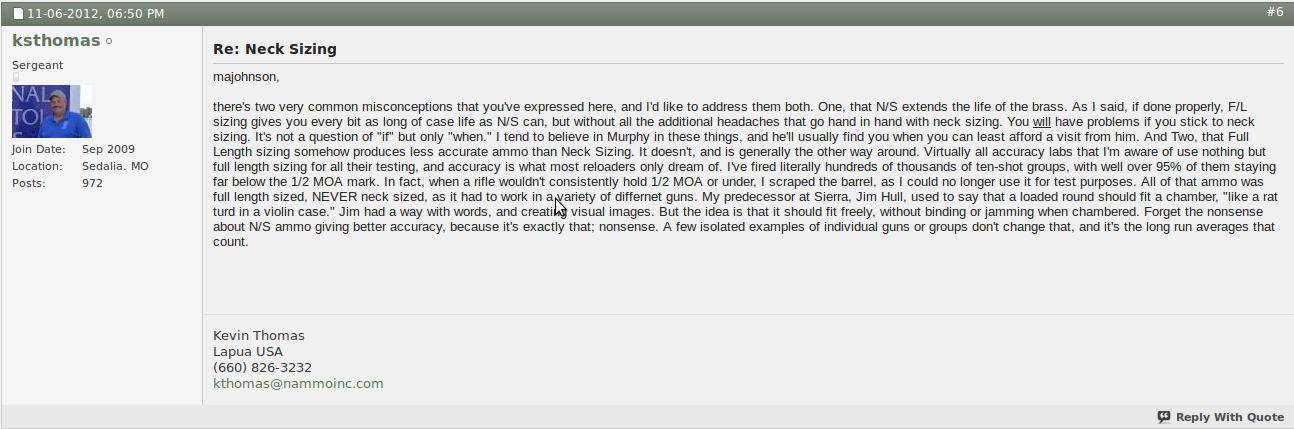

I use FL dies with Redding Competition shellholders. I use the .010" over until there is more bolt resistance than I feel like putting up with; then go down .002" at a time on a single case until there is either just the slightest hint of bolt resistance or none. Slight resistance is zero shoulder bump; and one step past is .002" bump. Or up to .002" if you want to split hairs. At this point I'll write the shell holder number on the shell box and use it for that rifle for all the brass and any future new brass.
Easier than falling down a well. Never set a die again, never oversize a case again, and use the same dies on multiple rifles without setting.
Easier than falling down a well. Never set a die again, never oversize a case again, and use the same dies on multiple rifles without setting.

I use FL dies with Redding Competition shellholders. I use the .010" over until there is more bolt resistance than I feel like putting up with; then go down .002" at a time on a single case until there is either just the slightest hint of bolt resistance or none. Slight resistance is zero shoulder bump; and one step past is .002" bump. Or up to .002" if you want to split hairs. At this point I'll write the shell holder number on the shell box and use it for that rifle for all the brass and any future new brass.
Easier than falling down a well. Never set a die again, never oversize a case again, and use the same dies on multiple rifles without setting.
I'm thinking this is the way I'll go if I get more than 1 rifle of the same calibre. Either that or pick up another die (one per rifle), although the .002" steps take the guesswork out of how much you're moving the die.
For the OP's question, unless the die over works the brass (such as .303 British is noted for) I don't see any harm in full length sizing for a hunting rifle. You'll normally never have issues with chambering if you full length size every time.
My brass get resized every time around, with neck annealing every fourth firing. I'm getting acceptable brass life. Unless you plan to shoot and reload a lot, you should have no problem getting 8-10 reloads out of quality brass. Possibly more than that depending on the brass, how tight your chamber is, and how hot your loads are.
My brass gets sized to bump the shoulder back .002-.003" from the dimension where it gets tight to chamber a round. My loads aren't overly "hot", it may take 4-5 firings or more before the shoulder moves enough to fit tightly in the chamber. My Winchester brass stretches easily. Lapua is much more resilient, I've seen very little shoulder movement so far.
Bumping the shoulder back .001 or .002 means pushing the shoulder back .001 or .002 below the red dotted line below.
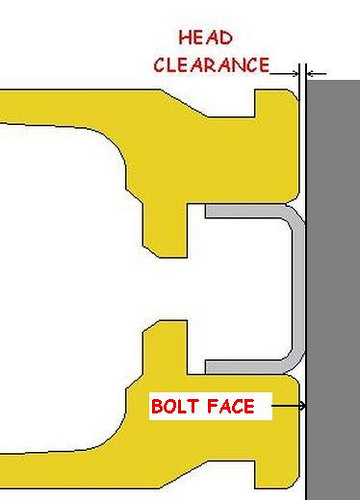
Meaning the minimum amount of shoulder setback (bump) for a full length resized case. "AND" longer case life due the minimum head clearance between the bolt face and the rear of the case.

Your resizing shoulder bump is the equivalent to your head clearance when the cartridge is chambered. Meaning how far the case has to stretch to meet the bolt face when fired.
On the flip side of this I have had new unfired cases with .011 head clearance so .001 to .002 head clearance is well within the cases elastic limits and not stretch when fired.
Meaning the minimum amount of shoulder setback (bump) for a full length resized case. "AND" longer case life due the minimum head clearance between the bolt face and the rear of the case.
Your resizing shoulder bump is the equivalent to your head clearance when the cartridge is chambered. Meaning how far the case has to stretch to meet the bolt face when fired.
On the flip side of this I have had new unfired cases with .011 head clearance so .001 to .002 head clearance is well within the cases elastic limits and not stretch when fired.
By bumping the shoulder back you are referring to moving the datum line back correct?Weatherby brass is $$ and I want to get the most out of it.
Yeah, I have a tool that fits over the case to determine the case head to shoulder datum dimension.
I think Hornady sells a tool specifically for that purpose. Probably Sinclair does too. The tool isn't a must-have, but it takes some of the guesswork out of the process.
For a hunting rifle, being sure loaded rounds will chamber reliably and safely is a priority for me. Top accuracy is a good thing, but having a critter with designs on eating me staring me in the eye while my bolt won't close on a loaded round wouldn't be good.. every hunting round I load gets checked before it goes in a box.
Yeah, I have a tool that fits over the case to determine the case head to shoulder datum dimension.
I think Hornady sells a tool specifically for that purpose. Probably Sinclair does too. The tool isn't a must-have, but it takes some of the guesswork out of the process.
For a hunting rifle, being sure loaded rounds will chamber reliably and safely is a priority for me. Top accuracy is a good thing, but having a critter with designs on eating me staring me in the eye while my bolt won't close on a loaded round wouldn't be good.. every hunting round I load gets checked before it goes in a box.
That happens a lot in Nova Scotia, does it?


That happens a lot in Nova Scotia, does it?
There were quite a few land monsters when I lived down there...
Lol... not often, no. I think once would be enough, just the same.
In this part of the country there isn't much that'll normally tackle a healthy human. Animals can be unpredictable, however, as the linked article illustrates.
http://www.cbc.ca/beta/news/canada/nova-scotia/coyotes-kill-toronto-singer-in-cape-breton-1.779304
Personal safety concerns aside, hunting ammunition shouldn't be untried. You need to be able to rely on it to work as intended.
In this part of the country there isn't much that'll normally tackle a healthy human. Animals can be unpredictable, however, as the linked article illustrates.
http://www.cbc.ca/beta/news/canada/nova-scotia/coyotes-kill-toronto-singer-in-cape-breton-1.779304
Personal safety concerns aside, hunting ammunition shouldn't be untried. You need to be able to rely on it to work as intended.