












































You are using an out of date browser. It may not display this or other websites correctly.
You should upgrade or use an alternative browser.
You should upgrade or use an alternative browser.
Trade gun
- Thread starter 3Beavers
- Start date

I have never seen one of the Pedersoli reproductions, but it looks respectable according to the photo I just found on the web. I have a soft spot for trade guns, having manufactured a quantity of them over 30 years ago. Most went to historic sites, a few were private sales. These were styled like a typical gun from the 1830s. Most British made trade guns from the 19th century were 24 ga., about .577" caliber. Some modern repros are this size, many are 20 ga. Not going to make much difference for shooting. Generally speaking, trade guns are light, handy and slender. They use a lock about 6" long; this does not contribute to the fastest possible locktime. They function well with either shot or ball, keeping in mind the limitations of a smoothbore gun. You might also have a look at 3w.northstarwest.com or 3w.trackofthewolf.com. Where in Upper Canada are you?
I got some 12ga.round ball from a fella in Brantford 2yrs ago for a "project"I was working on.He commented that in target shooting smoothbore 20ga.would be better,hence my question.Thanks for your input tiriaq! I reside in the Grey/Bruce area of S.Ont.
Regards,Jed.
I reside in the Grey/Bruce area of S.Ont.Regards,Jed.
go to caywood guns on the net i bought their wilson trade gun.20ga. its awsome, workmanship and customer service is second to none,waiting fore a english game gun.45 i have ordered, i have seen a lot of flint b.p. guns these guys rate with the best, wade

I have had Pedersoli guns in the past. Like the Armi Sport and Lyman BP guns I've also had, my biggest pet peeve on Italian made examples is the ugly electrostnciling they put on the barrels to (proudly?) announce they made it.
Probably not an issue with a trade gun which uses a musket size lock, but on their rifles and fusils the Italian guns (ie, Pedersoli and Armi Sport) have non-typical lock geometry requiring either short flints, or you'll have to knap a standard 5/8 flint down about 1/8th inch to get it to fit the lock at half-#### with the frizzen closed.
They're decent for production guns, but don't expect "custom gun maker quality" in the fit and finish department. FAR better than Spanish made stuff though.
Probably not an issue with a trade gun which uses a musket size lock, but on their rifles and fusils the Italian guns (ie, Pedersoli and Armi Sport) have non-typical lock geometry requiring either short flints, or you'll have to knap a standard 5/8 flint down about 1/8th inch to get it to fit the lock at half-#### with the frizzen closed.
They're decent for production guns, but don't expect "custom gun maker quality" in the fit and finish department. FAR better than Spanish made stuff though.


3Beavers said:Sounds like I better check out these other manufacturers and maybe the WTS board 1st,before I "settle" on the Ped.
Thanks,Jed.
there's nothing wrong with the Pedersoli, it's a perfectly useable firearm in it'd price range. Are there better guns? Absolutely. But they will also have a price that reflects that.
Depends what you want to spend and what your expectations are for that price.
Rather than buying a finished reproduction, using one of the available kits is a viable option, particularly if you enjoy working on your guns. The ml hobby is one area where it is entirely practical to make your own guns from scratch, with the possible (probable?) exception of the barrel.
I have yet to learn how to post photos - I'm a dinosaur - but if any anyone would care to do this, I could email photos of the trade gun which I made.
I have yet to learn how to post photos - I'm a dinosaur - but if any anyone would care to do this, I could email photos of the trade gun which I made.
This is one of the nicest trade guns I've seen,It's a Caywood "Chiefs Grade"
You can order it as a kit, or fully assembled in which case it has a lifetime guarantee.[/QUOTE]
Looks good! 20ga.?(back to my origional Q. )
Regards,Jed.
You can order it as a kit, or fully assembled in which case it has a lifetime guarantee.[/QUOTE]
Looks good! 20ga.?(back to my origional Q.
)Regards,Jed.
Mine is 24ga., and I use 1 oz. of shot. I suppose a bit more could be used. Used to prove the barrels with 2 oz. and equal volume of powder, this being double a reasonable charge. 20 ga. shot load would be similar, the ball would be a bit heavier in 20 than in 24. Given a choice, I really don't know that it would make much difference. I wouldn't pass on a gun that I otherwise liked, just because of the bore size.
Like my father before me,I want the best for less!Claven2 said:there's nothing wrong with the Pedersoli, it's a perfectly useable firearm in it'd price range. Are there better guns? Absolutely. But they will also have a price that reflects that.
Depends what you want to spend and what your expectations are for that price.
Regards,Jed.
(really,I do believe quality counts!
)3Beavers said:Like my father before me,I want the best for less!
Regards,Jed.
(really,I do believe quality counts!
If you want higher quality for less money than a Pedersoli Reproduction gun, then you need to look at buying a kit and building it yourself
I just looked on the Pedersoli website, not a bad looking trade gun, do you know what the price for one is ?
I concur what all has been said in these posts, all good info.
The Caywood in the pic is a 20ga.So is the one in the 2006 Rondy pics.that one was built from a kit,Mike's built 3 of them so far.
I concur what all has been said in these posts, all good info.
The Caywood in the pic is a 20ga.So is the one in the 2006 Rondy pics.that one was built from a kit,Mike's built 3 of them so far.
Posting for tiriag.Pics of his trade gun.


That is a sweet looking trade gun ,hoping you give us the skinny on the lock , stock and barrel.
I was looking at that Pedersoli again and I'm thinking there's not enough drop in stock?
I was looking to buy one at the Heffley Creek Rendezvous couple of years ago,and it didn't have enough drop, no matter how you held it you couldn't get on it.
Maybe down the road I'll have to build one.
Thanks tiriag for the pics.
Cheers nessy.
That is a sweet looking trade gun
,hoping you give us the skinny on the lock , stock and barrel.I was looking at that Pedersoli again and I'm thinking there's not enough drop in stock?
I was looking to buy one at the Heffley Creek Rendezvous couple of years ago,and it didn't have enough drop, no matter how you held it you couldn't get on it.
Maybe down the road I'll have to build one.
Thanks tiriag for the pics.
Cheers nessy.
Thanks for posting these! When we were manufacturing the trade guns in the early 70s, I did not set one up for myself. Kept some parts, and put this one together over 20 years ago. We were manufacturing from scratch, and had dies made for wax casting the lock parts, breechplug, serpent, trigger and trigger guard. Sold some of our serpents to Dixie. Barrels were machined from .58 x 1 3/16" diameter x 36" 1137 steel blanks. 2 1/2 hrs from blank to breeched barrel, all machining done on a 16" South Bend. The lock original was an unused American Fur Company lock borrowed from Charlie Hansen at the Museum of the Fur Trade in Nebraska. The hardware patterns were from a really fine specimen from about 1812. It had been converted to cap, but its lock would have been unsuitable, because it was not bridled in or out. We had this gun cast in aluminum, for use as a pattern for the stock carving machine. We carved stocks on a North Star carving machine for a while, but then sent our pattern to Fajen, and they did them for us.
Someone else borrowed the same lock, and cast lockplates from it, with the original tombstone fox IA mark. I have one of these, got it out of curiosity.
When I set this one up, I did not have one of our barrels, so used a 30" NorthStar, and carved the stock from a 2" cherry plank. Didn't have any plans, shaped it from memory. Overall, the gun would be typical for the 1840s; the NWCo marks are wrong for that period, of course. Our plate castings were blank, we stamped them with the circle fox and Barnett.
Trade guns I've handled have enough drop to be able to aim them. They will also stand up, if you set them on their butt. The drop and pitch are such that they will stay standing.
Someone else borrowed the same lock, and cast lockplates from it, with the original tombstone fox IA mark. I have one of these, got it out of curiosity.
When I set this one up, I did not have one of our barrels, so used a 30" NorthStar, and carved the stock from a 2" cherry plank. Didn't have any plans, shaped it from memory. Overall, the gun would be typical for the 1840s; the NWCo marks are wrong for that period, of course. Our plate castings were blank, we stamped them with the circle fox and Barnett.
Trade guns I've handled have enough drop to be able to aim them. They will also stand up, if you set them on their butt. The drop and pitch are such that they will stay standing.
Just had a look at the Pedersoli on Dixie's site. The serpent is unlike any Ive ever seen. The lock apears to be the "Lott" lock, which first appeared on repro blunderbusses. Its about the right size, but the style is wrong. I think that the best route might be to go with either a NorthStar or Track of the Wolf kit.
I got one.
Finally got a tradegun! I got it at the Orangeville gunshow a week ago.
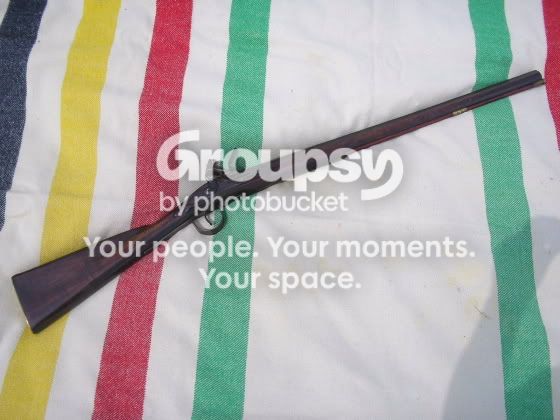
It is aprox. 20 years old,made by J.Clark,Tottenham Ont.(gunsmith)
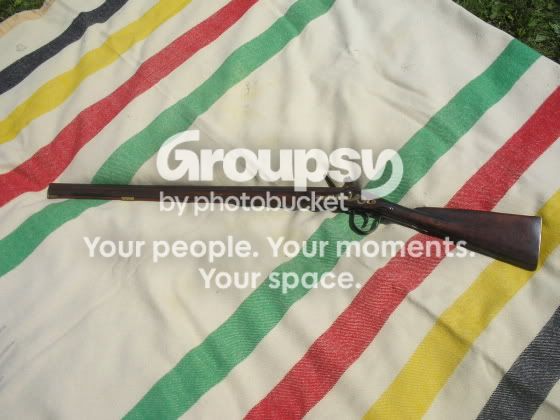
It has a circlefox on the lock and on the barrel.
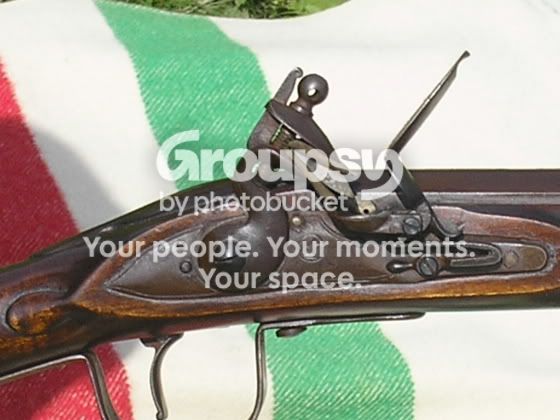
I have not shot it yet.It is 20ga.I am going to try a load of 120g 3f
Regards,Jed.
Finally got a tradegun!
I got it at the Orangeville gunshow a week ago.
It is aprox. 20 years old,made by J.Clark,Tottenham Ont.(gunsmith)
It has a circlefox on the lock and on the barrel.
I have not shot it yet.It is 20ga.I am going to try a load of 120g 3f
Regards,Jed.






















