












































You are using an out of date browser. It may not display this or other websites correctly.
You should upgrade or use an alternative browser.
You should upgrade or use an alternative browser.
Trying to identify British SxS maker
- Thread starter Torandir
- Start date

sillymike
CGN Ultra frequent flyer
Found of picture of the blue bolts I was thinking about

Just thinking out loud...
- on a matched-pair, shouldn't there also be a # on the barrel/rib?
- - If you take a high-def. picture of the rib right in front of the action and zoom in, can you see if something might have gotten buffed away? Maybe it's just the lighting, but about 4" from the breach, it looks like some faint letters?
I think it's nice someone went trough the trouble of putting a engraved bolt underneath the forehand.
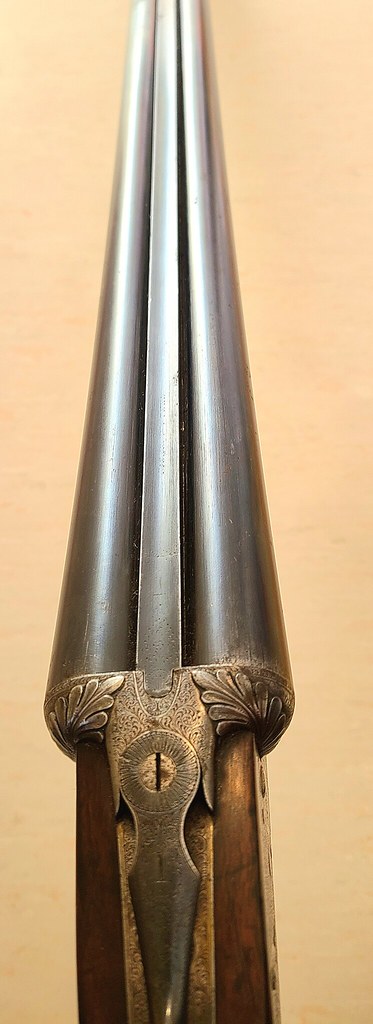
Just thinking out loud...
- on a matched-pair, shouldn't there also be a # on the barrel/rib?
- - If you take a high-def. picture of the rib right in front of the action and zoom in, can you see if something might have gotten buffed away? Maybe it's just the lighting, but about 4" from the breach, it looks like some faint letters?
I think it's nice someone went trough the trouble of putting a engraved bolt underneath the forehand.

Found of picture of the blue bolts I was thinking about
Here's one of the triggers on one of my guns just having been nitre blued:

 Maybe I should write it down somewhere...
sillymike
CGN Ultra frequent flyer
Just thinking out loud: But someone with a shotgun with barrels potentially too thin for modern load, I'd assume that something like the Briley Companion Drop-In 20 Gauge Tube Set would still be safe to use (Assuming the lockwork is ok) ?
https://www.briley.com/p-52192-companion-drop-in-20-gauge-tube-set-ultralite.aspx
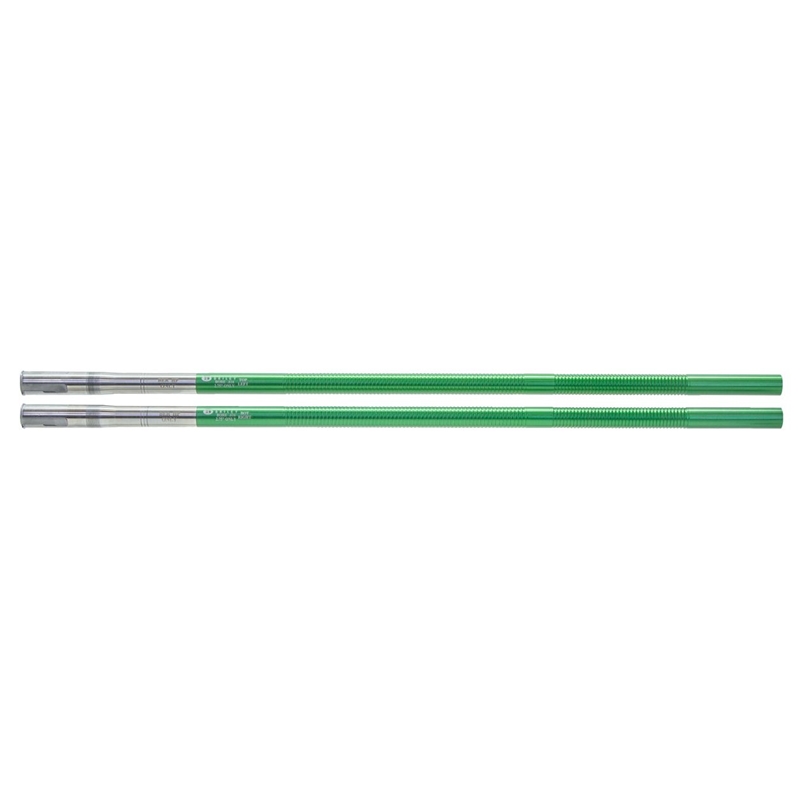
Not exactly cheap, but still a lot less than a sleeving job (not that I would know where to send it to anyway?)
https://www.briley.com/p-52192-companion-drop-in-20-gauge-tube-set-ultralite.aspx
Not exactly cheap, but still a lot less than a sleeving job (not that I would know where to send it to anyway?)
I was thinking or sleeving (or re-barreling) as an (somewhat expensive) solution to the potentially too-thin barrels... Reading on a British double forum that some folks are sending their guns out to Spain and Italy to have the work done, because there aren't all that many people doing it in the UK...
But unless the gun has sentimental value, or is from a desirable maker... Not sure it make sense.
*-*-*
Speaking of the posted SxS, I wonder what's the cobalt-blue they used for the "safe" ?
- Kind of reminds me of the finish used on some sidelock bolts (Of course, I can't find a picture now that I'm looking for one)
The blue “SAFE” is enamel, used on some best quality Army & Navy sidelocks. They also used these same fences on these guns. My guess would be that this could be an Army & Navy best quality sidelock. Their guns were made by various makers, mostly in Birmingham but the best guns were often made in London. The suspiciously engraved maker’s name area on the lockplate suggests a gun that was diverted during production, possibly not room in the original space for ARMY AND NAVY CSL, so the space was filled with alternate engraving. The smooth forend suggests original when compared to the stock grip. This isn’t worn to be perfectly smooth, it was either ordered this way, quite common, or sanded off. The gun is very worn, the barrels and rib have been heavily sanded which of course thins the walls. Shooting doesn’t induce much barrel wear but pitting from corrosive ammo and indifferent maintenance often results in rebores to clean up the bores, sometimes done more than once. A principled and skilled gunsmith would not bore a barrel below a safe minimum. .025” is accepted as the desired minimum wall thickness for pristine barrels, .020” is acceptable if this occurs in the muzzle 6” of the barrel. These dimensions are not hard and fast but the proof house will not usually accept less than .020” for proof testing - too many failures. I have seen barrels being used with spots near the muzzle of .016” but not by me. Such barrels are very fragile and dent from a hard look.

The blue “SAFE” is enamel, used on some best quality Army & Navy sidelocks. They also used these same fences on these guns. My guess would be that this could be an Army & Navy best quality sidelock. Their guns were made by various makers, mostly in Birmingham but the best guns were often made in London. The suspiciously engraved maker’s name area on the lockplate suggests a gun that was diverted during production, possibly not room in the original space for ARMY AND NAVY CSL, so the space was filled with alternate engraving. The smooth forend suggests original when compared to the stock grip. This isn’t worn to be perfectly smooth, it was either ordered this way, quite common, or sanded off. The gun is very worn, the barrels and rib have been heavily sanded which of course thins the walls. Shooting doesn’t induce much barrel wear but pitting from corrosive ammo and indifferent maintenance often results in rebores to clean up the bores, sometimes done more than once. A principled and skilled gunsmith would not bore a barrel below a safe minimum. .025” is accepted as the desired minimum wall thickness for pristine barrels, .020” is acceptable if this occurs in the muzzle 6” of the barrel. These dimensions are not hard and fast but the proof house will not usually accept less than .020” for proof testing - too many failures. I have seen barrels being used with spots near the muzzle of .016” but not by me. Such barrels are very fragile and dent from a hard look.
My thoughts exactly in Post #7…re: this potentially being an Army & Navy…

Just thinking out loud: But someone with a shotgun with barrels potentially too thin for modern load, I'd assume that something like the Briley Companion Drop-In 20 Gauge Tube Set would still be safe to use (Assuming the lockwork is ok) ?
https://www.briley.com/p-52192-companion-drop-in-20-gauge-tube-set-ultralite.aspx
Not exactly cheap, but still a lot less than a sleeving job (not that I would know where to send it to anyway?)
I use a set of Briley side kicks in my Westley Richards, they work just fine.
It's not so much the whole length of the barrel, but the chamber area itself , and of course the condition the wood is in for the older guns.
Cat
If it was made for the Army and Navy Cooperative Society there is probably only one way of learning more about it. There are extensive factory records. The Glasgow University Archives have the records. If the record for the serial number matches the shotgun it would probably have the buyer and manufacturer's name, DOM, price, ect.
I would be extremely careful about the wall thickness. I'm not sure if I understand your method of measuring the WT, but if you mic'd .048" at the muzzle and it is a full choke barrel with .040" of restriction wouldn't it by definition be .008" before the the start of the choke? I'd find someone with a Hosford or Manson WT gauge to measure it properly before shooting even low pressure ammo. I have a Manson and it works pretty well.
Chris, did you have the lock plates off? I'm just wondering whose back action lock design was used. Might give a clue to the maker if it has a patent or use number stamp.
It is a beautiful, well made gun. I hope it is functionally safe, but like they say, you don't buy the gun, you buy the barrels.
I would be extremely careful about the wall thickness. I'm not sure if I understand your method of measuring the WT, but if you mic'd .048" at the muzzle and it is a full choke barrel with .040" of restriction wouldn't it by definition be .008" before the the start of the choke? I'd find someone with a Hosford or Manson WT gauge to measure it properly before shooting even low pressure ammo. I have a Manson and it works pretty well.
Chris, did you have the lock plates off? I'm just wondering whose back action lock design was used. Might give a clue to the maker if it has a patent or use number stamp.
It is a beautiful, well made gun. I hope it is functionally safe, but like they say, you don't buy the gun, you buy the barrels.
Last edited:





















