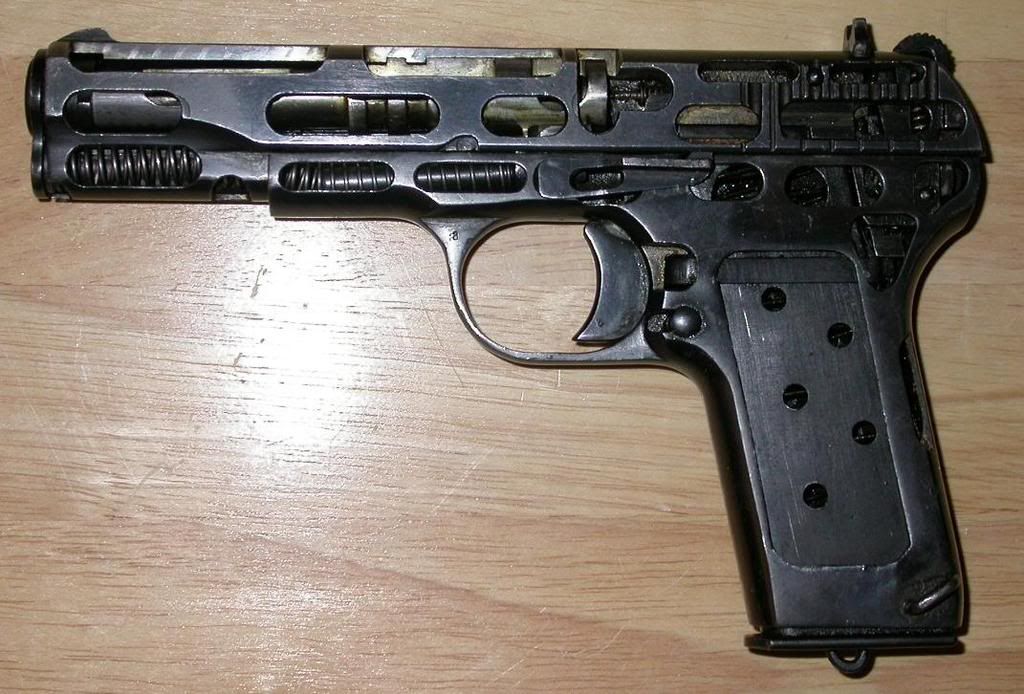
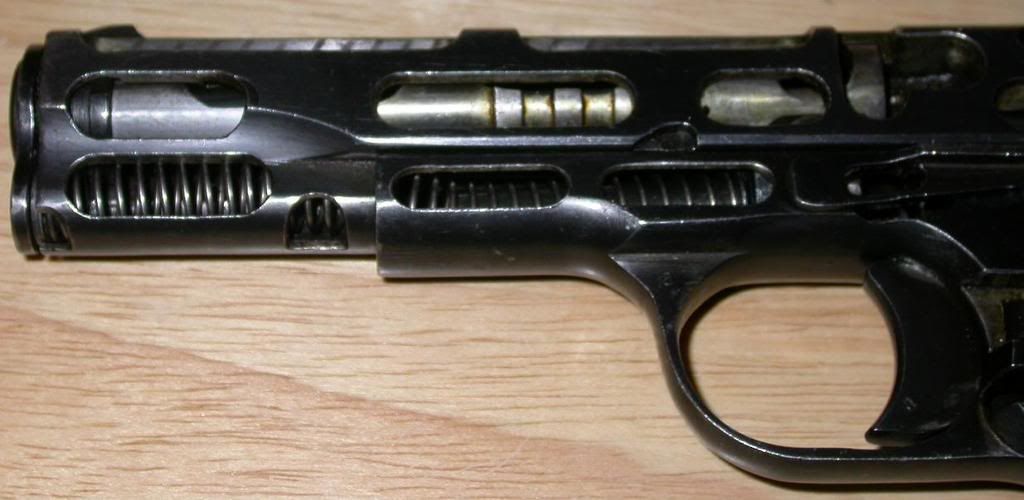
A most interesting cutaway demonstration specimen is shown in the illistrations on pages 86 and 87. The only markings in evidence are the digital grouping "000075-21-1951", engraved on the hammer group and the digit 112 stamped into the underside of the barrel. Of the former it is believed that the number 21 is an arms code for Poland and the 1951 represents a date, possibly the year of the sectioning.
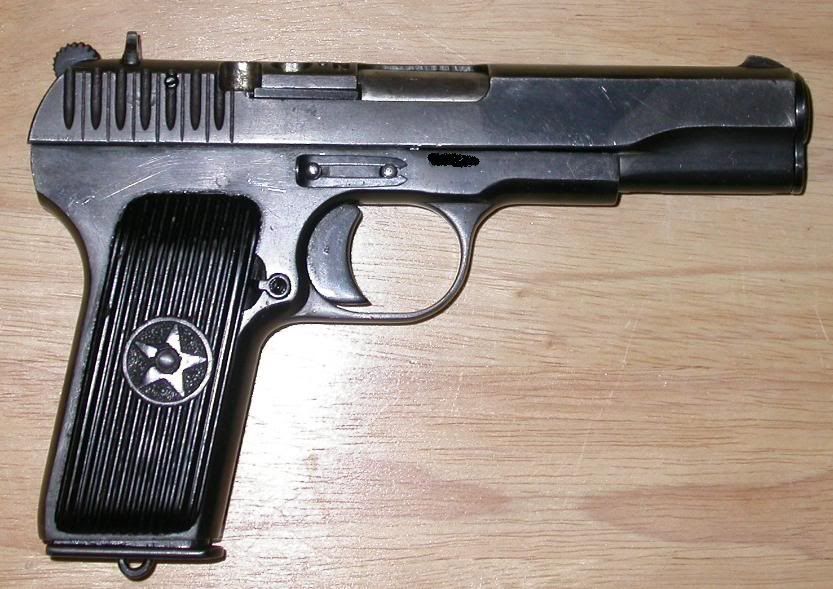
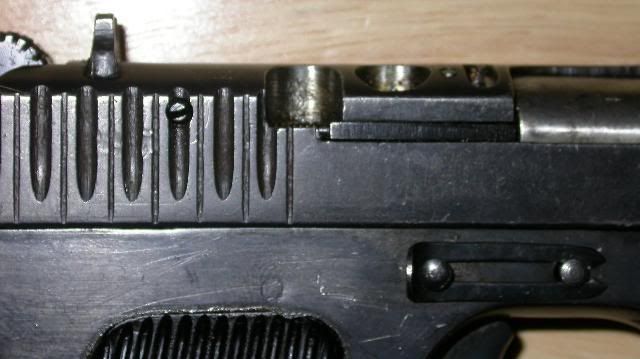
Of special note are the original type of side serrations in contrast to those employed on post 1945 dated TT pistols. Contrarily when comparing the right-side views of the original TT with the postwar Tokarev pistol, it may be noticed that the curved lower line on the front of the slide, arcing to a position adjoining the forward extremity of the frame is cut at a much wider angle on the postwar than the original. (This arc is relatively identical to that of the same festure on Polish VIS wz35 Radom pistols).
It may also be noted that the front sight blade is of a different contour and height on the two types, the cutaway bearing the postwar version. In summation of these features, one might state that this basic specimen in question, sectioning apart, could be termed a transition between TT pistols of the original and postwar patterns, bearing features of both.
It is believed that the U.S.S.R sold a set of TT tooling to Poland early in the postwar period but of the noted Polish speciments the original type of arced slide conture and slide serrations were retained whereas on Soviet Russian examples dated between 1947 and 1953 inclusive, they were not. The compsition hard-rubber grip-plates, though retaining the familiar 5-pointed star, are lacking the accompanying C C C P (SSSR) lettering. This was to become the norm for TT pistols made in the Soviet Union for and/or domestically by the Peoples Republic of China.
This unusual specimen has been sectionalized to a much greater extent than any other cutaway demonstration firearm as yet personally encountered, the magazine alone bearing nine seperate cuts! No mass produced version of the TT pistol despite origin or nationality (Soviet Russian, Polish, Chinese, Hungarian, Yugoslavian, North Korean etc) has been found to be identical to specimens of the cutaway in guestion