Awesome thank you.I believe it was mid-late 90’s that Alberta removed the minimum cartridge length. Only requirement now is centerfire and .22 caliber minimum.
The Henry just might be with me on my next outing.













































Awesome thank you.I believe it was mid-late 90’s that Alberta removed the minimum cartridge length. Only requirement now is centerfire and .22 caliber minimum.

.357 is a better big game cartridge than .223, and I'd say it keeps that advantage out to 200 yards, or a bit better.Out of a rifle the .357 is comparable to a .357 pistol at the muzzle.
I'm not a huge .357 fan, but the momentum is better, and it's really a different animal out of a rifle. The 180 carries energy farther, but it does drop considerably.
Really not really great .224 bullets for BC, and probably about 77 grain is the best. It is flatter shooting of course, bullet expansion will be better.
Not a bad comparison really, and using something similar to the Taylor TKO scale will probably give you a roughly similar range.
Though for "pistol" chamberings, I'd rather have the .44 Mag or hot .45 Colt.
Please show any information that would make any of this even remotely close to accurate….
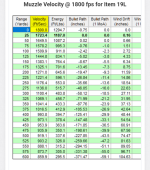
You can draw your own conclusions. I used a ballistic calculator figuring a starting speed of 1700 for a 180 gr. Hornady for the .357 and just a factory 77 gr. for the .223.
If you believe that FPE is an accurate measure of killing power, then the .17 Remington and .204 Ruger should be better performers on big game, and big game guides would be using a lot more high velocity .224 and .243 rifles as back up guns.
As another poster mentioned, the .223 is pretty good at making holes in mild steel, but fluid resistance in the study of hydrodynamics is completely different.
I didn't really go far out of the way to try to find the most ballistically advantageous bullets for each, but I don't believe I'd want to try a .223 for deer any farther than I'd want to use the .357.
.357 has been fairly widely accepted as a deer and black bear round for ages now out of a pistol, as well as regarded the minimum carry gun for grizzly defense to boot. Despite some people using the .223 for all manner of big game, I have a hard time putting it on par at 150 yards, or 200 yards with what equates to a .357 revolver "stuck in the ribs".
Sure they do. Don't disagree with that.Having killed a few bigger critters with a stoutly loaded 44 mag and 240’s AND with 22 centerfires, I will take a 223 with 77 TMK or 80/88 ELD m every single time over a pistol cartridge out to 5 or 6 times the effective range of a 357 or 44 carbine.
Bullets matter.
I KNOW that the 77 TMK will do MORE damage.Do you think the .223 will do as much damage and penetrate at 200 yards as the Buffalo Bore ammo test?
And if you consider the pistol cartridge carbines 150 yard capable, you figure the .223 is good for 800??
Elmer Keith finished a deer shot by a friend at what he figured was 600 yards with a .44 Magnum revolver. Whether it was that far or not, it's in a whole other class for killing power.
I KNOW that the 77 TMK will do MORE damage.
I figure the 357 marginal at 75 yards. I KNOW a 77 TMK or 88 ELD m will penetrate and expand violently down to 1800 fps.
Elmer Keith finished a deer shot by a friend at what he figured was 600 yards with a .44 Magnum revolver. Whether it was that far or not, it's in a whole other class for killing power.
I’ve read this story more than once. And keeping in mind that very few people can get range estimation even remotely close to accurate, 600 yards is a very long guess.
Much like estimating 55 FEET of hold over with a 44 mag to make a 600 yard hit, with a bullet that would be doing roughly 600 fps at impact with a 2 second flight time. One might say that borders on fanciful story telling.
I figure the 357 marginal at 75 yards.