













































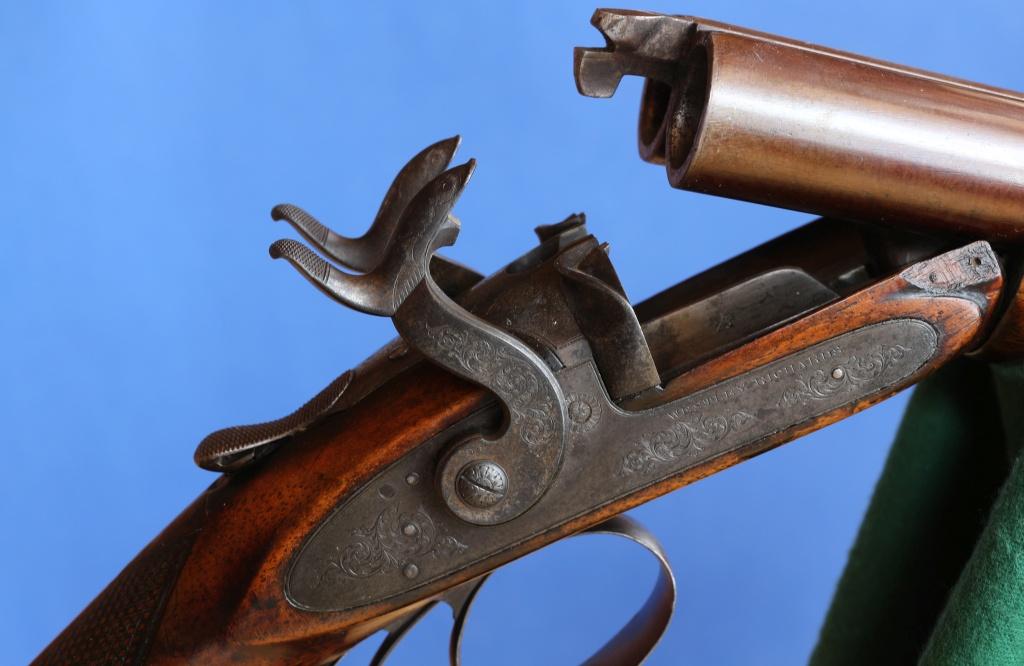
Dougall was not the only gunmaker/inventor who addressed the opening at the top of the breech. In a more practical variation of Lancaster’s solution, the approach was to secure the barrels to the standing breech at this top point to minimize movement. Westley Richards started this trend with the “doll’s-head” extension of the top rib/barrels fitted to the top of the standing breech. His first design, patented in 1862, was operated by a top lever that was pulled straight back with the thumb. In practice, there is only so much leverage that can be applied in this way against a strong spring, and it is no surprise that Westley Richards decided that a laterally pivoting lever did the same job with less effort, leading the way to the top levers we take for granted today. His lateral lever was patented in 1864. While the doll’s head extension has appeared as a third fastener on many guns over the years, the notched doll’s head is the only attachment in these Westley Richards guns, and there are none of the more typical under-barrel bites. While intuitively, this seems a weak arrangement, placing the single attachment point as far from the hinge as possible was an excellent strategy to deal with the physical forces acting on the action, and it was good enough for guns put to heavy use. Ultimately, James Purdey’s sliding double underbolt, patented in 1863, proved to be the simplest and strongest way to keep the breech from moving, and it has been copied by just about everyone after the patent expired; very often, in combination with a third bite at the top of the breech face, like the doll’s head, Greener’s cross-bolt, or the Rigby rising-bite and others.
Westley Richards doll’s head fastener, 1862 patent.
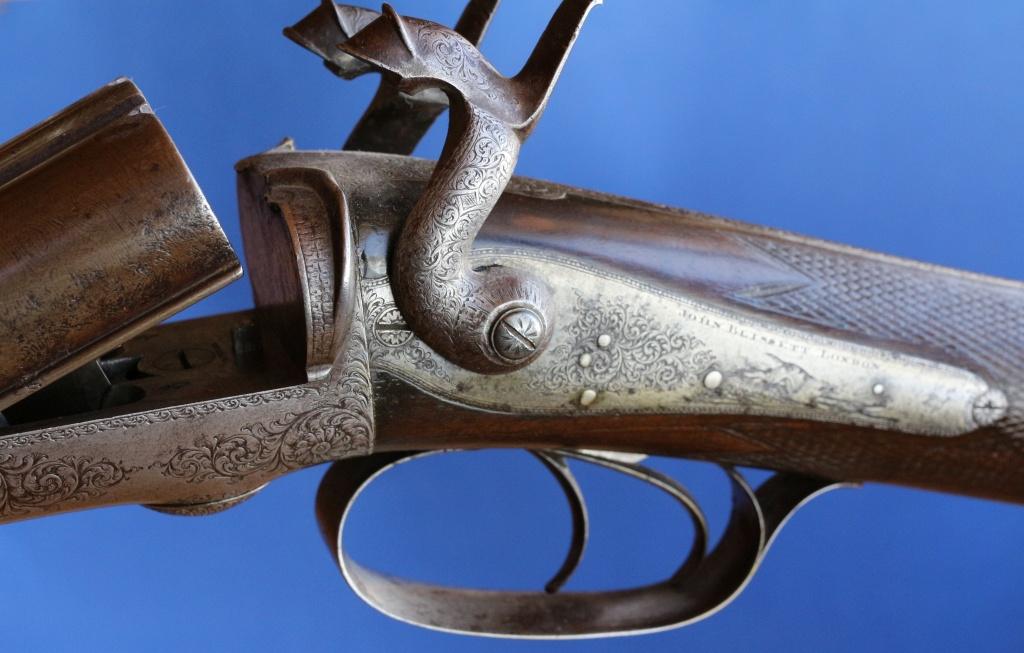
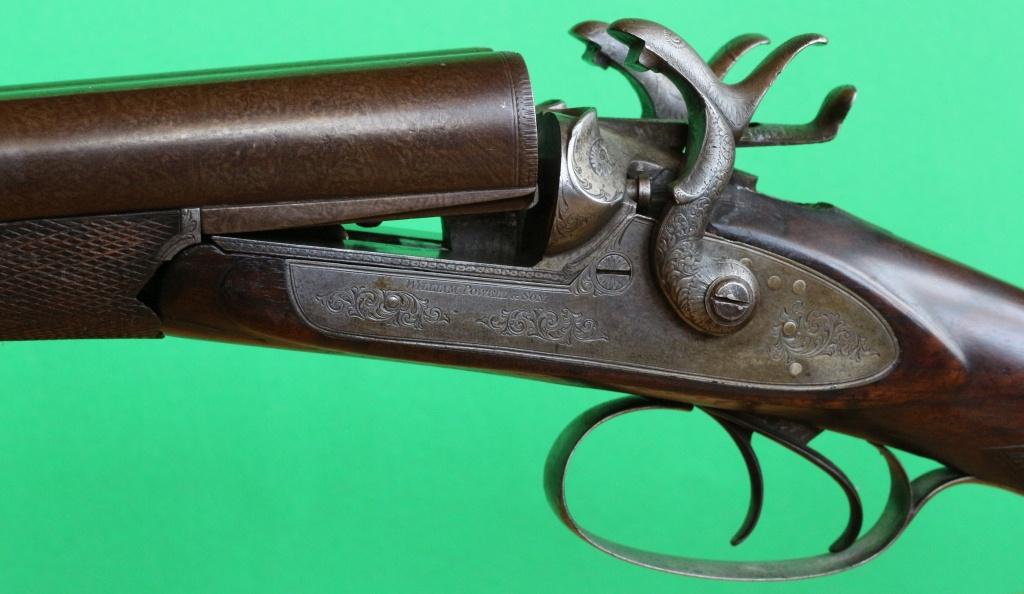
Last to be addressed was the troublesome stresses at the root, the juncture between the action bar and the breech face. A sharp right-angle joint between two opposing forces is not a good idea, as all the stresses focus on the joint. Steel is a strong substance, but the repeated stresses from firing heavy loads can cause the action to crack at this point (as owners of vintage guns submitted for re-proof can attest). The sharp 90-degree angle is proof of the mastery of the action filers, but it was not a good design. At some point in the 1860s, it is difficult to determine precisely when, someone figured out that filing the root as a radius (curve), instead of a right angle, spread out the opposing forces more efficiently. Think of it this way: an egg can be cracked open very easily, as just about any force acting at a right angle to the eggshell will result in breakfast; try compressing an egg in your fist, providing even pressure, and I bet you can’t – the curve of the egg spreads the pressure around. From about the mid-1860s onwards, more and more gunmakers filed a radius in their actions, until it became universal; look at any hinge-action gun nowadays, and you will see a marked radius at the root. And as a final precaution against the vibrations acting on the action bar, it was found that leaving a tiny gap between the barrel flats and the action bar, as opposed to a sucking fit, would leave enough room to reduce pressure on the bar. The gap is not noticeable, but it is there, and for a reason.
John Blissett of London, pre-1860, showing the sharp 90-degree angle at the root.
William Powell & Son of Birmingham, 1866, showing the curved radius at the root.
I find it remarkable that mid-Victorian gunmakers, engineers of the purest sort, understood these stress problems and found solutions for them. We take these designs for granted nowadays, secure in the belief that those three-inch ‘hot’ loads will not shatter our prized possession (while we suffer mild concussions and black-and-blue shoulders). I, for one, avoid stress in all forms, and give my old guns a break by never throwing more than one ounce at a time, usually less.
Westley Richards doll’s head fastener, 1862 patent.
Last to be addressed was the troublesome stresses at the root, the juncture between the action bar and the breech face. A sharp right-angle joint between two opposing forces is not a good idea, as all the stresses focus on the joint. Steel is a strong substance, but the repeated stresses from firing heavy loads can cause the action to crack at this point (as owners of vintage guns submitted for re-proof can attest). The sharp 90-degree angle is proof of the mastery of the action filers, but it was not a good design. At some point in the 1860s, it is difficult to determine precisely when, someone figured out that filing the root as a radius (curve), instead of a right angle, spread out the opposing forces more efficiently. Think of it this way: an egg can be cracked open very easily, as just about any force acting at a right angle to the eggshell will result in breakfast; try compressing an egg in your fist, providing even pressure, and I bet you can’t – the curve of the egg spreads the pressure around. From about the mid-1860s onwards, more and more gunmakers filed a radius in their actions, until it became universal; look at any hinge-action gun nowadays, and you will see a marked radius at the root. And as a final precaution against the vibrations acting on the action bar, it was found that leaving a tiny gap between the barrel flats and the action bar, as opposed to a sucking fit, would leave enough room to reduce pressure on the bar. The gap is not noticeable, but it is there, and for a reason.
John Blissett of London, pre-1860, showing the sharp 90-degree angle at the root.
William Powell & Son of Birmingham, 1866, showing the curved radius at the root.
I find it remarkable that mid-Victorian gunmakers, engineers of the purest sort, understood these stress problems and found solutions for them. We take these designs for granted nowadays, secure in the belief that those three-inch ‘hot’ loads will not shatter our prized possession (while we suffer mild concussions and black-and-blue shoulders). I, for one, avoid stress in all forms, and give my old guns a break by never throwing more than one ounce at a time, usually less.























