













































Since before Confederation, Canada has been defended by a stalwart group of dedicated individuals called the Canadian Militia. Originally raised to support British regulars as early as the 1790’s they saw their first engagement in the war of 1812 against the Americans. Since then, the Canadian Militia units had been instrumental in protecting Canada’s sovereignty until they were integrated into the standing Canadian military of today. Before Confederation, Canada was divided into the provinces of Upper Canada (mostly today’s Ontario), and Lower Canada (mostly what is today Quebec), with a total population in the 1850’s of about 1.2 million. The relationship between the Americans and the British had been “difficult”, to say the least, since the Revolutionary War of 1875-83, and Britain was acutely aware of the colonies’ exposure to American aggression. By 1812 the two sides were at each other’s throats again, fighting over the competition to expand their respective reach westward – both the US and Britain coveted the Old North-West of the continent (North of the Ohio River, and around the Great Lakes), and a bitter rivalry ensued. The British supported Tecumseh, the Shawnee chief who had united the indigenous tribes and nations around the Great Lakes, threatening US expansion in this area. Posturing and overt actions on both sides eventually resulted in the declaration of war. Canadian and British units inflicted a series of devastating defeats on the Americans in the North and West, while the Americans in turn repulsed the British in the East and Southeast. By the end of 1814, both sides wanted peace, the Americans because they realized that British naval superiority devastated their economy through naval blockades, and the British because they realized that defending their North American holdings would be difficult and costly in the long run. The Treaty of Ghent was ratified in December of 1814.
The mistrust between the two nations did not end there though, and Britain continued to keep a substantial military presence in Canada, including the militias. By 1844 a new motto emerged in the US: “Manifest Destiny”, or the “God-given right” of the Americans to expand across the continent and take all, by force, purchase (Alaska), or coercion (sound familiar?). This included at first Texas, California, and parts of Mexico (Mexican-American War of 1837), and the territories from Oregon to British Columbia. It is understandable that Britain looked on with concern, assuming correctly that the Americans still had intentions on Canada. The colonies were defended by the British regulars and what became known as a “sedentary” militia, a force of part-time soldiers drawn from the male population aged 16 to 50. They were to drill once a year, supply their own weapons and “uniforms”, and be ready to be called up at any moment. Although these militia men proved brave and determined during the war of 1812, their part-time engagement did not make for a convincing deterrent. When war broke out in the Crimea in 1853, Britain was forced to withdraw much of her regular complement from Canada to the Crimea, including several units of militia, leaving the colonies dangerously exposed to American aggression. Therefore, in 1855, parliament passed the Militia Act, which established a permanent volunteer militia, properly organized, armed, and uniformed. The “sedentary” militia remained in place, but would be supplemented by members of the volunteer militia, who were issued weapons and uniforms, trained on a regular basis and participated in a variety of formal events throughout the year to strengthen their bond, and sharpen their skills. That same year, and the year following, the British government placed orders with Samuel Colt’s London Armory for 800 Colt Model 1851 Navy revolvers, 150 for Lower Canada, and 650 for Upper Canada. These revolvers were to be duly marked as the property of the government, and distributed to the various militia companies, as directed by Militia General Order of 16 May, 1856: Upper Canada Colts were marked on the left side of the grip “U.C” followed by a letter identifying the troop or company, and the rack number of the gun, while those destined for Lower Canada were marked “L.C.”, followed also by a letter and rack number. It is interesting to note that Upper Canada Colts had their markings upside-down, while Lower Canada guns are marked right-side up. This may be due to how the armorers working on the guns placed them on their workbench.
The guns were issued to the captains of each troop, to be accounted for, and kept safe when not in use:
“The Captains in command of the several Troops and Companies &c., in the Province, are directed to take the utmost care of these Arms, &c., which are of the very best description, and when not in use by the men, to keep them in store, for which purpose, at places where there are no public Armories, an annual allowance is granted by the 29th Clause of the Militia Act…”
The militias enjoyed a time of peace during the ten years from 1856 to 1866, a time when their American neighbours were pre-occupied with their own struggles against slavery, and a devastating civil war. In 1866 however, a group of Irish loyalists in upstate New York, called the “Fenian Brotherhood” hatched out a plan to invade and occupy the Canadian provinces, and hold them “hostage” in exchange for a free Irish Republic, independent from Britain. This venture was supported and financed by the US government under the administration of president Andrew Johnson, supplying the Fenians with finances, training and uniforms, as well as surplus weapons from the recent war. The Fenians numbered in the thousands, mostly hardened veterans from the war and well-versed in battle tactics. The Canadians, on the other hand, were ordinary men – cobblers, blacksmiths, merchants, farmers and the like, commanded by the captains who often served as a town’s mayor, judge or attorney. They were complemented by British regular troops, and would soon have to fight side-by-side against the Fenian invaders…
Now that we have a bit of background information, let us look at this particular revolver:
It is a .36 caliber Colt M1851 Navy, originating from Colt’s London Armory. The serial number is 33114, matching on all components which bear numbers: frame, cylinder, barrel, rammer, wedge, cylinder pin and grip strap. The Colt serial number records put its manufacturing date as 1856. The left grip is stamped “U.C.” with the letter “F” and the number “29” below it. A detailed article by Paul Lederer in a 1989 issue of “Arms Collecting“ (Vol. 27, No. 1) puts the gun into the Cornwall Troop of Volunteer Militia Cavalry, numbered 49 strong. Further research indicates that the Cornwall militia was raised in 1856, and commanded by Captain James J. Dickinson, and later, Lieutenant William D. Wood, who would be promoted to Captain by 1863.
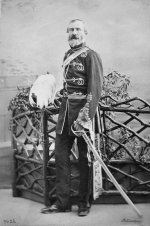
Captain William D. Wood, ca. 1863
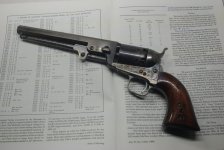
The gun is in very fine condition, with traces of blue on the barrel, about 50% blue on the cylinder, and very strong case colors on the frame, hammer and rammer. The nipples are undamaged and show no wear, and the safety pins between the chambers are all intact. The bore of the 7 ½ inch barrel is bright, with sharp rifling and no visible pitting. The markings are exceptional, and the cylinder scene is well visible. This is the later version of the London Colt, the one which was actually made in London, for the British market, not a “Hartford-London” Colt, shipped from the US to the London Armory. This is evident from the rounded screw heads, the shape of the hammer knurling, and the shape of the rammer catch, among other characteristics. Lederer writes that his research indicated a survival rate of about 16% of these London Colts, with about 100 known Upper Canada, and less than 25 Lower Canada Colts remaining. Many of these are known to have mis-matched serial numbers, which Lederer surmises that armorers swapped parts between damaged guns in order to keep a limited number functional. With all numbers matching, and in pristine operational condition, this is an amazing 1851 Navy in any case, especially so as an Upper Canada Colt!
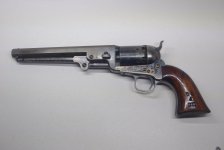
Upper Canada Colt No. F 29, Cornwall Militia 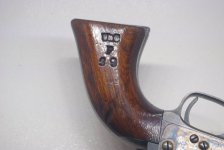
The mistrust between the two nations did not end there though, and Britain continued to keep a substantial military presence in Canada, including the militias. By 1844 a new motto emerged in the US: “Manifest Destiny”, or the “God-given right” of the Americans to expand across the continent and take all, by force, purchase (Alaska), or coercion (sound familiar?). This included at first Texas, California, and parts of Mexico (Mexican-American War of 1837), and the territories from Oregon to British Columbia. It is understandable that Britain looked on with concern, assuming correctly that the Americans still had intentions on Canada. The colonies were defended by the British regulars and what became known as a “sedentary” militia, a force of part-time soldiers drawn from the male population aged 16 to 50. They were to drill once a year, supply their own weapons and “uniforms”, and be ready to be called up at any moment. Although these militia men proved brave and determined during the war of 1812, their part-time engagement did not make for a convincing deterrent. When war broke out in the Crimea in 1853, Britain was forced to withdraw much of her regular complement from Canada to the Crimea, including several units of militia, leaving the colonies dangerously exposed to American aggression. Therefore, in 1855, parliament passed the Militia Act, which established a permanent volunteer militia, properly organized, armed, and uniformed. The “sedentary” militia remained in place, but would be supplemented by members of the volunteer militia, who were issued weapons and uniforms, trained on a regular basis and participated in a variety of formal events throughout the year to strengthen their bond, and sharpen their skills. That same year, and the year following, the British government placed orders with Samuel Colt’s London Armory for 800 Colt Model 1851 Navy revolvers, 150 for Lower Canada, and 650 for Upper Canada. These revolvers were to be duly marked as the property of the government, and distributed to the various militia companies, as directed by Militia General Order of 16 May, 1856: Upper Canada Colts were marked on the left side of the grip “U.C” followed by a letter identifying the troop or company, and the rack number of the gun, while those destined for Lower Canada were marked “L.C.”, followed also by a letter and rack number. It is interesting to note that Upper Canada Colts had their markings upside-down, while Lower Canada guns are marked right-side up. This may be due to how the armorers working on the guns placed them on their workbench.
The guns were issued to the captains of each troop, to be accounted for, and kept safe when not in use:
“The Captains in command of the several Troops and Companies &c., in the Province, are directed to take the utmost care of these Arms, &c., which are of the very best description, and when not in use by the men, to keep them in store, for which purpose, at places where there are no public Armories, an annual allowance is granted by the 29th Clause of the Militia Act…”
The militias enjoyed a time of peace during the ten years from 1856 to 1866, a time when their American neighbours were pre-occupied with their own struggles against slavery, and a devastating civil war. In 1866 however, a group of Irish loyalists in upstate New York, called the “Fenian Brotherhood” hatched out a plan to invade and occupy the Canadian provinces, and hold them “hostage” in exchange for a free Irish Republic, independent from Britain. This venture was supported and financed by the US government under the administration of president Andrew Johnson, supplying the Fenians with finances, training and uniforms, as well as surplus weapons from the recent war. The Fenians numbered in the thousands, mostly hardened veterans from the war and well-versed in battle tactics. The Canadians, on the other hand, were ordinary men – cobblers, blacksmiths, merchants, farmers and the like, commanded by the captains who often served as a town’s mayor, judge or attorney. They were complemented by British regular troops, and would soon have to fight side-by-side against the Fenian invaders…
Now that we have a bit of background information, let us look at this particular revolver:
It is a .36 caliber Colt M1851 Navy, originating from Colt’s London Armory. The serial number is 33114, matching on all components which bear numbers: frame, cylinder, barrel, rammer, wedge, cylinder pin and grip strap. The Colt serial number records put its manufacturing date as 1856. The left grip is stamped “U.C.” with the letter “F” and the number “29” below it. A detailed article by Paul Lederer in a 1989 issue of “Arms Collecting“ (Vol. 27, No. 1) puts the gun into the Cornwall Troop of Volunteer Militia Cavalry, numbered 49 strong. Further research indicates that the Cornwall militia was raised in 1856, and commanded by Captain James J. Dickinson, and later, Lieutenant William D. Wood, who would be promoted to Captain by 1863.
Captain William D. Wood, ca. 1863
The gun is in very fine condition, with traces of blue on the barrel, about 50% blue on the cylinder, and very strong case colors on the frame, hammer and rammer. The nipples are undamaged and show no wear, and the safety pins between the chambers are all intact. The bore of the 7 ½ inch barrel is bright, with sharp rifling and no visible pitting. The markings are exceptional, and the cylinder scene is well visible. This is the later version of the London Colt, the one which was actually made in London, for the British market, not a “Hartford-London” Colt, shipped from the US to the London Armory. This is evident from the rounded screw heads, the shape of the hammer knurling, and the shape of the rammer catch, among other characteristics. Lederer writes that his research indicated a survival rate of about 16% of these London Colts, with about 100 known Upper Canada, and less than 25 Lower Canada Colts remaining. Many of these are known to have mis-matched serial numbers, which Lederer surmises that armorers swapped parts between damaged guns in order to keep a limited number functional. With all numbers matching, and in pristine operational condition, this is an amazing 1851 Navy in any case, especially so as an Upper Canada Colt!
Upper Canada Colt No. F 29, Cornwall Militia
Upper Canada Colts were marked upside-down
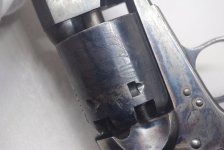
Detail of the Texas Navy Battle of 1843, and the "Engraved by W.L. Ormsby" legend on the cylinderLederer's Article on Upper Canada Colts
























