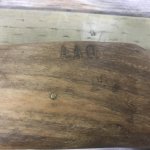
How to tell a WWII re-work? I have one here - it has rather prominent stampings on left side of stock - below about where the rear sight is - in my case a fainter "AA" and then very strong "AAO", which I believe indicates an overhaul at Augusta (Georgia) Arsenal. From various references, there were a number of arsenals in several states doing that overhaul. Again, in my case, the barrel is by "HS" - High Standard - one of two or three WWII contractors that made barrels for those re-builds - "JA - Johnson Automatic" was another barrel contractor - not sure of the third one. I suppose that it is possible that a WWI era barrel survived to WWII - it was apparently the lousy storage during the 20's and 30's that caused many of those rifle bores to deteriorate.
Is a bit important - this is an "R" marked stock, with an Eddystone receiver and an "HS" barrel. Barrels, for some years, were available as surplus. So the piece that I have could have been an arsenal rebuild at beginning of WWII, or could have been put together at someone's workshop 65 years later, if he could find some parts.
Some one more knowledgeable will no doubt clarify about the finish - I think that the overhaul resulted in every single metal part being "re-finished" - so not the same metal finish as when they left factory during WWI.
If you go to m1903.com, find the left side title for M1917 parts - click on it - a list will come up - click on a part name and a sketch will pop up for that part and show you where "E", "R" or "W" were supposed to put their stamps on that part - is not the same place, at all, for some pieces, and many marks are not visible unless the parts are removed from the rifle - in several cases the maker's mark is against the wood, or against the partner metal part, or in the case of sling swivels, some are on the side of the sling eye - inside the swivel base "ears". I have an upper band with "E" where it is supposed to be, then a correctly place "W", and something unreadable where the "R" was supposed to be - it never left any factory or re-build like that.
To claim your rifle to be "all matching", would require complete dismantling into all 80 or so pieces, and assure that they indeed do all have the matching "E" stamp - including the three wood pieces. I have several magazine springs - even they got an "E" or "R" or "W" at the bottom near the toe. Apparently screws and coil springs, and pins do not have a maker mark on them.
Another book here documents the inspector numbers that are found behind the eagle head stamp - who was at which arsenal for what months of production. You can see no. "89" on your safety and no. "21" on your stock - immediately behind the eagle heads - you would have to look that up and see where Inspector 89 and 21 were posted when the rifle was put together / when the parts were made.
Many parts are exactly the same as from a P14, or some parts are identical to the same part in a Lee Enfield No. 1 (sling swivels) or No. 4 (front sight inserts) - interchange perfectly, but the markings will be wrong. One of the M1917's I have came with a P14 front sight insert - fits and works perfectly - identical to the correct one - just had wrong markings on it - i would not have known until grunge and old grease were cleaned off the top of it to show the P14 markings. As per more than one reference here, was not that unusual for stampings to be missed for some runs of some parts - so end up with a collection of "unmarked" parts - no maker mark at all - no eagle head, either - so could be P14 parts - I have no way to know, but "unmarked" is not "matching", in my opinion.
Was a USA military thing - the bolts did NOT get serial numbers. Any M1917 that went to Britain or Canada did get serial numbers added when received, so no serial number is correct for a bolt in a rifle that was the property of the USA military until sold for surplus.
I can not really help about what you might get for selling it - pretty much between you and a buyer, I guess. Likely comes down to what you know; what buyer knows; how badly buyer wants it; etc.
A picture of the AAO stamping, and the fainter "AA" stamping, once I had removed the varnish that a previous owner had applied: