Not a review yet...
I just created a PhotoBucket account so I could share a few images along with my... what, soliloquy? Ramblings? Beginnings? Well, here's my experiences, anyway. It's just a start, because I have not been able to score any range time yet. So, more will follow, but some of what I already have could spark a bit of healthy discussion, I think.
In an earlier post, MiracleJoe passed on a comment from Cory at Valley Combat, that the circlips could get lost. My take on this is that the circlips only need to come off if you're replacing a part. There's literally no reason to pop them off, for even the deepest possible scrub-down. I tore mine down when I first got it, and the circlips are quite hard to remove even with the correct tool. Best to be put there, and left there. I think an AR-style pin replacement would yield very little value.
I picked up my UTS-15 lightly used, for a price I found acceptable. It has a low serial number. Most people are aware the first UTS-15's off the line had hiccups. Wolverine got all of the relevant improved parts from UTAS, installed them all for me, crafted and installed their proprietary fore-end rail to hold a foregrip or a FAB or MagPul "pointing grip", and installed the UTS light/laser. Wolverine also sent me a barrel extension for my birdshot enjoyment. I will mention, the machining is not perfect on some of the barrel extensions UTAS produces. Wolverine took pains to make sure I had a nice one. The free upgrades do not include a metal picatinny top rail, which are apparently available. The original polymer one seems fine to me, but stories have been told out in internet-land of the rail getting damaged under heavy use.
My preference was to order the laser, because I think everything should have a laser. My coffee machine has a laser. I might not otherwise recommend the factory light/laser, if you know you won't be in dark environments when you're shooting. The reason is that it's not a high-power green laser, but a standard 5mw red one. Both the flashlight feature and the red laser dot are quite lost in any amount of sunlight. If you don't have the factory light plus the factory 3-position switch installed, there is a rubber button filling the switch hole on the side of the receiver. This filler button can be accidentally popped into the interior of the receiver if you mash on it. If it pops in there, it wouldn't get lost, and it shouldn't block anything... But putting a solid backing on that filler button would be one of my projects if I hadn't installed the factory switch.
Aesthetically, the original receiver had light and laser markings embossed by the switch hole. I think they figured out this was annoying to people without a switch there. The newer receiver is now unmarked. Mine now has a decal applied along with the switch, that replaces the old built-in markings. The glue on the decal isn't the strongest, though, so I may cement that later.
The laser is made with little tabs that positively align the laser sight. They are like tiny squared-off aluminum rails on the laser body. The mild steel receiver has slots to fit these into. I found that these slots were made with rounded bottoms, like a letter U. Tightening down the laser securely actually caused the square aluminum tabs to start deforming against the rounded steel slots. I squared off the bottoms of these slots with a jeweller's file. I believe this is a critical fix when installing the factory laser in any UTS-15. Be warned, a power tool will swish through that thin steel like warm butter.
[/URL][/IMG]
I also went ahead and deepened the slots further, making room for a very thin 7/8" bushing to go between the laser and the barrel retaining nut. Overtightening that nut with a laser installed will shear those tiny aluminum tabs right off. The new 7/8" bushing absorbs the pressure between the nut and the laser, while the 1" main O-ring absorbs the pressure between the nut/barrel and the receiver. I'd recommend adding this new bushing to the factory laser going into any UTS-15. I think that without it, the tiny tabs on the laser could shear off pretty quick.
[/URL][/IMG]
In the top corner panel here, I included a picture of a quick-release picatinny base that I have clipped on at the back of my rail. A UTS-15 does not have a positive lock for the feed cover that forms the top of the stock. It's great to pull quickly open and clear a jam. But it can accidentally loosen during shooting. With that little QR base acting as a lock, my cover stays down. If I have to open the feed cover, I have only one QR lever to pull and the whole thing comes open.
I only have a picture of the fore-end rail Wolverine put on for me, because the actual FAB pointing grips were (until today) out of stock. MiracleJoe mentioned the slide could be hard to get a grip on, and I believe adding one of these will make the difference. Just having the new rail there gives you something decent to grab.
I took a few minutes to heat-form the side panels that cover the barrels. They are held on with simple hex-key bolts, one of which is the front sling swivel. As they came from the factory, they only rested lightly against the barrels, and you could make them rattle a bit if you hit them just right. Now, they fit firmly.
The biggest customization item that I could possibly share, though, is a very little tiny change that made - for me - a huge difference. I'd like to share it here, and maybe get Grumpy's feedback too.
It's all about the O-ring that acts as a bushing for the barrel retainer ring. Here is a picture, with the barrel loosened.

That 1" diameter O-ring from the factory is 0.100" thick. The problem is, that's too thick. Some other people in Internet-land have played with repositioning or removing the O-ring. I looked a little closer, though. The barrel assembly really needs to have a nice even alignment with the receiver. The magazine selector switch needs to be centered in its port. The bolt needs to pump forward far enough to just easily lock, but not too far so that it goes all sloppy when it's locked up. If there's too much play there, the slide and bolt can drift so far back that you get weak primer strikes. Most important, though, is this picture:
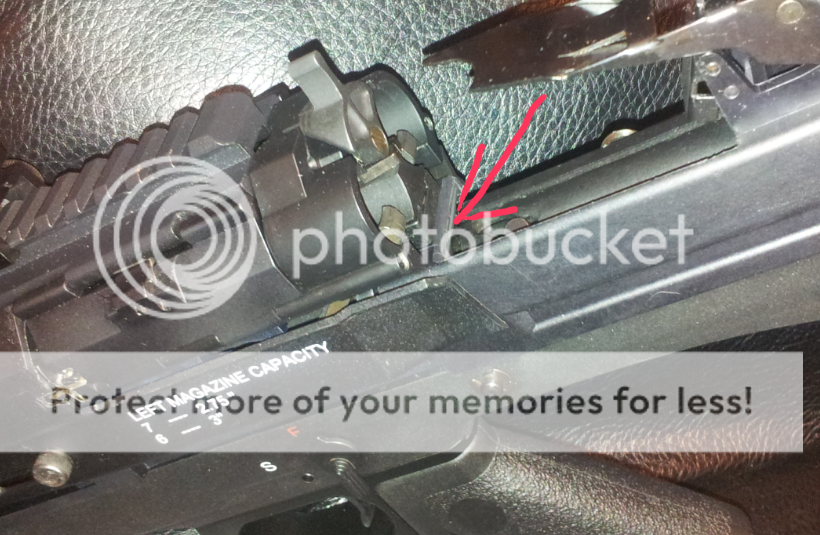
The arrow is pointing to two little edges. The thin metal edge is part of the barrel assembly. The thicker polymer edge, just above it, is part of the receiver. This is the area where the two components are held together.
If the O-ring is too thick, like the factory one is, then that polymer lip sticks out into the feed path. Originally, 1 in 5 of my shells were hanging up on that lip.
I procured a replacement O-ring that's only three-quarters as thick as the original. About 0.075". It aligns the barrel assembly perfectly. I can't get a snap-cap to hang up on that lip any more, but the range test will tell the real tale. I know the bolt is locking up rock solid, with no excess play. I can no longer pull back on the slide and cause a weak primer strike.
All in all, I think the UTS-15 is just a young design with a limited production, and that means a bit of tuning. I think every UTS-15 needs a correctly fitted main O-ring to properly align the barrel assembly. Hey, it could be that all UTS-15's ever made actually need a 0.075" ring instead of the 0.100" ring they're shipped with.
So, what do you think? Agree? Disagree?