












































You are using an out of date browser. It may not display this or other websites correctly.
You should upgrade or use an alternative browser.
You should upgrade or use an alternative browser.
Value 1861 Enfield 577 percussion
- Thread starter scjordan
- Start date


Shelldrake
CGN frequent flyer
- Location
- Right behind you,,
Well Dad has a very nice 1861 Enfield Percussion 577 rifle. Excellent shape, is in working condition and fires great.
Just wondering if anyone had a value for these guns??
Jordy
Depends on a few things,,
- original or is it a repro.
- if a repro, then who made it. Parker Hale's bring a better dollar than the Italian/Spanish makers.
Is this the musketoon?,, the one with the 24" barrel, and nipple protector on a chain?
Last edited:


- Location
- West coast of Vancouver Island
SC, If you want to send me the pics I will post them for you.
6grant@telus.net
Kevin
6grant@telus.net
Kevin
Says that I dont have those privleges to post pics??
- Location
- West coast of Vancouver Island
And here it is.

A really nice cadet carbine, which this appears to be, with excellent bore and action would be in the $350.00 to $500.00 area. If it has been stripped or refinished in any way you can take off a hundred or so. Should have a bead front sight. Ramorod channel should be plugged with a dowel. What are the markings on the tang of the butt plate and also the marks on the stock...Regimental marks, if any? Sometimes that makes a difference in price as well. Sorry if I sounded gruff in my fist post. Dave

Yes, that would certainly appear to be a "Cadet Carbine" - which is a uniquely Canadian creature, by the way:
Canada's military forces (Militia) were among the first anywhere in the Empire to receive the "new" Snider-Enfield rifles (converted from the P'1853-family of .577 muzzle-loading Enfield rifles) in 1866-67, to enable them to better meet the Fenian Raids threat .... but were also among the last Empire military forces to still be using Snider-Enfields, long after they were hopelessly obsolete. Canada did acquire some .577-450 Martini-Henry rifles, but the great majority of those remained in stores and were never issued. When the bolt action .303 Magazine Lee-Metford was adopted by Britain in 1888, Canada purchased very few, and the venerable Snider remained our primary-issue military longarm. The Magazine Lee-Enfield rifle (with its improved rifling for cordite loads) was adopted by Britain in 1896.
At about that time Canada had finally decided to loosen the purse-strings enough to acquire a more effective military rifle to replace the nearly worthless Sniders - and made the brilliant decision to purchase 40,000 .303 Martini-Metford single shot rifles! However, in view of the significant prospect of war at that time between the United Kingdom and the United States over the "Venezuela Crisis", Britain pressured Canada (and, I suspect, also offered financial inducements) to acquire the same number of the more expensive, but unquestionably more effective, new Magazine Lee-Enfield rifle.
However, it was years before all units of the Active Militia were finally equipped with repeating rifles - in fact, the last Snider-Enfields were not withdrawn from the Militia until 1907!
In the meantime, one use was found for at least some of the tens of thousands of 3-band .577 Snider-Enfield infantry rifles - they were cut down into approximately the same configuration as the Snider-Enfield cavalry carbine for issue to the many Cadet Corps in the country at that time. However, the original rear sight was retained and a simple bead-type foresight was installed on the shortened barrel with the result that, even though they were fully functional, if fired they would print excessively high. In fact, their primary purpose was for parade ground and marching drills, and each Cadet Corps was to be issued with two Lee-Enfield rifles for actual musketry instruction. As already pointed out, your carbine would certainly appear to be one of these cadet carbines. If you look at the front end of the forestock, you should be able to make out the wood plug filling in the clearing rod channel of the original full-length rifle.
Here is a comparison of a Snider-Enfield cavalry carbine (top) with a cadet carbine (bottom) -

Canada's military forces (Militia) were among the first anywhere in the Empire to receive the "new" Snider-Enfield rifles (converted from the P'1853-family of .577 muzzle-loading Enfield rifles) in 1866-67, to enable them to better meet the Fenian Raids threat .... but were also among the last Empire military forces to still be using Snider-Enfields, long after they were hopelessly obsolete. Canada did acquire some .577-450 Martini-Henry rifles, but the great majority of those remained in stores and were never issued. When the bolt action .303 Magazine Lee-Metford was adopted by Britain in 1888, Canada purchased very few, and the venerable Snider remained our primary-issue military longarm. The Magazine Lee-Enfield rifle (with its improved rifling for cordite loads) was adopted by Britain in 1896.
At about that time Canada had finally decided to loosen the purse-strings enough to acquire a more effective military rifle to replace the nearly worthless Sniders - and made the brilliant decision to purchase 40,000 .303 Martini-Metford single shot rifles! However, in view of the significant prospect of war at that time between the United Kingdom and the United States over the "Venezuela Crisis", Britain pressured Canada (and, I suspect, also offered financial inducements) to acquire the same number of the more expensive, but unquestionably more effective, new Magazine Lee-Enfield rifle.
However, it was years before all units of the Active Militia were finally equipped with repeating rifles - in fact, the last Snider-Enfields were not withdrawn from the Militia until 1907!
In the meantime, one use was found for at least some of the tens of thousands of 3-band .577 Snider-Enfield infantry rifles - they were cut down into approximately the same configuration as the Snider-Enfield cavalry carbine for issue to the many Cadet Corps in the country at that time. However, the original rear sight was retained and a simple bead-type foresight was installed on the shortened barrel with the result that, even though they were fully functional, if fired they would print excessively high. In fact, their primary purpose was for parade ground and marching drills, and each Cadet Corps was to be issued with two Lee-Enfield rifles for actual musketry instruction. As already pointed out, your carbine would certainly appear to be one of these cadet carbines. If you look at the front end of the forestock, you should be able to make out the wood plug filling in the clearing rod channel of the original full-length rifle.
Here is a comparison of a Snider-Enfield cavalry carbine (top) with a cadet carbine (bottom) -
Last edited:
- Location
- West coast of Vancouver Island
And here they are.


The markings on the buttplate tang signify that in its original 3-band Snider-Enfield "long rifle" configuration, this was rifle #260 issued to the 28th Battalion of the Active Militia of Canada.
"28th Perth Battalion of Infantry" formed 14 September 1866 with HQ at Stratford, Ontario by regimentation of four independent companies:
* No. 1 Company at Stratford, raised 1856 as 1st Volunteer Militia Company of Stratford
* No. 2 Company at Stratford, raised 29 Oct. 1862 as Stratford Infantry Company
* No. 3 Company at St. Mary's, raised 8 June 1866
* No. 4 Company at Listowell, raised 31 Aug. 1866
* No. 5 Company at Mitchell, raised 28 Sep. 1866
* No. 6 Company at Blanchard, raised 9 Nov. 1866
Redesignated: 28th Perth Regiment 08 May 1900
Redesignated: The Perth Regiment 01 April 1920
The circular marking on the right side of the butt is the cartouche of the "Royal Manufactory Enfield", and the arabic numeral '1"' below it signifies that, when originally completed in about 1861 - as a muzzle-loading 3-band Enfield Pattern 1853 rifle, in view of the lockplate date - it passed inspection as a First Class arm.
The mark to the right of the cartouche is a Canadian Government "Sold Out of Service" stamp - i.e. two opposing (point-to-point) "broad arrows" encircled by a capital 'C' - signifying that it had been duly "surplussed" and was no longer Government property. This is a 20th Century marking, but that is entirely in keeping with the history of the arm, since it would not have been converted to a Cadet Carbine until at least 1905, and not ultimately disposed of until some time after conversion .....
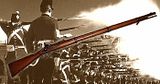
By the way, here is what it would have looked like prior to conversion into a Cadet Carbine - this is my Snider-Enfield 3-band rifle, against a backdrop of members of the Fort Henry Guard volley firing ..... (click each thumbnail to enlarge) -
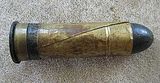
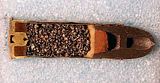
The cartridges for the Snider-Enfield were of "composite" construction, having a coiled brass body - generally paper-covered. There were about nine different versions, but they were all similar - here are some images:
First, a complete cartridge -
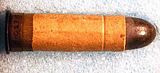
A complete cartridge, without paper covering, so the coiled brass body is exposed -
A sectioned cartridge, nicely displaying the various components -
"28th Perth Battalion of Infantry" formed 14 September 1866 with HQ at Stratford, Ontario by regimentation of four independent companies:
* No. 1 Company at Stratford, raised 1856 as 1st Volunteer Militia Company of Stratford
* No. 2 Company at Stratford, raised 29 Oct. 1862 as Stratford Infantry Company
* No. 3 Company at St. Mary's, raised 8 June 1866
* No. 4 Company at Listowell, raised 31 Aug. 1866
* No. 5 Company at Mitchell, raised 28 Sep. 1866
* No. 6 Company at Blanchard, raised 9 Nov. 1866
Redesignated: 28th Perth Regiment 08 May 1900
Redesignated: The Perth Regiment 01 April 1920
The circular marking on the right side of the butt is the cartouche of the "Royal Manufactory Enfield", and the arabic numeral '1"' below it signifies that, when originally completed in about 1861 - as a muzzle-loading 3-band Enfield Pattern 1853 rifle, in view of the lockplate date - it passed inspection as a First Class arm.
The mark to the right of the cartouche is a Canadian Government "Sold Out of Service" stamp - i.e. two opposing (point-to-point) "broad arrows" encircled by a capital 'C' - signifying that it had been duly "surplussed" and was no longer Government property. This is a 20th Century marking, but that is entirely in keeping with the history of the arm, since it would not have been converted to a Cadet Carbine until at least 1905, and not ultimately disposed of until some time after conversion .....
By the way, here is what it would have looked like prior to conversion into a Cadet Carbine - this is my Snider-Enfield 3-band rifle, against a backdrop of members of the Fort Henry Guard volley firing ..... (click each thumbnail to enlarge) -

The cartridges for the Snider-Enfield were of "composite" construction, having a coiled brass body - generally paper-covered. There were about nine different versions, but they were all similar - here are some images:
First, a complete cartridge -

A complete cartridge, without paper covering, so the coiled brass body is exposed -

A sectioned cartridge, nicely displaying the various components -

- Location
- West coast of Vancouver Island
Jordy, It is a nice rifle. I imagine it is a keeper
Grant, thanks for all that information. It is great when you can read the history of a piece.
Grant, thanks for all that information. It is great when you can read the history of a piece.






















