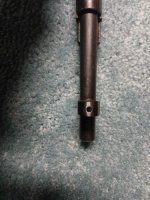
Value Appraisal on 1920 Mosin Nagant

MooseSlayer07

Member
Rating - 0%
0   0   0
Location
Chilliwack, BC
I'm looking to gather information on and the value of this rifle. Here is what I know:
  1. 1920 action, hex receiver, buttplate (81333)
  2. Ishevsk city factory
  3. Refurbished M91/30 with Dragoon stock
  4. Likely ex-Dragoon
  5. Possibly forced matching
From what I've read on m9130.info, the Izhevsk factory ended M91/30 Dragoon production in 1931. My eye sight isn't too great, nor were the stampings clear, but the the action, hex receiver, buttplate, etc, are stamped as 1920. The guy I was talking to about this rifle said it's refurbished with a Dragoon stock to make it era-appropriate. The pre-1930 date stampings along with the information that this rifle is refurbished and doesn't have the original stock installed, leads me to believe this would be classified as an ex-Dragoon. Would that be correct, or have I missed something? I'll ask the guy for further information, my memory is a little hazy.

Also, I'd like to know if there is any published information on serial number blocks for the Mosin Nagant rifles, either from the Tula or Izhevsk city factories.

The stock definitely is pre-war, because of the metal finish sling points. My understanding is that the wartime production stock models ditched that in favor of cutting down cost and machining time, with post-war models having a simplified metal finish without the screws.

If I've missed anything critical, please let me know.

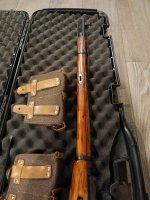
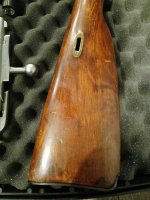
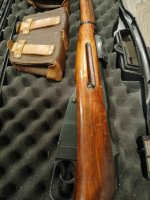
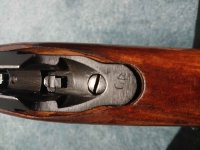
Unfortunately, I don't have any pictures of the stampings. I will try to get some soon, as that'll help determine if everything is forced matched or not. In the meantime, here are the pictures I do have, not that they are great:
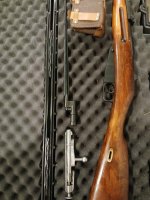
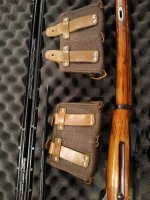
20251115_160530.jpg20251115_160525.jpg20251115_160522.jpg20251115_160518.jpg20251115_160515.jpg20251115_160512.jpg20251115_160507.jpg
 
I'm looking to gather information on and the value of this rifle. Here is what I know:
  1. 1920 action, hex receiver, buttplate (81333)
  2. Ishevsk city factory
  3. Refurbished M91/30 with Dragoon stock
  4. Likely ex-Dragoon
  5. Possibly forced matching
From what I've read on m9130.info, the Izhevsk factory ended M91/30 Dragoon production in 1931. My eye sight isn't too great, nor were the stampings clear, but the the action, hex receiver, buttplate, etc, are stamped as 1920. The guy I was talking to about this rifle said it's refurbished with a Dragoon stock to make it era-appropriate. The pre-1930 date stampings along with the information that this rifle is refurbished and doesn't have the original stock installed, leads me to believe this would be classified as an ex-Dragoon. Would that be correct, or have I missed something? I'll ask the guy for further information, my memory is a little hazy.

Also, I'd like to know if there is any published information on serial number blocks for the Mosin Nagant rifles, either from the Tula or Izhevsk city factories.

The stock definitely is pre-war, because of the metal finish sling points. My understanding is that the wartime production stock models ditched that in favor of cutting down cost and machining time, with post-war models having a simplified metal finish without the screws.

If I've missed anything critical, please let me know.

Unfortunately, I don't have any pictures of the stampings. I will try to get some soon, as that'll help determine if everything is forced matched or not. In the meantime, here are the pictures I do have, not that they are great:
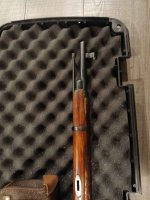
View attachment 1040387View attachment 1040388View attachment 1040389View attachment 1040390View attachment 1040391View attachment 1040392View attachment 1040393

I did confirm that this is an ex-Dragoon. Regardless, it's a nice rifle.
 
You’d have to show better photos to confirm the ex dragoon and matching SNs. front of the sight base, receiver markings etc. Barrel length can help too. Either way with the stock it’s got a hefty repair in the middle, condition wise that’s really up to your prospective buyer but generally not winning any awards. Serial numbers are another you’d have to see to know, I’ve found most mag floor plates are force matched, stock is probably too and usually the butt plate when that’s the case.

I just looked at a local example in immaculate condition for $650, numbers matching. So I guess anywhere between $450 and $650 depending on the range of your market.
 
You’d have to show better photos to confirm the ex dragoon and matching SNs. front of the sight base, receiver markings etc. Barrel length can help too. Either way with the stock it’s got a hefty repair in the middle, condition wise that’s really up to your prospective buyer but generally not winning any awards. Serial numbers are another you’d have to see to know, I’ve found most mag floor plates are force matched, stock is probably too and usually the butt plate when that’s the case.

I just looked at a local example in immaculate condition for $650, numbers matching. So I guess anywhere between $450 and $650 depending on the range of your market.

Thank you for providing a detailed response. I'll post more pictures as soon as I can, along with the barrel measurements.

Will there be additional markings on the parts if they are force matched? Also, I've been told that the hex receivers are of better quality than the rounded ones, is that considered generally true?
 
Thank you for providing a detailed response. I'll post more pictures as soon as I can, along with the barrel measurements.

Will there be additional markings on the parts if they are force matched? Also, I've been told that the hex receivers are of better quality than the rounded ones, is that considered generally true?

Well generally speaking anyways, they weren’t producing the “hex receiver” during WW2, so odds are if you have a round receiver it’s wartime production and as you’ve noted about stocks, produced quickly under limiting provisions. It doesn’t mean they’re all lesser grade or cheaper but there’s a whole lot more common field grade examples in round.

Force matched I’ve seen examples that were either blanks or ground down and stamped which are harder to distinguish but you can sometimes tell because the stamp doesn’t totally match up or the numbers aren’t spaced/aligned as neatly. More commonly it’s just a mismatched number, or a punched out number along side a new one.
 
The whole ‘hex receiver’ thing is blown out of proportion by people not very knowledgeable on Mosins. Basically if it was made 1936 or earlier it has a hex receiver. There is nothing wrong with round receivers, some of the mid/late WWII receivers are exceptionally crude on the outside as they weren’t taking time for ascetics, but where it matters they are fine.

Your 1920 rifle is also a wartime production, just Russian civil war.

Odds are your rifle was formerly a dragoon pattern, though they were still making cossack and infantry pattern rifles at the same time. To properly dissect your rifle I would need photos of any markings found on all the parts, the front sight base, the bottom tang of the receiver (should have a arsenal marking with a year, that is the actual year of receiver production) etc. that stock ‘repair’ is also very interesting, honestly the most interesting thing on your rifle.

Makes me wonder if it spent some time in Finnish hands as it looks a lot like one of the joints they would use to help prevent the stocks from warping in the winter. Wouldn’t be the first rifle to be captured by the Finns and then recaptured by the Russians.
 
That stock splice has been touted as of Soviet origin in various places and, as mentioned, is probably the most interesting attribute of the rifle. There were many refurbished "ex-Dragoons" packed in with the standard 91/30 refurbs. I believe the Soviet 91/30 refurb programs had pretty high standards meaning the bore of the rifle must have been in pretty good shape which adds some interest. I have a '27 refurbed ex-dragoon with as good a bore as I've seen in a Mosin. Value would be a slight premium over whatever typical refurbs in similar condition are going for.

milsurpo
 
The Soviets didn’t differentiate between ‘ex-dragoons’ and 91/30s after they were converted to 91/30 standards. At that point for all intents and purposes it is a 91/30. Only collectors care and even then realistically it is a 91/30 just with a earlier production year. Personally I don’t get too excited over it, but some might.
 
The whole ‘hex receiver’ thing is blown out of proportion by people not very knowledgeable on Mosins. Basically if it was made 1936 or earlier it has a hex receiver. There is nothing wrong with round receivers, some of the mid/late WWII receivers are exceptionally crude on the outside as they weren’t taking time for ascetics, but where it matters they are fine.

Your 1920 rifle is also a wartime production, just Russian civil war.

Odds are your rifle was formerly a dragoon pattern, though they were still making cossack and infantry pattern rifles at the same time. To properly dissect your rifle I would need photos of any markings found on all the parts, the front sight base, the bottom tang of the receiver (should have a arsenal marking with a year, that is the actual year of receiver production) etc. that stock ‘repair’ is also very interesting, honestly the most interesting thing on your rifle.

Makes me wonder if it spent some time in Finnish hands as it looks a lot like one of the joints they would use to help prevent the stocks from warping in the winter. Wouldn’t be the first rifle to be captured by the Finns and then recaptured by the Russians.

That stock splice has been touted as of Soviet origin in various places and, as mentioned, is probably the most interesting attribute of the rifle. There were many refurbished "ex-Dragoons" packed in with the standard 91/30 refurbs. I believe the Soviet 91/30 refurb programs had pretty high standards meaning the bore of the rifle must have been in pretty good shape which adds some interest. I have a '27 refurbed ex-dragoon with as good a bore as I've seen in a Mosin. Value would be a slight premium over whatever typical refurbs in similar condition are going for.

milsurpo

The Soviets didn’t differentiate between ‘ex-dragoons’ and 91/30s after they were converted to 91/30 standards. At that point for all intents and purposes it is a 91/30. Only collectors care and even then realistically it is a 91/30 just with a earlier production year. Personally I don’t get too excited over it, but some might.

Thank you for the detailed responses. I'll try and get some pictures this weekend, and I will do my best to find a camera that isn't on a sh1tty droid phone.
 
Eaglelord17 milsurpo MosinMan13

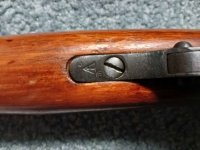
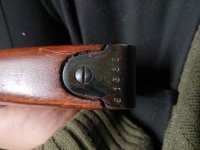
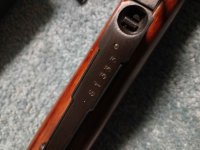
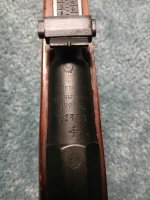
I had forgotten to get barrel measurements, but I may be able to get them over this weekend or next Friday. Here are the serial number pictures:
 

Attachments

  • 20251128_201312.jpg
    20251128_201312.jpg
    80.8 KB · Views: 15
  • 20251128_201258.jpg
    20251128_201258.jpg
    89.7 KB · Views: 15
  • 20251128_201326.jpg
    20251128_201326.jpg
    82.8 KB · Views: 16
  • 20251128_201241.jpg
    20251128_201241.jpg
    80.3 KB · Views: 16
  • 20251128_201205.jpg
    20251128_201205.jpg
    93.9 KB · Views: 16
Also, in regards to the stock splice, would that ever become a concern when using the rifle? Another guy I was taking to doesn't seem to have much faith in 80 year old Soviet glue. Would/could that splice separate during firing?
 
Did the Russians use finger joints to repair their Mosin Nagant rifles?

I've seen literally thousands of Mosin Nagant variants, most of which I didn't pay much attention to, unless there seemed to be something special about a particular rifle.

When they first started appearing on Canadian markets, I came across a Westinghouse, new, unissued, and never sent overseas.

I used that rifle for decades as a shooter.

Then, when I did start to get a bit more interest in them, most of the flood was already over.

I've owned/traded/sold dozens over the decades, and the only Russian/Soviet issue Mosins I've seen with various types of finger joints, all had Finnish stamps on them somewhere.

OP, I don't know if your rifle has Finn stamps.

It could possibly have been a stock taken from a captured Finn FTR rifle, and repurposed on a Soviet rifle.

Usually, there would be stamps on it somewhere to indicate this happening, but you can never say never when it comes to milsurps.

I've seen Russian/Soviet rifles with some amazing repairs, from crude in the field to elaborate and professional refurbishments. I just haven't seen any issued by the Russians/Soviets with finger joints.
 
Also, in regards to the stock splice, would that ever become a concern when using the rifle? Another guy I was taking to doesn't seem to have much faith in 80 year old Soviet glue. Would/could that splice separate during firing?
Good photos, what id actually want to see is the sight base from the same perspective, that’s giveaway to your dragoon question. Hard to say about the magazine floor plate, but I’d guess original, numbers look similar in character and the last digit even appears worn down or a light strike.

As for the splice, unless the finish on the wood overall looks dry and flakey, I wouldn’t worry too much. Wood glues are stronger than you think.
 
Are you able to take the action out of the stock and take a photo of the bottom tang (end) of the receiver? It will have a two to four digit number and a bow and arrow symbol. That will tell you exactly when the receiver was made.

If you do this, please take photos of the stock repair as well, very curious on that also.
 
As mentioned above, this type of stock splice is considered Soviet. Most definitely not Finnish. The stamped numbers are not factory original, the font isn't even close. A good condition post-war refurb with replacement matching parts which by itself isn't at all unusual. The Soviet refurb standards for 91/30s were pretty good with many crucial parts replaced. I have a 1927 ex-Dragoon that has such a great bore that I used it in a PE Sniper replica. It also had stamped, matching replacement parts and grouped extremely well right out of the crate. It was a great value at $225!

milsurpo
 
Good photos, what id actually want to see is the sight base from the same perspective, that’s giveaway to your dragoon question. Hard to say about the magazine floor plate, but I’d guess original, numbers look similar in character and the last digit even appears worn down or a light strike.

As for the splice, unless the finish on the wood overall looks dry and flakey, I wouldn’t worry too much. Wood glues are stronger than you think.

The stock and wood feels very sturdy.

Is this what you meant by front sight base?


20251128_201448.jpg
 
Are you able to take the action out of the stock and take a photo of the bottom tang (end) of the receiver? It will have a two to four digit number and a bow and arrow symbol. That will tell you exactly when the receiver was made.

If you do this, please take photos of the stock repair as well, very curious on that also.

Sure, I can do that. I will have to watch a few videos to understand how to disassemble this rifle without damaging anything.
 
As mentioned above, this type of stock splice is considered Soviet. Most definitely not Finnish. The stamped numbers are not factory original, the font isn't even close. A good condition post-war refurb with replacement matching parts which by itself isn't at all unusual. The Soviet refurb standards for 91/30s were pretty good with many crucial parts replaced. I have a 1927 ex-Dragoon that has such a great bore that I used it in a PE Sniper replica. It also had stamped, matching replacement parts and grouped extremely well right out of the crate. It was a great value at $225!

milsurpo

I took several pictures of the bore, but unfortunately, my camera doesn't do it justice. I will be buying a bore snake for better pictures.
 

Attachments

  • 20251128_200745.jpg
    20251128_200745.jpg
    12.7 KB · Views: 4
  • 20251128_200736.jpg
    20251128_200736.jpg
    11.3 KB · Views: 5
  • 20251128_200554.jpg
    20251128_200554.jpg
    63.2 KB · Views: 5
  • 20251128_200542.jpg
    20251128_200542.jpg
    65.2 KB · Views: 5
Back
Top Bottom