velocity not constant through powder increases

Farlsincharge

CGN frequent flyer
Rating - 100%
86   0   0
Location
Saskatchewan
I finally got out to shoot some loads yesterday through my 300 win mag. Shooting 200 gr sierra GK on top of h4831sc.

velocities were as follows

68gr - 2650-2665
68.5gr 2650-2685
69gr 2712-2730
69.5gr 2707-2715
70gr 2696-2707
70.5gr 2800-2848
71gr 2804-2833

69 grains of powder produced more velocity than 70 grains, but when I hit 70.5 it shot right up to where I would expect it to be at 2800. 71 does not seem to have any increase over 70.5 either.

When I hit 71 I did see some pressure signs, but not enough to stop me from going higher.

Any insight into this? Are these results telling me something?
 
The reduction in velocity rate per grain of powder is an indication that you are approaching maximum pressure for that load. If you want to go higher, reduce your load increases to about .2 or .3 grains. Watch for pressure signs.
 
Welcome to the wonderful wonder of internal ballistics. The day someone figures out and understands completely internal ballistics, is coming, the day after we figure out Women and what they want to make them happy all the time.
 
Grinch is right. You are either at or approaching maximum loads for H4831 "in your rifle".

Be careful of what you are calling pressure signs as well. Especially in high case capacity cartridges.

IMHO, I would go to a slower powder than H4831sc. I really like Rel25. It is consistent at all temps, meters easily and loves magnum primers.

The thing about magnum cartridges is that they seem to like to be loaded very close to maximum pressures to get the best accuracy from them. Not really sure why this is the case but it seems to be pretty much the norm.

W780 would be OK as well, H4350 is to fast and intended for lighter bullets, where it works very well.

H4831, is a good choice all around. It works well with different weights of bullets and in most cases, wether they are standard or large capacity. If you don't mind haveing different powders around, get something else. If you're trying to squeeze an extra 50fps out of your rifle, remember the rule of diminishing returns. The more you increase your charges, the less you will get out of the increase, until the pressures reach the blow up point. When you start to get inconsistencies in the pressure/velocity curves that is a good sign that something is awry. Another thing that happens then is that you can no longer trust the velocities to remain within a given zone and that will lead to erratic accuracy as well.

You are on the right path though in looking for the sweet spot. Now the only thing you haven't mentioned, is which load proved to be the most accurate. The game animal on the receiving end of the bullet won't much care or notice any difference, unless you tell it first of course.
 
Just finished cleaning it and after seeing 21 rounds it was not heavily fouled, which surprised me as I though I would be seeing the results of an incomplete burn.

I don't think I am overpressured yet as the only sign was the case sticking to the chamber walls, which I am actually not attributing to pressure as it is new Norma brass that was not full length resized and I know this gun has a tight chamber. They were tight on loading as well.

Guess I have to load up a bunch more and see how consistent the results are.

The groups were .45 to 1.2 moa, and it seemed to favour the lower charges. I'm going to try some H1000 next time as well.
 
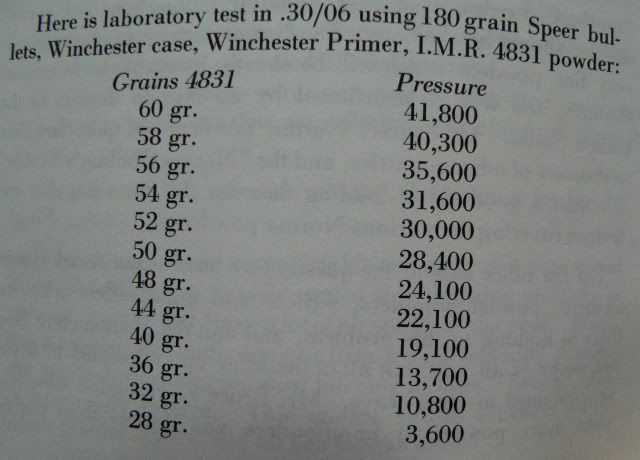
Not long after Bruce Hodgdon got into the war surplus powder marketing business, he too, heard the myths about an increase of powder not increasing the pressure, as full pressure was approaching. He also heard talk of his slow powders doing all sorts of funny things if cartridges were loaded lighter with his slow powders.
He made thousands of tests in his lab and couldn't detect any sign of either rumor.
Here are the results of just one test made with IMR4831 powder. Note that in every single case, an increase in powder made an increase of pressure. Not every increase made an exact equal increase in pressure, but there is certainly no pattern shown.
P1020738.jpg
 
The reduction in velocity rate per grain of powder is an indication that you are approaching maximum pressure for that load. If you want to go higher, reduce your load increases to about .2 or .3 grains. Watch for pressure signs.


This sums it up well.
 
I guess I was wrong about my brass being tight to chamber. They are hard to chamber because of the extractor slipping over the rim. My brass from 70 grains and up are tight near the belt and were difficult to extract, they measure a good 2 thou bigger in diameter right above the belt than my unfired brass.

The primers are flat, but not excessively and the bolt lift wasn't heavy. But I think you guys may be right about me reaching the limits of 4831 even though I am still a full grain under published max.
 
H4831 says Hodgdon demonstrated the lack of a predictable increase in velocity indicating excessive presure is a myth. But I have read modern tests demonstrating exactly that. Perhaps Hodgdon lacked the the instrumentation sophisitcation folks like Whites lab has today.

Or not, who knows. I do know that I have read dozens of atricles, using modern ballistic lab numbers, that when you encounter one of those "signs" you are already in excess pressure country. The fact that your piece will stay intact for a few hundred rounds in the excess country is just a tip of the hat to modern steels, design and manufacture.

dats why dey got da book.
 
Custom chambers that are cut on the "tight" side of SAAMI specs often reach pressure limits [and max velocities] at lower powder charges than do factory chambers that tend to be sloppier.
I have two rifles chambered for the same cartridge, one is a factory chamber, one is a custom job.
Fired brass from the factory chamber measures .5145" right in front of the belt.
Fired brass from the custom chamber measures .5105" in the same place.
Velocities in the custom gun always run higher with the same bullet and powder charge.
Obviously, the tighter chamber builds higher pressures.
Pays to be careful!! Regards, Eagleye.
 
Back
Top Bottom