A lot of contradictory information about Rawbone.
But! The important part is they were here, in Canada and were selling English shotguns under their brand - W.G. Rawbone, Toronto.
William George Rawbone (born 1809 in London) was a gunmaker believed to have trained in Birmingham, England, where he appears to have been active early in his career.
In 1848, he took his wife and five children to Cape Town, South Africa. By 1852 he had established his own firm.
During the 1850s, Rawbone was also recorded as making percussion rifles in Cape Town. By 1852 the sons John William and William were already involved in the business and appear to have taken over much of its management.
In 1860, during the visit of Prince Alfred, John William and William Rawbone formally took over the management of the firm, although the name W. & G. Rawbone continued to be used.
In 1861, W. G. Rawbone and his son Henry returned to England and opened a buying office or factory at Back of 21 Lower Loveday Street, Birmingham.
In 1862, W. G. Rawbone patented a sporting rifle sight (Patent No. 2530).
That same year John Rawbone left the family firm in Cape Town and opened a competing business at 13 Burg Street.
In 1865, the Birmingham factory moved to Hope Works, Theodore Street, where it remained recorded until 1869.
In 1868, John Rawbone closed his firm at 13 Burg Street and rejoined William, trading as W. & J. Rawbone.
In 1869, W. G. Rawbone reportedly retired, and the Birmingham factory was taken over by Joseph Loxton Rawbone (possibly a relative).
It is believed that W. G. Rawbone, possibly accompanied by Henry Rawbone, travelled through the United States and Canada, and in 1873 established the Rawbone Gun and Manufacturing Co. in Toronto, Canada. Rawbone may have returned to England or Cape Town around 1877.
In 1893, W. G. Rawbone died, though the location is unknown.
Around 1900, William Rawbone retired and his son T. M. Rawbone took over the operations.
Because the Rawbone family operated businesses in England, South Africa, Canada, and the United States, often simultaneously, the history of the firm is confusing and sometimes contradictory.
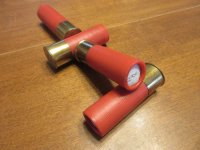
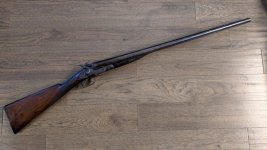
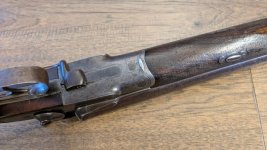
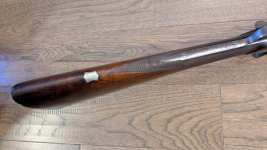
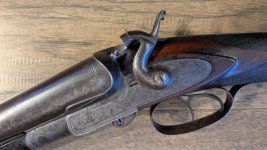
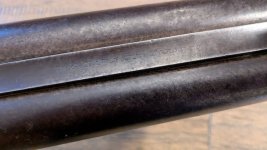
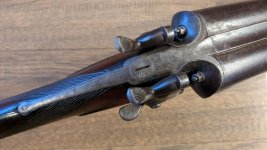
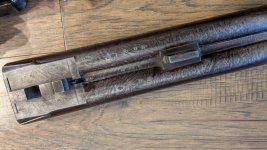
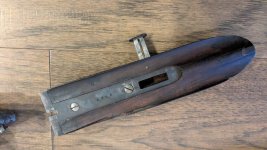
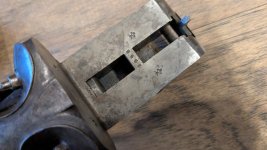
Here's a fair condition survivor in 11ga(!) Looks like approximately 1855-1875 made.
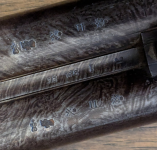
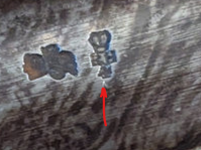
Help me to identify original UK maker behind this SxS.
But! The important part is they were here, in Canada and were selling English shotguns under their brand - W.G. Rawbone, Toronto.
William George Rawbone (born 1809 in London) was a gunmaker believed to have trained in Birmingham, England, where he appears to have been active early in his career.
In 1848, he took his wife and five children to Cape Town, South Africa. By 1852 he had established his own firm.
During the 1850s, Rawbone was also recorded as making percussion rifles in Cape Town. By 1852 the sons John William and William were already involved in the business and appear to have taken over much of its management.
In 1860, during the visit of Prince Alfred, John William and William Rawbone formally took over the management of the firm, although the name W. & G. Rawbone continued to be used.
In 1861, W. G. Rawbone and his son Henry returned to England and opened a buying office or factory at Back of 21 Lower Loveday Street, Birmingham.
In 1862, W. G. Rawbone patented a sporting rifle sight (Patent No. 2530).
That same year John Rawbone left the family firm in Cape Town and opened a competing business at 13 Burg Street.
In 1865, the Birmingham factory moved to Hope Works, Theodore Street, where it remained recorded until 1869.
In 1868, John Rawbone closed his firm at 13 Burg Street and rejoined William, trading as W. & J. Rawbone.
In 1869, W. G. Rawbone reportedly retired, and the Birmingham factory was taken over by Joseph Loxton Rawbone (possibly a relative).
It is believed that W. G. Rawbone, possibly accompanied by Henry Rawbone, travelled through the United States and Canada, and in 1873 established the Rawbone Gun and Manufacturing Co. in Toronto, Canada. Rawbone may have returned to England or Cape Town around 1877.
In 1893, W. G. Rawbone died, though the location is unknown.
Around 1900, William Rawbone retired and his son T. M. Rawbone took over the operations.
Because the Rawbone family operated businesses in England, South Africa, Canada, and the United States, often simultaneously, the history of the firm is confusing and sometimes contradictory.
Here's a fair condition survivor in 11ga(!) Looks like approximately 1855-1875 made.
Help me to identify original UK maker behind this SxS.