W. H. Tisdall Birmingham information

Hendon

New member
Rating - 0%
0   0   0
Good afternoon

I have my fathers 12 guage ( I belive, Im not a gun guy) shotgun. Im trying to locate what year it was manufactured. Ive read up on W.H. Tisdall and they had shops in Birmingham England, Frederickton, New Brunswick, and in Vancouver for a brief time at the end of the 1800's. There is not alot of information online to help me decipher the markings. Any help would be appreciated. Plus this site will not let me post pictures if you know the trick let me know.
 
Welcome to CGN. You've come to the right place for information, despite your not being a 'gun guy'. That can change, and once hooked, it can be a passion of a lifetime. On the matter of posting photos, you can purchase a CGN membership to facilitate posting pictures. It is money well spent. The other option is to use a 3rd party image host. I use Imgur, which is very easy to use for posting pictures on this site. If you go this route, PM me for directions on how to do it.

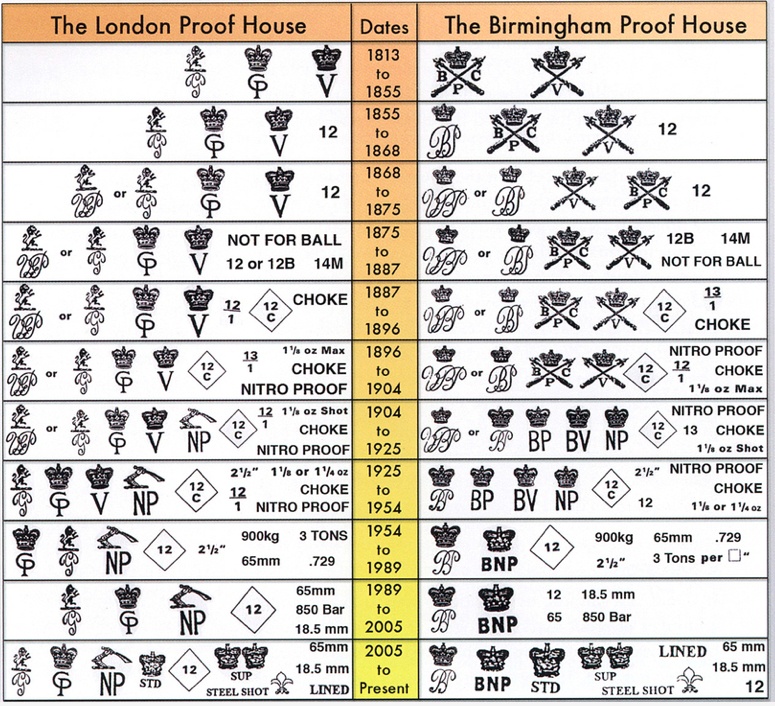
As to the markings on the gun, the first to look at is the rib inscription on the barrels, usually with a name and address. Gunmakers often had family members join the business, or they moved about or established new shops, so the name and address can offer clues as to the date of manufacture. Then there are the proof marks, usually under the barrel flats. These were added when the gun underwent pressure testing, and as these marks changed over time, the combination on your gun can help narrow down the year range.

Here is a chart that includes the Birmingham proof marks, presumably the ones on your gun:
oqV9SsT.jpg


Ideal is when the records and ledger books of the company still exist, providing more exact data, but this is rarely the case with British guns (often thanks to the Luftwaffe). W. H. Tisdall records did not survive. Trying to find information on W. H. Tisdall online can be confusing, as there was more than one W. H. Tisdall. Here is some information on the family line.

William Hodgetts Tisdall, born 1841, was the son of George Tisdall, a gun barrel forger in Wood Green, Wednesbury, Staffordshire. In 1848, the family moved to live and work in Chesshire Street, Aston Manor, Birmingham. In the 1851 census, George was listed with four more sons: Joseph , James, Thomas, and Henry. In 1863, a firm named Tisdall & Co was recorded as gun and rifle makers at 16 St Mary's Row, Birmingham, and from 1864 to 1867 the firm was recorded as Tisdall & Earp. This was almost certainly George Tisdall, and not his sons.

In 1863, William Hodgetts Tisdall was in business as a gun barrel and rifle maker at Court, 5 Steelhouse Lane, Birmingham. He was a maker to the trade, and did not have a retail business. In 1868, he moved the business to 40 Digby Street. In 1874, William moved the business to 47 Whittall Street. In the 1881 census, William described himself as a master gun maker employing 35 men, a huge business for someone who was not recorded in the directories.. William Hodgetts's son, William Henry, was described as a gun maker aged 16 years.

On 31 May 1879 W H Tisdall registered patent No. 2177 for a bolting mechanism and a safety mechanism, so he was also an inventor.

In the 1891 census, William (then aged 53) described himself as a gun manufacturer. In 1893, the business moved to 18 Sand Street, but William Hodgetts Tisdall died in September of that year. The business continued until 1900, possibly under the management of his son, William Henry Tisdall, but it was not recorded after that year.

As he supplied guns to the trade, I'm not surprised that he would have dealt with importers in Canada, though I can't find information on these. Sometimes the importer/retailer is added to the barrel rib inscription.

I hope this adds to your ongoing search for information on your father's gun. For information on 19th century British gunmaking, I can point you to another thread on CGN, which, though a long read, might help you appreciate your gun, and maybe convince you to delve more deeply into this pastime:

https://www.canadiangunnutz.com/forum/threads/the-allure-of-the-british-gun.2492672/


 
Last edited:
Wow fantastic information, Thank you so much. Based on what you have sent me this is in the 1887-1896 range. It has the number 11 over 1 also stamped on one barrell and 11 on the other, does this indicate 12 guage?
 
Wow fantastic information, Thank you so much. Based on what you have sent me this is in the 1887-1896 range. It has the number 11 over 1 also stamped on one barrell and 11 on the other, does this indicate 12 guage?
The question is what size cartridge fits in the chambers. The numbers refer to bore size, or the width of the interior of the barrel. 11 is close to .751 inches. By comparison, 10 gauge is .775 inch, and 12 gauge .729 inch. So, it is either a 10-gauge gun with a slightly restricted bore (my guess), or a 12-gauge with a more open bore (also possible). The /1 refers to a slightly bigger bore than the nominal (but not enough to count as a different bore/gauge). This is where pictures of the marks would help give a more definitive answer!

Here is a good reference for British bore sizing:
https://www.vintageguns.co.uk/magazine/proof-sizes

10-bores were uncommon in Britain, though these were popular in North America; many Birmingham export guns were in 10-gauge.
 
Do you have some way of measuring the diameter of the chambers?
The gun does need a sympathetic cleaning...
 
Looks like 10ga.
How about the diameter of the chamber at the breech end? A 10ga shell is a bit over 7/8" in diameter just past the rim.
 
Last edited:
I cleaned up the bottom of the barrels and a couple of new markings appeared. At some point it appears this gun was covered in a varnish, Im deciding if I should remove the varnish from the metal components or not. Any hints on how to at least refresh the wood and metal parts?

https://drive.google.com/drive/folders/1Um3bEQnbKw9ojVJlgMVLqb76Hmj3MqJ5?usp=drive_link
Cleaning old guns requires walking a very fine line between restoration and ruination. Any attempt should be done slowly, so as to not lose patination. A gun can have sentimental value AND collector's value. The latter can be lost very quickly through inattentive cleaning or restoration attempts.

Step number one should be warm water, mild soap, and a stiff nylon brush. Get surface dirt off to see where the starting point truly is. Dry with cloths/paper towels.

Step number two is to assess what the original finish was on the wood, if any remains. It might be an oil finish, lacquer, or a varnish. Where you go next will be based on which one it is. Stay away from any thoughts of sandpaper. An oil finish might just need a few drops of linseed oil, rubbed in by hand for friction and warmth, to regain its looks. Try to avoid a full strip and refinish if you can (these rarely look right: old metal, new wood).

For any disassembly, use gunsmith screwdrivers, and patience, only. Anything else ruins the screw heads.

Metal requires special care. Do not use abrasives. Once the dirt is removed, rubbing with a cloth and olive oil might get you where you want to go. It might take a lot of rubbing, but this will not remove the patina. If more aggressive methods are warranted to remove surface rust, then super-fine steel wool (the kind you get from a specialty store like Lee Valley, not Canadian Tire) and oil might be appropriate, but start small where it doesn't show and go slow, just to be sure. It looks like there might be a surface lacquer or varnish on the metal parts (or dried oil, it is hard to tell). If it doesn't go away with soap, water and a nylon/natural brush, you might try a bit of alcohol, or mineral spirits, and rubbing.

Once clean, dry, and the wood refreshed, a bit of conservator's wax (microcrystalline wax) rubbed all over and polished with a soft cloth, will preserve the gun. Common floor paste wax also works well, if you can't find the conservator's wax.

Hope this helps.

By the way, the set of initials under the barrels ('RB') is the barrel maker, who signed his work. When I find a moment I'll see if I can narrow it down.
 
Just to finish up, it would appear that the initials 'RB' under the barrels identify the barrel maker as Richard Boot, of Court 13, Price Street, Birmingham (@1890-1930), an address right in the Gun Quarter. Boot was born in Birmingham in 1858, and the 1891 census has him listed as a 'gun barrel filer.' living at 97 Victoria Road, Aston, Birmingham, with his wife Emily and his two young sons, William H and George FE. This puts a human face on things and reminds us that these guns are crafted and built by human hands, not just assembled in a generic factory somewhere.

Enjoy your gun!
 
Thank you all for your help and information, Im planning on handing this down to my son for X-mas and this will make a great informaton package. Thanks again!
 
Back
Top Bottom