












































You are using an out of date browser. It may not display this or other websites correctly.
You should upgrade or use an alternative browser.
You should upgrade or use an alternative browser.
Was there ever a bad milsurp?
- Thread starter Alex_Zues
- Start date
The 1915 "B" headstamped ammunition didn't work well in machineguns either.
The "pin" modification to Mk. III Ross bolts was done during WW2.
The troops turning in their Mk, II rifles in Kingston in 1915 would have been issued Mk. II Rosses.
The CSRG - Chauchat - was manufactured by two factories, most being made by Gladiator. Most parts were made in house.
The "pin" modification to Mk. III Ross bolts was done during WW2.
The troops turning in their Mk, II rifles in Kingston in 1915 would have been issued Mk. II Rosses.
The CSRG - Chauchat - was manufactured by two factories, most being made by Gladiator. Most parts were made in house.
mcpherson284
Regular
- Location
- Vancouver Island
I'm a lee enfield guy, don't get me wrong, but wasn't the .303 jungle carbine nicknamed the "wandering zero"? Please forgive me lee enfield, for I have said your name in vein.
The wandering Zero only was a problem after lots of rounds were fired off, heating up the barrel and receiver enough to take advantage of the areas where metal was removed to lower the weight a little.
mcpherson284
Regular
- Location
- Vancouver Island
Wasn't our Ross rifle a POS as well? I don't know too much about this gun.
Where the Ross had problems was with the British ammo of World War one and the mud and dirt of the battle field. The reality is that the Ross set some Match shooting records well before you or I were a thought in our Grandparents eyes.
mcpherson284
Regular
- Location
- Vancouver Island
Yes it was a good target rifle but it was an embarasment in combat when the target chamber wouldn't allow the use of slightly less than perfect ammo. I guess it made a fine club at that point though.
In the early service life of the M-16, it had the same problems as the Ross, and more on top of that.
mcpherson284
Regular
- Location
- Vancouver Island
I love the fact that certain rifles are deemed to be crap! That means I can afford to buy and shoot them. I'd put my $150 Ross mkIII against any $1500 garand in a match, even if I lost it would be great fun to watch people at the range point and stare as I risk my face with every pull of the trigger.
Then there's my Turk Mauser an always despised gun. I'm not sure why this is so as the Turks have huge military history and the fact that it's a Mauser should be good enough for most but they're still deemed to be "junk". Oh well guess I'll keep buying all of the "crap" and leave the fancy milsurps to the more serious collectors.
Well said
Back aways, one of my school teachers in the late 50's early 60's had been sent out to Normandy as a replacement platoon commander - a 2nd Lt in a well-known British infantry regiment. He lasted all of two days before his unit, all on tracks, and with him in a Bren Gun carrier as the third vehicle, were suddenly mown to shreds by what turned out to be four or five MG-42 set up about 600m away on a slight rise. Out of the 27 men under his direct command, three survived, him being one of them. He recalled vividly lying on the ground. looking through the 'lacework' superstructure of his burning BGC, wondering how it had all happened so fast. He left his left arm and most of his left leg in Normandy, and his innocence - he had never actually seen a live German either.
The MG42, 'Hitler's Buzz-saw', was then, and still is, the finest and most innovative general purpose machine gun ever made.
tac
For anyone who has never seen a bren gun carrier, it is a tiny little tracked vehicle the size of a smart car with a tiny armored box with NO ROOF and a gun on the front. I could probably take one out with a baseball, let alone an mg 42!!

I pity the poor men who served in these contraptions.
As far as poor military issued weapons.. I feel the list of terrible vehicles might be much longer.

mcpherson284
Regular
- Location
- Vancouver Island
Actually the French Chauchat in 8mm Lebel wasn't that bad. Not awesome, but not that bad. The real problems came with the American .30-06 model.
I'd argue that the Nagant 1895, while reliable and fairly accurate, would be about the last handgun I'd ever want to take into combat. Also, the earliest Astra 1921s are notorious for cracking frames.
Guns&Ammo Surplus Firearms - September 2010
"Wheel Guns of the Second World War"
Great Britain - Webley/Enfield No.2 Mk.1, Webley Mk. IV, Smith & Wesson Military and Police,
France - Revolver d'Ordonnance Mle 1892,
Soviet Union - 1895 Nagant,
United States - Smith & Wesson-Second Model Hand Ejector (Model 1917), Colt New Service (Model 1917), Smith & Wesson Victory Model
Italy - Rotazione Modello 1872, Rotazione System Bodeo, Modello 1889, M 1898 Rast & Gasser Armeerevolver,
Japan - Smith & Wesson No. 3, Meiji 26 Nen Ken-Ju (Type 26),
These revolvers were marked against each other, and the results from Guns & Ammo?
After a great deal of consideration and soul searching, Rusty's Choice of a Combat revolver was the S&W 1917. his decision was based on three things: the 1917's reputation of ruggedness, its ease of reloading and (Big surprise) the effectiveness of the .45 ACP. He again surprised me by declaring the Enfield No.2 as his second choice. Despite the somewhat lackluster performance of the .380 cartridge, its handling characteristics, DA trigger pull, and sights were superiors to the Victory Model.
LAST PLACE. the Nagant 1895g, which Rusty just could not find anything good to say about. In fact, his most laudatory comment about the small caliber Russian round gun was, "Well, I guess it would have been suitable for executing kneeling prisoners."
So we're at the bottom of Page 5 and people hve fnally stopped, for perhaps a post or three, slagging the Ross/defending the Ross.
I wonder if anyone here wants to defend the Berthier. It was, after all, France's mainstay during the Great War.
To save you having to go back a couple of pages to find it, here it is again:
In my own opinion, the worst design for a combat rifle MUST be the French 1907 and 1907/15 "dit coloniel" Berthier-system rifles. They were finely-fitted and beautifully-made from the best of materials by workmen who cared what they were doing, but they were a DISASTER of a design. Nevertheless, MILLIONS were made and they served for half a century and more, from the Western Front to Viet-Nam to the Rif War and, without doubt, there are still a few chugging along, should ammunition be available.
Think on this for a moment. Read it carefully first. You have a beautifully-made, long, elegant rifle. It uses a sighting system which the sales Anglaises discarded in 1890. You can see daylight around the Bolt. The bottom of the Magazine is OPEN at all times; the War is in heavy mud. It has NO safety mechanism of any kind. Ammunition is issued just before you need to use it, in 3-round clips. To carry the rifle with a round in it, you have to load 3 rounds, chamber and eject the first one, hold down the second and slip the Bolt forward. You now have a TWO-SHOT rifle. You are wearing a snazzy blue jacket and bright red pantaloons and shiny black leggings and a bright-blue kepi with gold trim. When the Sous-lieutenant blows his whistle the first time, you will attach the 17-1/2-inch spike bayonet and load the rifle. The second time the Sous-lieutenant blows his whistle, you will climb out of your Trench and advance, shoulder-to-shoulder, with the rifles at waist level, firing from the hip, toward the Boche. The machine-guns are 300 yards away and Fritz has had 2 years to sight them in.
A GENERATION of Frenchmen died in this manner. They should have lived.
A generation of French GENERALS and POLITICIANS should have been shot instead. They were the ones who sent better Men than themselves out to die with this ABORTION of a thing in their hands.
'Nuff said.
I wonder if anyone here wants to defend the Berthier. It was, after all, France's mainstay during the Great War.
To save you having to go back a couple of pages to find it, here it is again:
In my own opinion, the worst design for a combat rifle MUST be the French 1907 and 1907/15 "dit coloniel" Berthier-system rifles. They were finely-fitted and beautifully-made from the best of materials by workmen who cared what they were doing, but they were a DISASTER of a design. Nevertheless, MILLIONS were made and they served for half a century and more, from the Western Front to Viet-Nam to the Rif War and, without doubt, there are still a few chugging along, should ammunition be available.
Think on this for a moment. Read it carefully first. You have a beautifully-made, long, elegant rifle. It uses a sighting system which the sales Anglaises discarded in 1890. You can see daylight around the Bolt. The bottom of the Magazine is OPEN at all times; the War is in heavy mud. It has NO safety mechanism of any kind. Ammunition is issued just before you need to use it, in 3-round clips. To carry the rifle with a round in it, you have to load 3 rounds, chamber and eject the first one, hold down the second and slip the Bolt forward. You now have a TWO-SHOT rifle. You are wearing a snazzy blue jacket and bright red pantaloons and shiny black leggings and a bright-blue kepi with gold trim. When the Sous-lieutenant blows his whistle the first time, you will attach the 17-1/2-inch spike bayonet and load the rifle. The second time the Sous-lieutenant blows his whistle, you will climb out of your Trench and advance, shoulder-to-shoulder, with the rifles at waist level, firing from the hip, toward the Boche. The machine-guns are 300 yards away and Fritz has had 2 years to sight them in.
A GENERATION of Frenchmen died in this manner. They should have lived.
A generation of French GENERALS and POLITICIANS should have been shot instead. They were the ones who sent better Men than themselves out to die with this ABORTION of a thing in their hands.
'Nuff said.

To what purpose did the French army feel it was a good idea to lack a safety?
You certainly do make quite the case against the Berthier rifle. I must admit I don't know much about their service history. I am interested to see what others think.
Also, are there any records of how the French troops felt about their issued rifles? Was it one of those things that they ditched when they had the chance to capture others?
You certainly do make quite the case against the Berthier rifle. I must admit I don't know much about their service history. I am interested to see what others think.
Also, are there any records of how the French troops felt about their issued rifles? Was it one of those things that they ditched when they had the chance to capture others?
Last edited:

In Major John Plaster's book The History of Sniping and Sharpshooting
ht tp://www.amazon.ca/History-Sniping-Sharpshooting-John-Plaster/dp/158160632X
he mentions that while the regular soldiers traded their Ross's in for L-E, the snipers kept their Ross rifles.
The snipers knew enough to keep their rifles clean and lubricated, and assembled properly, so it served them very well in combat.
ht tp://www.amazon.ca/History-Sniping-Sharpshooting-John-Plaster/dp/158160632X
he mentions that while the regular soldiers traded their Ross's in for L-E, the snipers kept their Ross rifles.
The snipers knew enough to keep their rifles clean and lubricated, and assembled properly, so it served them very well in combat.

The Ross rifle was not liked in the trenches because they would not fire dirty ammo as good as the Enfields. First of all, the Ross was built to extremely tight tolerences whereas the Enfields were purposely built sloppy just for that reason. The Ross was so revered for it's quality that the snipers used it as their number one choice. The Ross got a bad rep because it was built too good, funny isn't it ! I love mine.
That and if you don't close the bolt all the way it can blow back in your face and yes it's happend to many people. It's like granad thumb the rifle is very accurate though.
"if you don't close the bolt all the way it can blow back in your face"..... That is just so wrong that it is silly. If you don't close the bolt all the way, the rifle won't fire - just like any other bolt action rifle.
The blowback has occurred occasionally; no, it has not happened to many people.
It requires that the bolt be assembled in such a manner that the bolt doesn't rotate to lock.
It is a failure in the same category as shooting a Lee Enfield rifle without its bolthead installed. And, yes, there are prople who have managed to do that.
Last edited by a moderator:
Regarding the Chauchat, it also has a terrible reputation that isnt entirely deserved.
It actually had some innovative features that are standard nowadays.
From Wiki:
" The Chauchat combined a pistol grip, an in-line stock, a detachable magazine, and fully automatic fire capability in a compact package of manageable weight (20 pounds) for a single soldier. Furthermore, it could be fired from the hip and while walking. In shape and intended function the Chauchat, in spite of all its imperfections, may be considered as an early forerunner of the assault rifle concept."
It actually had some innovative features that are standard nowadays.
From Wiki:
" The Chauchat combined a pistol grip, an in-line stock, a detachable magazine, and fully automatic fire capability in a compact package of manageable weight (20 pounds) for a single soldier. Furthermore, it could be fired from the hip and while walking. In shape and intended function the Chauchat, in spite of all its imperfections, may be considered as an early forerunner of the assault rifle concept."

The biggest issue with the Chauchat was the fact its been made with poor quality material. I have read that were investigations about the industrials who manufactured the rifle, taking low quality material to maximize profit. Ofc the Chauchat was ugly and not perfect but with better quality materials and control, maybe could have served not so bad after all.
Joce
Joce

The Chauchat is pretty much universally regarded as "the 'worst machine gun' ever fielded in the history of warfare."
http://en.wikipedia.org/wiki/Chauchat
The version chambered in .30-06 for the AEF was particularly prone to failure.
I've read the account of an American that claimed his grandfather carried around a piece of one of them embedded in his hip for the rest of his days, after it exploded on him in France.
This is something I've seen
 - the mechanism just wasn't "30.06-friendly".....
The biggest problem with material used in the Chauchat was in the magazine. The cases were thin, and easily damaged, while the springs tended to take a set, and therefore fail to feed the rounds.
There appears to be next to no definitive material available about the failure of the .30-36 Chauchat in 1918.
More recently, there is evidence that the chambering specs were way off. If this was the problem, the how and why are lost.
The Chauchat was successfully converted to 7.65 Belgian and 7.92x57 Mauser. The guns in these calibers worked better than in 8mm Lebel. Probably because a totally different magazine was used.
The Chauchat in original caliber worked decently in North Africa in the '20s. No mud.
One real problem with the Chauchat was overheating. A clean gun in serviceable order could start experiencing failres of barrel return to its foreward position after 300 odd rounds of rapid fire. Given that gunners normally loaded about 15 rounds in a magazine to reduce spring setting, that is about 20 magazines in a row, one right after the other.
There appears to be next to no definitive material available about the failure of the .30-36 Chauchat in 1918.
More recently, there is evidence that the chambering specs were way off. If this was the problem, the how and why are lost.
The Chauchat was successfully converted to 7.65 Belgian and 7.92x57 Mauser. The guns in these calibers worked better than in 8mm Lebel. Probably because a totally different magazine was used.
The Chauchat in original caliber worked decently in North Africa in the '20s. No mud.
One real problem with the Chauchat was overheating. A clean gun in serviceable order could start experiencing failres of barrel return to its foreward position after 300 odd rounds of rapid fire. Given that gunners normally loaded about 15 rounds in a magazine to reduce spring setting, that is about 20 magazines in a row, one right after the other.

stencollector
CGN Ultra frequent flyer
- Location
- shilo MB, the armpit of Canada
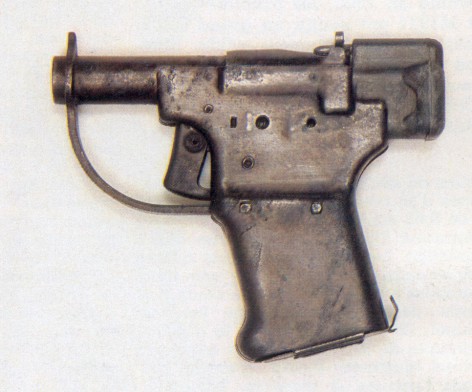
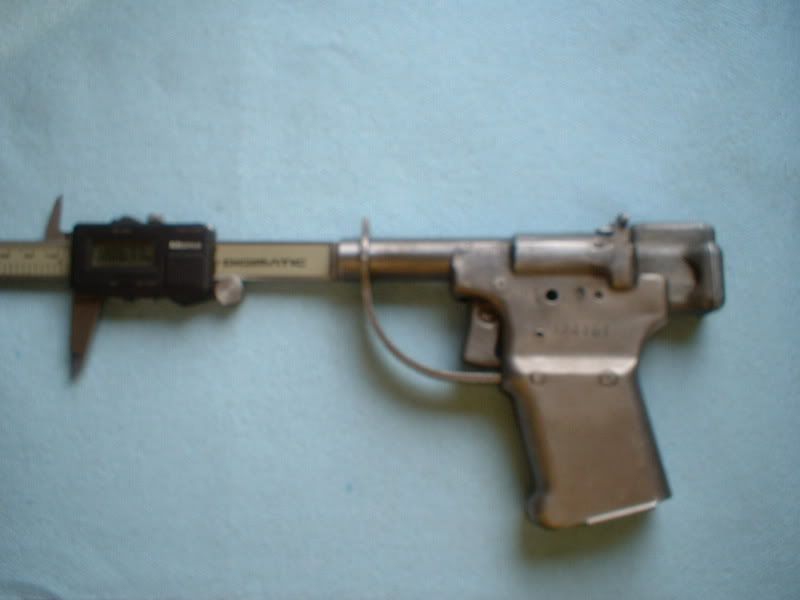
Here is my nomination for worst milsurp ever: The FP45 Liberator. It was designed as a disposable gun meant to be dropped to the civilian population of an occupied country in order for them to use it to acquire a real gun from their oppressors. It required it's possessor to get up very very close to his intended target in order to hit anything, and the time it would take to poke the empty case with the supplied little stick, and load another of the lower powered .45 cartridges into it, would likely have negated any chance for a second shot.
It was made cheaply out of stamped and cast parts for a couple bucks each. The barrel was smooth bore. Mind you, when I say smoothbore, I am being generous in that description. The bore looked like it had been drilled on a cheap drill-press.
It was intended as a psychological weapon, to demoralize the German's with the thought that anybody could have one. Of course, if they had actually been supplied to the resistance, it's discovery on a person would have likely resulted in their execution.
There were over a half million of them made, but no record of one ever having been used for it's intended purpose. Most were eventually destroyed, making it very collectable.
The photo is of mine, after I installed a new barrel (4mm longer) to make it restricted only.

Milsurp failures?
More like about leadership failures at the head of Army/Governments.
Like putting the Browning 1919 in the field vs the German MG34/42? Not one machine gunner in a million would chose the 1919 if they had the choice.
The FN-49, mostly designed in the late 30s, would have been a game changer in WW2. Provided they used a detachable mag btw. Despite it's designer making his way to England after the Belgian surrender nobody at Allied HQ seemed interested in what he was up to at FN!
More like about leadership failures at the head of Army/Governments.
Like putting the Browning 1919 in the field vs the German MG34/42? Not one machine gunner in a million would chose the 1919 if they had the choice.
The FN-49, mostly designed in the late 30s, would have been a game changer in WW2. Provided they used a detachable mag btw. Despite it's designer making his way to England after the Belgian surrender nobody at Allied HQ seemed interested in what he was up to at FN!























