Was there ever a bad milsurp?

The Huot might have been useful.
But Lewis guns were available in quantity, and it would have taken time to get Huot production/conversion underway. Probably a simple case of staying with what you have, rather than diverting time and resourecs into something unknown and untried. It is interesting that as a rifle, the Ross suffered from a reputation of being sensitive to mud, yet the Huot performed well in comparison with the Lewis. Of course, the Lewis' magazine was anything but mud resistant. About as mud resistant as the Chauchat's magazine was. Maybe the standard for mud resistance was higher for a rifle than for a machinegun.

 
The FN (later SAFN) was produced in trial quantities at Enfield in 1944. Later 2000 troop trials rifles were ordred but never built when it was decided to proceed with the .280" ctg program.
As for the Ross it has the distinction of being the only infantry rifle to be with drawn from front line service in WWI. However it is a nice collector's item.
 
i'm going to say the springfield 1888. they where making NEW rifles using a system designed to convert US civil war muzzle loaders while things like the lee-metford, mauser 93, commission 88, mannlicher, mosin-nagant, lebel, etc where being made.
 
So we're at the bottom of Page 5 and people hve fnally stopped, for perhaps a post or three, slagging the Ross/defending the Ross.

I wonder if anyone here wants to defend the Berthier. It was, after all, France's mainstay during the Great War.

To save you having to go back a couple of pages to find it, here it is again:

In my own opinion, the worst design for a combat rifle MUST be the French 1907 and 1907/15 "dit coloniel" Berthier-system rifles. They were finely-fitted and beautifully-made from the best of materials by workmen who cared what they were doing, but they were a DISASTER of a design. Nevertheless, MILLIONS were made and they served for half a century and more, from the Western Front to Viet-Nam to the Rif War and, without doubt, there are still a few chugging along, should ammunition be available.

Think on this for a moment. Read it carefully first. You have a beautifully-made, long, elegant rifle. It uses a sighting system which the sales Anglaises discarded in 1890. You can see daylight around the Bolt. The bottom of the Magazine is OPEN at all times; the War is in heavy mud. It has NO safety mechanism of any kind. Ammunition is issued just before you need to use it, in 3-round clips. To carry the rifle with a round in it, you have to load 3 rounds, chamber and eject the first one, hold down the second and slip the Bolt forward. You now have a TWO-SHOT rifle. You are wearing a snazzy blue jacket and bright red pantaloons and shiny black leggings and a bright-blue kepi with gold trim. When the Sous-lieutenant blows his whistle the first time, you will attach the 17-1/2-inch spike bayonet and load the rifle. The second time the Sous-lieutenant blows his whistle, you will climb out of your Trench and advance, shoulder-to-shoulder, with the rifles at waist level, firing from the hip, toward the Boche. The machine-guns are 300 yards away and Fritz has had 2 years to sight them in.

A GENERATION of Frenchmen died in this manner. They should have lived.

A generation of French GENERALS and POLITICIANS should have been shot instead. They were the ones who sent better Men than themselves out to die with this ABORTION of a thing in their hands.

'Nuff said.

I had no idea that the Berthier rifles could not be carried with a full magazine and empty chamber. I think we have a "winner"!

It is interesting to note that despite (or perhaps because of) their generally awful bolt action rifles, the French almost adopted a semiautomatic rifle (the A6 Meunier) chambered for a high-velocity 7mm cartridge prior to WWI, some 20 years before the Garand.
 
The Chauchat is pretty much universally regarded as "the 'worst machine gun' ever fielded in the history of warfare."

http://en.wikipedia.org/wiki/Chauchat

The version chambered in .30-06 for the AEF was particularly prone to failure.

I've read the account of an American that claimed his grandfather carried around a piece of one of them embedded in his hip for the rest of his days, after it exploded on him in France.

I have to disagree. The Chauchat was designed for the 8x50R Lebel and it worked very well with that cartridge. It was also inexpensive to manufacture from mostly round stock, and suffered from being one of the first light machine guns that other later guns improved upon.

It has a poor reputation only amongst Americans because the AEF converted their Chauchats to .30-06 - a calibre with insufficient case taper to function well in that design. This is TOTALLY contrary to the French who were very well served by the gun.
 
Yes it was a good target rifle but it was an embarasment in combat when the target chamber wouldn't allow the use of slightly less than perfect ammo. I guess it made a fine club at that point though.

That isn;t really the reason the Ross was disposed of for combat use. Rosses in Europe were mostly reamed before seeing much service to the "E" chamber, meaning RSAF Enfield chamber dimensions for the SMLE, and this fixed the ammo issue for the most part. The true problem that caused the Rosses to jam was an insufficiently wide bolt stop. Vigorous working of the action caused this part to peen, which eventually would jam the action tight. The desing flaw was addressed in the list of changes, but by then the poor reputation had stuck and the British were all to anxious to sell SMLE's to the Dominion and benefit from a common supply chain, so the Ross was dropped.

There are so many myths about the Ross Rifle that it's just amazing. Another popular theory is the one of bolt assembly being incorrectly done. This was solved by adding a rivet to the bolt body to the guns in theatre, but really you'd have to be a blind monkey to assemble the bolt incorrectly - you literally have to set out to make it fail on purpose in my opinion.
 
The early M16s were introduced with lots of hype and limited cleaning supplies and tools. When the troops couldn't clean them (or didn't), they started to jam up. Knowledgible commentators blame the combination of cheap but fouling powder, the basic design faux-pas of the gun vomiting gas back into its mouth, and uncertain maintenance. Ever wonder why there is a forward assist on the M16A1s and every version since?

As you point out, most issues can be traced to incorrect powder being used in the first production lots of 5.56.
 
I guess the last ditch Japan rifles would be under that category. Only designed to be fired once or twice so you can take the dead enemies gun. The semi auto Wembley revolvers didn't do well in the field.

I'm going to guess you've never held one in person? Or are you referring to the Naval Special rifles with cast receivers? The late war type 99 is as safe to fre as an early war rifle, it's just that the stocks are cruder and all external polishing was deleted from production to save time and materials. Suggest you read Julian Hatcher's notebook - he goes into great detail on how they failed to make a late-war type 99 fail at aberdeen proving grounds, including taking the receiver way past pressures that would grenade a high-number 1903 springfield. Similar work was done by PO Ackley with the same result.
 
I can think of a few:

Rifles:
-The Lebel M1886 was badly outclassed soon after its introduction due to its slow-loading tube magazine. The lack of a safety (a flaw common to other French military bolt actions) rules out carrying the rifle in a state of immediate readiness.
-US Krag-Jorgensen: No charger-loading either, but at least it could be topped up with single rounds without opening the action. The strength of the action was another major disadvantage. That the Americans picked these when the Mauser was in the same trial is mind-blowing.

Pistols:
-All things Nambu, especially the Type 94 with its exposed trigger bar.
-Glisenti M1910: Despite having a locked breech, it still couldn't handle standard 9x19mm ammunition.

Machine guns:
-Japanese Type 11
-Fiat-Revelli Models 1914 and 1935
-Breda Model 30

Ref French guns not having safeties:

No French rifle until the MAS49 had a safety. This is not a design flaw. The french order of battle called for troops not loading their firearms until ordered to do so by the responsible officer. Read "La Grande Aventure Des Armes Reglementaires Francaise" for more details. Like most good books on the subject, only available in French. The French considered adding a safety like the Kropatcheks they bought from Steyr for the Navy, but consciously decided to omit it b/c it did not fit with their manual of drill. In the case of the Lebel, it was carried loaded in the magazine with the cutoff engaged and the chamber empty. When ordered to form a firing line, the French soldier opened the action and readied his ammunition waiting for the order to load. The Lebel was never officially carried in magazine mode. A soldier could only unlock his magazine upon receiving an order to do so.

Interestingly, the first Berthier long rifles did not appear on the line until 1916, with the exception of the Sengalais Corps who had the 1907 Berthier - they arrived on the Western Front in the second month of the war. With that exception, the French Army fought the Germans to a standstill with the help of only 6 British divisions and sporradic support form the Belgians conducting sorties out of the Armed Camp of Antwerp until 1915 using only the M86/93 Lebel rifle. Clearly the claimed obsolescence of that rifle was not a decisive factor.

I do agree with you on the Krag - not the best design out there. For that matter, the M1903 Springfield, which I love for its sights - was a step backwards from the M1895 Spanish Mauser it tried to copy. Particularly in how it handled cartridge case failure.

Also agree on the Type 94 Nambu, though apart from not liking dry-firing, the type 14 was a really nice pistol that balanced, pointed and shot exceedingly well - perhaps the most accurate pistol to be issued in WW2.
 
In my own opinion, the worst design for a combat rifle MUST be the French 1907 and 1907/15 "dit coloniel" Berthier-system rifles. They were finely-fitted and beautifully-made from the best of materials by workmen who cared what they were doing, but they were a DISASTER of a design. Nevertheless, MILLIONS were made and they served for half a century and more, from the Western Front to Viet-Nam to the Rif War and, without doubt, there are still a few chugging along, should ammunition be available.

Think on this for a moment. Read it carefully first. You have a beautifully-made, long, elegant rifle. It uses a sighting system which the sales Anglaises discarded in 1890. You can see daylight around the Bolt. The bottom of the Magazine is OPEN at all times; the War is in heavy mud. It has NO safety mechanism of any kind. Ammunition is issued just before you need to use it, in 3-round clips. To carry the rifle with a round in it, you have to load 3 rounds, chamber and eject the first one, hold down the second and slip the Bolt forward. You now have a TWO-SHOT rifle. You are wearing a snazzy blue jacket and bright red pantaloons and shiny black leggings and a bright-blue kepi with gold trim. When the Sous-lieutenant blows his whistle the first time, you will attach the 17-1/2-inch spike bayonet and load the rifle. The second time the Sous-lieutenant blows his whistle, you will climb out of your Trench and advance, shoulder-to-shoulder, with the rifles at waist level, firing from the hip, toward the Boche. The machine-guns are 300 yards away and Fritz has had 2 years to sight them in.

A GENERATION of Frenchmen died in this manner. They should have lived.

A generation of French GENERALS and POLITICIANS should have been shot instead. They were the ones who sent better Men than themselves out to die with this ABORTION of a thing in their hands.

'Nuff said.

You know, I used to agree with you on the Berthier... that is until I started using one in the EOHC milsurp matches. That 3 round clip system is lighting-fast to load and cycle - MUCH faster than the Mauser charger clip. In prolonger firing, the Berthier is a superb weapon - if you can keep it clean. This was addressed in the M1916 upgrade which added a mud flap to the ejection port. The sights are NOT precise, but that ultra-wide front blade makes snap-shooting at man-sized target intuitive. Try it - I was amazed and surprised at how wrong I was about these rifles.

As noted before, the French drill manual forbade the French soldier from carrying any long arm loaded unless equipped with a magazine cutoff. Loading of rifles was the purview of the regimental Lieutenant when the situation warranted it. The French did not believe in the mechanical safety until they fielded semi-automatics.

Modern concepts of squat operations did not exist in the great war - most of them still thought and fought in Napoleonic terms.
 
Last edited:
Reisings suck.
The operating slot is underneath the hand guard and there really hard to clear jams.
The one I played with only had a 12 round mag.

Have to agree. Whe nthe M50 gets hot, it's virtually impossible to clear a jam with that awful cocking tab. This gets my vote for worst milsurp ever.
 
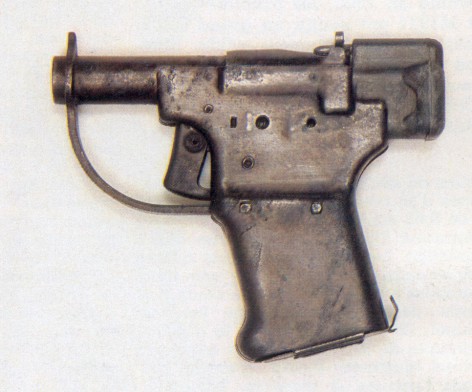
M1942_liberator.jpg


Here is my nomination for worst milsurp ever: The FP45 Liberator.

While a POS, I'm not sure it's even a milsurp. No military ever issued it. It was dropped in aid packages to resistance fighters as a cheap way to help them "acquire" better weapons (read: point-blank assassination using only one shot).
 
Think on this for a moment. Read it carefully first. You have a beautifully-made, long, elegant rifle. It uses a sighting system which the sales Anglaises discarded in 1890. You can see daylight around the Bolt. The bottom of the Magazine is OPEN at all times; the War is in heavy mud. It has NO safety mechanism of any kind. Ammunition is issued just before you need to use it, in 3-round clips. To carry the rifle with a round in it, you have to load 3 rounds, chamber and eject the first one, hold down the second and slip the Bolt forward. You now have a TWO-SHOT rifle. You are wearing a snazzy blue jacket and bright red pantaloons and shiny black leggings and a bright-blue kepi with gold trim.

They were actually wearing the blue horizon (grey-blue) with the Steel adrian helmet since 1915...

When the Sous-lieutenant blows his whistle the first time, you will attach the 17-1/2-inch spike bayonet and load the rifle.

Wich isnt worst or heavier than the german butcher blade or the british bayonet

The second time the Sous-lieutenant blows his whistle, you will climb out of your Trench and advance, shoulder-to-shoulder, with the rifles at waist level, firing from the hip, toward the Boche. The machine-guns are 300 yards away and Fritz has had 2 years to sight them in.

Like the British did so many times to, and the german, and so on and so on, it was the way back then. remember Gallipoli?

A GENERATION of Frenchmen died in this manner. They should have lived.

A generation of Frenchment died during this war MAINLY from artillery like so many during WW1. Most of the casualties during this war are from Artillery on all the sides... An dif you read about Verdun fo rexemple, you wont find anything about the Berthier beign a bad rifle. And beleive me the french soldiers and later historians would have been please to report that fact! During the battle of the Somme the british casualties from a unability to produce a sufficient progressive artillery barrage that follow the infantry advance. Seriously, the french hold up during the first stages of the war with only 6 british divisions to help, they did it with the 75mm artillery gun, the Lebel rifle and it worked. The Berthier have some flaws, like the 3 rounds clips, but its precise, sturdy and reliable. Give me one serious author who describe it as being as bad as you did...I beleive the best rifle of WW1 is the SMLE, followed by the Mauser 98, but you know, the Berthier isnt that bad.

A generation of French GENERALS and POLITICIANS should have been shot instead. They were the ones who sent better Men than themselves out to die with this ABORTION of a thing in their hands.

Seriously, Foch, Joffre and Petain during ww1 have nothing to be ashamed of in comparaison to General French, or Haig...
 
Joffre's biggest problem was that he was not an intelligent man, nor was he particularly skilled at strategy and he HATED Sir John French, but he did have an essential quality that was much-needed in 1914 - he was calm and could weigh good advice and usually select the right course of action. The Guns of August is an excellent read for anyone interested in this timeframe.

Petain's biggest issue was that Verdun ruined his spirit so bad that he later collaborated with the Nazis to avoid having to preside over Verdun Part 2. My favorite French General though was Franche Despere. An brilliant tactician who is seriously under-rated in the history books.

I would argue the second-best rifle in WW1 as not the Gew98, but rather the M1917, owing mainly to its revolutionary rear-mounted peep sights and Mauser-like action. It also held 6 rounds, second only to the SMLE. YMMV.
 
While a POS, I'm not sure it's even a milsurp. No military ever issued it. It was dropped in aid packages to resistance fighters as a cheap way to help them "acquire" better weapons (read: point-blank assassination using only one shot).

Debatable I guess, so here is my take on it: It was designed by a government, built in quantity on government contract, with the intent to be given to resistance/underground fighters to help win a war.

I watched another CGN member shoot one at John Hipwells, and you would definitely have to be at point blank. From 10 feet away you were lucky to hit a man size target, and the bullet started to tumble at about 12 feet. That was with regular 1944 dated US military rounds....not sure if the reduced power rounds would have given better or poorer performance. I have heard reports that after a few dozen rounds the gun would start to misshape or come apart. Whether or not the gun is a true milsurp, just as a firearm that has to be just about a record for shortest life of a factory gun.
 
While a POS, I'm not sure it's even a milsurp. No military ever issued it. It was dropped in aid packages to resistance fighters as a cheap way to help them "acquire" better weapons (read: point-blank assassination using only one shot).

I have held and fired one of those. all stamped metal except fot the cocking knob which was cast
 
Back
Top Bottom