Ways to determine shotgun choke?

RatFink

Regular
Rating - 100%
1   0   0
Location
YYC
Hey guys,

My dad has an old CIL shotgun from the mid-late '60s I would imagine that I will inherit and use this year and I was wondering if there is a way to determine the choke that is on the barrel. Can I take calipers or something and measure in certain increments down from the muzzle to check the taper or something?
 
Measure the bore i.d. 5" or so down from the muzzle then measure the i.d. at the muzzle. Subtract muzzle i.d. from bore i.d. and that will give you the constriction. From there use the following chart to determine the amount of "choke" the barrel has.

ouuqs1.gif
 
There are mechanical and digital micrometers that are specifically designed for measuring the nominal bore and the choke constriction (long enough shaft to get down the barrel, adjustment range in standard shotgun gauges) . They're used in the manner described by VLT79 above. You will pay at least $100 for each micrometer and, because of the minimum to maximum internal diameter range that they can span, you'll need at least 2 of them to cover barrels from 28 ga to 12 ga. (only one is needed, if you only want to be able to do 16 and 12 ga, for example)

More expensive models are available that are more flexible. Gun shops and gunsmiths might have a set you can use in the store (or, perhaps, for a small charge) or, due to the delicate nature of such precision tools, they may insist on doing the measurements for a fee.

Companies like Brownells sell them and they're available from tool suppliers. Brownells and other firearms industry types charge more for them than the tool sellers but, if you buy from the tool suppliers you'll be responsible for getting the right one, whereas Brownells has already taken care of that for you.
 
or the more simple way is to get one of the neat little choke gauges made now of corse good way to tell if its a tight choke is a canadian dime will not fit down a modified choke they are both about the same diameter

of corse choke is also determend by what the bore diameter is si if its not the standard .729" then it could mean its more choke or less choke
 
Hey guys,

My dad has an old CIL shotgun from the mid-late '60s I would imagine that I will inherit and use this year and I was wondering if there is a way to determine the choke that is on the barrel. Can I take calipers or something and measure in certain increments down from the muzzle to check the taper or something?

Like the boys indicate above but being a CIL product 90% were full choke so keep that in mind when measuring. The barrel will be stamped also very small but there somewhere . Some makes not sure if CIL use a stamp like a triangle is full , circle mod etc. Check the barrel very close.
 
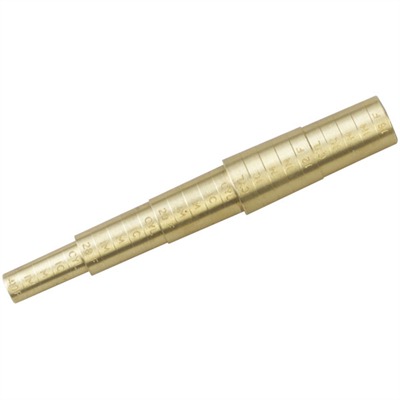
It's probably full choked but there are tools available for measuring chokes. I have one. It's a brass tool that is stepped for different gauges and choke constrictions. Reminds me of a metal cone for ring size measurement but laddered and with indication of different chokes (i.e. full, IM, M, etc...) You would drop this tool into the muzzle end of your shotgun and the tool drops there until it is stuck on a certain knuckle showing more or less what choke you might have.

I got mine from Gagnon Sports but there are other tools available as well.

Looks like this exactly:
p_344000001_1.jpg
 
Been many long years, but if I remember correctly,..a less professional way to get a quick estimate of choke size for 12ga bore is a dime. If the dime fits less than half in the bore, it's a tight choke and you can expect Full. If dime goes in about half way, Mod. If dime goes in more than half, it's bigger than mod. If dime falls inside and gets stuck....you're out'a 10 cents.
 
I have a bore gauge that can measure 12, 20, 28 and .410 gauges. It measures the bore and then the choke as you draw it out of the muzzle end of the barrel. It works very well. They cost over $500 new. Many guns shops will have a set. I live in Woodstock, Ontario and travel around much of Southern Ontario. If you live in this area of the country, we can probably arrange a meeting and I will check the barrel for you. PM me, if that works for you.

reg4gau.jpg
 
Last edited:
the simplest way is to pattern the gun as every shotgun barrel is a law unto its self . as far as using the dime method about all it does is prove you have a dime and a shotgun barrel as it does not measure the difference between the inside diameter of the barrel and the inside diameter of the choke . to give an example you could have a small choke opening but have a cylinder choke as the inside diameter of the barrel could be small as well . it is the difference between the two that counts .hope this makes sense.
 
The dime works pretty good for 12ga bore in most situations for most guys. Basically something for a quick check (as I said above) and you can carry it anywhere with you when at a show or a store.
 
Last edited:
Thanks for all your replies. Given what tools I have already, I will try measuring the inside of the barrel at different points from the muzzle and comparing that to the chart posted on the first page. If that doesn't give me anything, I'll have to look into more complicated methods - or does it really matter that much what kind of a choke I have? I don't plan on shooting slugs and I can really only see myself going after ducks or grouse in the future.

I have a bore gauge that can measure 12, 20, 28 and .410 gauges. It measures the bore and then the choke as you draw it out of the muzzle end of the barrel. It works very well. They cost over $500 new. Many guns shops will have a set. I live in Woodstock, Ontario and travel around much of Southern Ontario. If you live in this area of the country, we can probably arrange a meeting and I will check the barrel for you. PM me, if that works for you.

reg4gau.jpg

Thank you for your very kind offer, but as Beretta noted I'm in Calgary. Too bad our country is so darn big
 
It matters if you want to know how the gun is actually choked and/or if you want to use steel shot in a gun that wasn't made for it.

If what you intend to do is use lead shot, or bismuth/tungsten matrix for the odd waterfowl hunt, then you can easily get by with just patterning the gun with various loads at various distances, in order to determine what shells will work best without overkill for more delicate game (bunnies, ruffed grouse, partridge, etc.) and which to use for tougher species (sharptail grouse, pheasant, ducks and geese).
 
Could you please explain how the material of shot matters to the design of the barrel? I'm still very new to this game.

It matters if you want to know how the gun is actually choked and/or if you want to use steel shot in a gun that wasn't made for it.

If what you intend to do is use lead shot, or bismuth/tungsten matrix for the odd waterfowl hunt, then you can easily get by with just patterning the gun with various loads at various distances, in order to determine what shells will work best without overkill for more delicate game (bunnies, ruffed grouse, partridge, etc.) and which to use for tougher species (sharptail grouse, pheasant, ducks and geese).
 
Due to the toxicity of lead to almost all forms of life, and the usual junk science, governments across North America were conned into believing that ducks and wetland creatures were being poisoned by ingesting lead pellets that fell in water. So, laws were passed that banned the use of lead shot for hunting migratory birds or any game that would result in the pellets falling in the water.

Up to that point, lead was the only material used for making shot (not counting experimentation or specialty applications, which combined wouldn't have amounted to even a fraction of 1% of the shot produced). Taking into consideration issues such as toxicity and cost, steel became the material most often used for "non-toxic" shot.

There are two primary differences between lead and steel shot - lead shot is heavier by volume, and lead is very soft when compared to steel. Barrel steel always had to be hard enough to retain it's shape over decades of use, but elastic enough that sudden increases in pressure (when a shell goes off) wouldn't cause it to split as it would have were the steel too brittle. The lead shot was, and remains, soft enough that it would deform before the barrel steel. Steel shot is significantly harder to the point where, if a tightly packed shot stream passes through a tight choke (say "full") in a gun made from the elastic barrel steel, the barrel will bulge before the shot deforms. Usually it will take several steel loads through a tight choke to cause visible or catastrophic damage (but don't count on it).

For example, the first shot stretches the barrel imperceptibly, at the point where the shot starts to enter the choke constriction. The second shot stretches the barrel a bit more. By the third shot, a bulge is beginning to be noticeable, if you were looking closely. The fourth shot, even more so. By the fifth shot, the shot stream is not only slamming into the choke at the end of the barrel, but it's hitting the ridge caused by the bulge and even higher amounts of energy are transferring to the barrel (not to mention the havoc this is causing with shot patterns). A few more shots and the barrel will be badly bulged or split wide open at the muzzle.

It doesn't always happen that fast. Some barrels are harder than others, so there's no hard and fast guidelines to this. It's not unusual for it to take a season or two before the barrel is ruined.

As it turns out, steel shot doesn't require as much choke constriction to produce the same pattern at the same distance. So one option is to open up the choke(s) to "modified" or more open than that for closer shots. This allows for the use of steel shot shells through guns that were never designed for it. This is feasible with most shotguns made from about 1910 onward.

To do this safely, though, you need to know the actual amount of constriction as compared to the nominal bore - at a minimum after the reaming is complete, if not before starting, too. Simply knowing that a dime will fit through the choke doesn't tell you how much diameter is lost going through it. Two guns could have a muzzle opening that fits a dime exactly. But, if one has a larger nominal bore, the blocking effect on a shot stream of steel shot passing through it could be disastrous, whereas the other may be just fine because the shot stream was never expanded as wide while going down the barrel to begin with.

 
How about making a wax casting of the last five inches of the barrel?

I've read that some people use either paraffin or stearin wax to make chamber castings, would probably work on a shotgun barrel.

Stearin is hardener used for wax candles, it is quite hard when cool, Ikea sells stearin candles for $8. What if you lightly oiled the
inside last 5-6" of the barrel, melted the wax and poured it down the barrel. After it cools and assuming you can tap it out with
minimal deformation you can accurately measure the inside diameter and use the neat table another poster linked above.
 
Back
Top Bottom