Weight sorting bullets and cases

curseyou

CGN Ultra frequent flyer
Rating - 100%
2   0   0
Location
ΔΤΧ
For those who sort bullets and cases by weight, I understand that your match rounds are made from the majority in the centre of the bell curves. My question is how do you deal with the rest?

Do you load the heavier bullets with the heavier cases or is it the other way around. I'm leaning towards heavier bullets and heavier cases under the assumption that heavier cases will have less space, thus generate higher pressures to push heavier bullets in a self equalizing manner. Same idea for lighter cases and lighter bullets. How do other people do it?
 
i don't sort any of my components, but i would think, you would pick a certain weight range and the rest is used for plinking rounds.
 
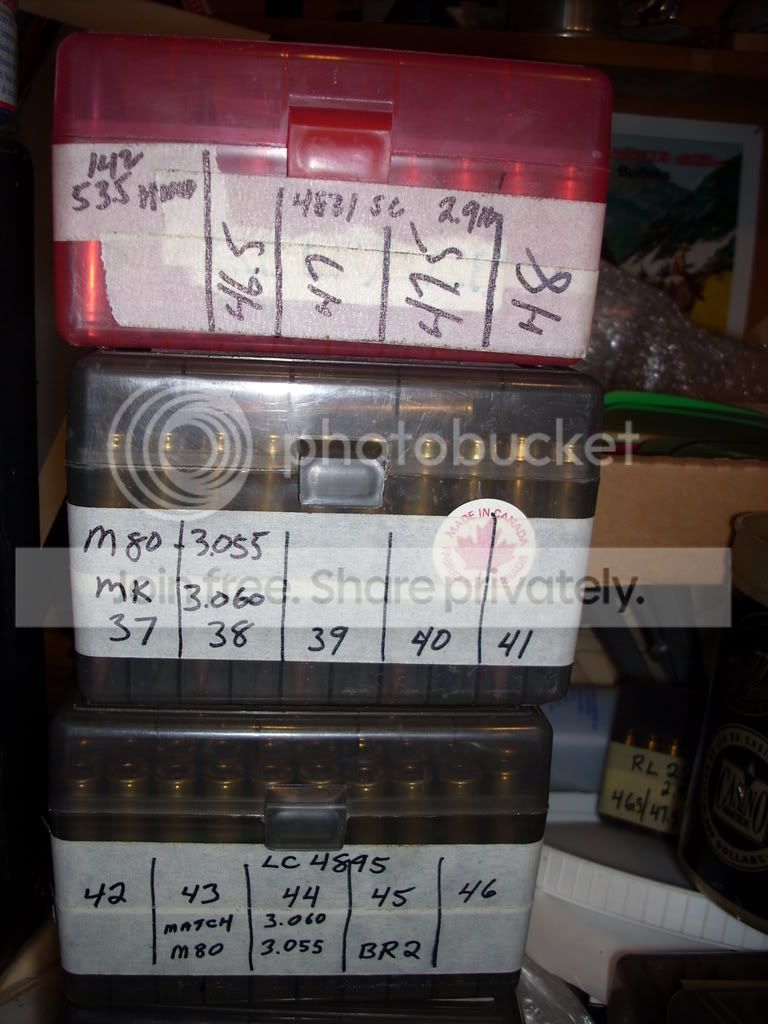
I take the cases from both the heavy side and light side, package and mark them accordingly.
then the next time I do another brass sorting session, I add the heavy/light cases to these weight groups.
after two/three brass sorting sessions, there should be enough to use. just be sure to lable the cartridge boxes with that information.

Keep in mind that any cases that fall significantly out of the weight catagories should be discarded.

hope this information helps.
 
I don't sort bullets. I do sort .308 brass into 1 gr batches. I have Lapua brass that runs from 170 gr up to 174 gr, so 5 batches. I keep these in plactic MTM. The difference from 170 gr brass and 174 gr brass is less than 1 MOA difference at 1000 yards.
 
I weigh 308 and 260 brass. I have 750 to 1000 cases to start with and sort them into casino coin pails marked in 0.3g increments. So long as there is at least 50 cases in the pail, I use them. My ammo goes into 50 round plastic boxes. I mark the case weight on the inside of the box. Those cases stay together for the rest of their life. It does not matter to me where they were on the bell curve, so long as all 50 are about the same weight.

The odds n ends go into boxes marked "Plinkers and Foulers". They get used for zeroing scopes, barrel break-ins, fouling barrels, etc.

comparator006.jpg
 
So, in the real world, what does all this mean.
In 243 Winchester calibre I have Federal cases which weigh about ten grains heavier than my old WW cases.
I checked to see how much Varget powder each brand would hold, even with the top of the neck. While there was ten grains difference in weight between the two types of cases, the lighter Winchester cases held only .7 grain more powder than did the Federal cases.
I loaded five WW cases with 46 grains of H414 powder and seated a 75 grain Sierra bullet.
I then put the identical load in five Federal cases and seated the same type bullet.
Over the chronograph, here are the results.
The five Win. Western cases -----------------------------------------------3491 fps.
The five Federal cases, Oops, those heavier case were supposed to be more, was 3468 fps!
Since the difference in velocity of 23 fps, is within the stated tolerance of error of the chronograph, we have to conclude that both groups are equal.
And, if we forget about the multitude of unproven theories that go the rounds on CGN, common sense tells us the two groups should be equal in velocty/pressure.
Look at it this way. With the bullets seated the same distance into the neck, the heavier case will have the smallest volume of space to hold the powder. However, as soon as the bullet moves, this all changes. Peak pressure isn't reached until the bullet is one to two inches down the barrel, so how could a very minor difference in the capacity of the original cases, possibly effect peak pressure, when there is now so much more space for the containment of the powder?
In the meantime, I have more important things to do, than to sort my rifle cases in to minute differences in weight.
 
I check and sort brass to 2/10grs and pay very close attention to powder weight to .02grns. but to me you must measure all your bullets ogive as they can vary greatly even with match bullets you can't get good results jumping & jaming them, and neck tensions must be the same on your brass.
I think all these things will help you keep elevation in check.
Hope to verify these things this spring at Connaught as we tested electronic targets last fall and hope to have 2 or three up & running.
These electronic targets give you the speed of bullet at 900 meters should be help in our reloading just to see if brass 3/10th gr out makes a differance
 
Back
Top Bottom