













































You are using an out of date browser. It may not display this or other websites correctly.
You should upgrade or use an alternative browser.
You should upgrade or use an alternative browser.
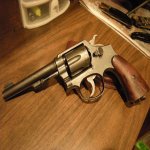
What are these Victory Model Smith and Wesson .38 Caliber Revolvers worth?
- Thread starter drm3m
- Start date


BlackPowderBurner
CGN frequent flyer
- Location
- the chesterfield
They seem to have been "modified" by some commercial concern in the UK, there's zero collector value as military antiques. Shooter value maybe $75ea?
They are S&Ws, so I would suggest that they are worth more than an Iver Johnson. I have a 4" M&P in .38Sp which is one of my favorite shooting revolvers.
As is $150? And TradeEx has 5" replacement barrels listed, so they could be reclassified as restricted.
As is $150? And TradeEx has 5" replacement barrels listed, so they could be reclassified as restricted.

They seem to have been "modified" by some commercial concern in the UK, there's zero collector value as military antiques. Shooter value maybe $75ea?
Isn't that just the British Lend Lease proof markings? BNP (Birminham Nitro Proof) and the rest.
I think the barrels have been shortened, and the front sights remounted, in addition to removal of the lanyard loops.
Yes, I missed that. Quite the mess.
TradeEx barrels are $75.
I'm not saying the barrels are over priced at all just the cost to rebarrel might be a bit, and the the price of the product when done being of two different finishes might not be what a fellow is expecting, an easier sell of course though, and a better chance of keeping them from the smelter
Yes, I missed that. Quite the mess.
Lanyard loops are available though and the barrels too but with them going between 400-700 (from what I've seen) without having been messed with its is the cost of repair/labour. And what some one was willing to pay for the final product, mind you they aren't making anymore.....
I paid 275 for my Parker hale conversion of one that was almost six years ago now, it is one of my favorite revolvers and in 22 cheap to shoot, I don't think it would be something they'd try today with all the work they put into making them.
They are S&Ws, so I would suggest that they are worth more than an Iver Johnson. I have a 4" M&P in .38Sp which is one of my favorite shooting revolvers.
As is $150? And TradeEx has 5" replacement barrels listed, so they could be reclassified as restricted.
TradeEx barrels are $75.
Keep in mind these guns are 38 Special (.357") and those barrels at TradeEx are 38 S&W (.360"). They would install and shoot safely but might not shoot great with the light bite the rifling will have on the bullet.
Now that said I will contradict myself by saying that I load the same .358" 158gr Campro copper washed projectiles for both my S&W 586 6" 357 mag and my S&W Victory 5" 38 S&W. They shoot fine in both guns.
It might work out well or they might tumble. Roll the dice. It's only $75.
Cheers
Moe


Keep in mind these guns are 38 Special (.357") and those barrels at TradeEx are 38 S&W (.360"). They would install and shoot safely but might not shoot great with the light bite the rifling will have on the bullet.
Now that said I will contradict myself by saying that I load the same .358" 158gr Campro copper washed projectiles for both my S&W 586 6" 357 mag and my S&W Victory 5" 38 S&W. They shoot fine in both guns.
It might work out well or they might tumble. Roll the dice. It's only $75.
Cheers
Moe
Look at the proof mark, and the case length stamped on the barrel.
Note the .38 S&W Ctge. stamped on the barrel.
Some S&W revolver history from my old files.
In 1974 my late father bought these two revolvers from Barry Shane from Lessard Police Equipment in Montreal for $20 each.
They may have come from the CNR Police.
As I recall they were quite accurate---we shot them quite a lot back then.
Stuff from my old records.
The Victory Model was manufactured between 1940 August 1945 . The total production of this model was 850,000 units. The Victory Model was supplied to all branches of the U.S. Armed Services in the .38 Special caliber.
A total of 571,629 of these guns were manufactured for the British Commonwealth Countries and other allies and were chambered for the .38 S&W cartridge.
They were supplied in the following manner;
-Between June 1940 and December 1940, a total of 112,854 were sold directly to the British Purchasing Commission.
-Between February 1940 and June 1941 21,347 were sold to the Union of South Africa.
-Between June 1940 and June 1941, 45,328 were sold to Canada.
-In April 1941 8,000 were sold to Australia.
The remaining 384,100 guns and were supplied by the U.S. Army Ordnance under the Lend Lease Program between 1941 until the end of the war.. These revolvers since they were on loan to the Allied Forces were United States property and so marked on the revolver.
There are no U.S Property markings on this gun.
Was the year of manufacture of V 560105 1944? Yes, and I would further estimate that it was likely shipped in the March-April, 1944 time frame. (Note that S&W did not record dates of manufacture but did record dates of shipment. Note further that S&W did not ship revolvers in strict consecutive serial number order. This latter fact slightly complicates shipping date estimates.)
What is the small number 4 in the first photo? I don’t know other than to say that it is not a factory marking. My guess is that it is some type of rack or inventory number.
Was this a Lend Lease gun? Yes.
Was the gun re-blued? Finishes are hard for me to decipher from photographs. However, my opinion is that your revolver was refinished from its original phosphate finish to a type of blue. Phosphate or parkerized finishes were considered war time finishes and were not thought to be popular with civilian purchasers.
Were the grips changed? I can’t tell but you can. If they are original to the gun they will have the serial number on the inside surface of the right grip. If there is no number there or another number then they are not original to the gun. Original stocks were smooth walnut so if these are original they have been modified with the checkering treatment.
Why was the barrel shortened? Most often barrels were shortened from the 5 inch standard to 4 or 2 inch as those lengths are more concealable and easier to handle. This was a common modification on the Lend lease guns that were re-worked and shipped back to North America post-war.
----------------------------------------------------------------------------------------------------------
OTHER COMMENTS;
Just pulled out my letter from Mr. Jinks at S&W about my similar Victory Model
Like yours, mine has British proofs (it's s/n is in the V6069## range), which fits as mine shows as having gone to Britain on Lend Lease. Like yours, it does NOT have any U.S. property marks on it, and it appears talking to other owners that quite a few Victory revolvers do not.
As for finish, S&W says the original bright blue finish evolved to a "sand-blasted" blue and then to a "military midnight black finish" Given the s/n of your Victory the midnight black would be right by my estimation.
GHD is the U.S. military inspection mark of Guy H. Drewry. Found on top straps from V300000 to end of production, prior on butt from 7/42 until moved in 1943.
T and L stamped on bottom of the grips. I have seen T marks like this on British WWII manufactured revolvers.
"U.S. Property" started on top strap at about V300000 (May 1943), prior to that it was "United States Property".
This revolver has a 5 inch barrel. (5 inch was standard after April 1942)
Serial numbers are correct and matching. These are located on Inside right grip, frame butt, Cylinder, extractor star, and bottom of barrel. Crane and crane recess are also serial numbered to each other, but this is a different number then the revolvers serial number as is standard on most manufacturers revolvers.
In 1974 my late father bought these two revolvers from Barry Shane from Lessard Police Equipment in Montreal for $20 each.
They may have come from the CNR Police.
As I recall they were quite accurate---we shot them quite a lot back then.
Stuff from my old records.
The Victory Model was manufactured between 1940 August 1945 . The total production of this model was 850,000 units. The Victory Model was supplied to all branches of the U.S. Armed Services in the .38 Special caliber.
A total of 571,629 of these guns were manufactured for the British Commonwealth Countries and other allies and were chambered for the .38 S&W cartridge.
They were supplied in the following manner;
-Between June 1940 and December 1940, a total of 112,854 were sold directly to the British Purchasing Commission.
-Between February 1940 and June 1941 21,347 were sold to the Union of South Africa.
-Between June 1940 and June 1941, 45,328 were sold to Canada.
-In April 1941 8,000 were sold to Australia.
The remaining 384,100 guns and were supplied by the U.S. Army Ordnance under the Lend Lease Program between 1941 until the end of the war.. These revolvers since they were on loan to the Allied Forces were United States property and so marked on the revolver.
There are no U.S Property markings on this gun.
Was the year of manufacture of V 560105 1944? Yes, and I would further estimate that it was likely shipped in the March-April, 1944 time frame. (Note that S&W did not record dates of manufacture but did record dates of shipment. Note further that S&W did not ship revolvers in strict consecutive serial number order. This latter fact slightly complicates shipping date estimates.)
What is the small number 4 in the first photo? I don’t know other than to say that it is not a factory marking. My guess is that it is some type of rack or inventory number.
Was this a Lend Lease gun? Yes.
Was the gun re-blued? Finishes are hard for me to decipher from photographs. However, my opinion is that your revolver was refinished from its original phosphate finish to a type of blue. Phosphate or parkerized finishes were considered war time finishes and were not thought to be popular with civilian purchasers.
Were the grips changed? I can’t tell but you can. If they are original to the gun they will have the serial number on the inside surface of the right grip. If there is no number there or another number then they are not original to the gun. Original stocks were smooth walnut so if these are original they have been modified with the checkering treatment.
Why was the barrel shortened? Most often barrels were shortened from the 5 inch standard to 4 or 2 inch as those lengths are more concealable and easier to handle. This was a common modification on the Lend lease guns that were re-worked and shipped back to North America post-war.
----------------------------------------------------------------------------------------------------------
OTHER COMMENTS;
Just pulled out my letter from Mr. Jinks at S&W about my similar Victory Model
Like yours, mine has British proofs (it's s/n is in the V6069## range), which fits as mine shows as having gone to Britain on Lend Lease. Like yours, it does NOT have any U.S. property marks on it, and it appears talking to other owners that quite a few Victory revolvers do not.
As for finish, S&W says the original bright blue finish evolved to a "sand-blasted" blue and then to a "military midnight black finish" Given the s/n of your Victory the midnight black would be right by my estimation.
GHD is the U.S. military inspection mark of Guy H. Drewry. Found on top straps from V300000 to end of production, prior on butt from 7/42 until moved in 1943.
T and L stamped on bottom of the grips. I have seen T marks like this on British WWII manufactured revolvers.
"U.S. Property" started on top strap at about V300000 (May 1943), prior to that it was "United States Property".
This revolver has a 5 inch barrel. (5 inch was standard after April 1942)
Serial numbers are correct and matching. These are located on Inside right grip, frame butt, Cylinder, extractor star, and bottom of barrel. Crane and crane recess are also serial numbered to each other, but this is a different number then the revolvers serial number as is standard on most manufacturers revolvers.
they might be worth more as parts guns.take all the parts off to sell and turn in the frames.im sure there are guys looking for parts.id be interested
If they were mine personally I'd rebarrel them but that's just me, I like them and smith and Wesson makes a fine revolver, there's plenty of parts to be had and why hand in a firearm that doesn't need to be.
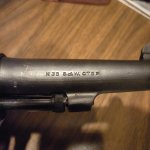
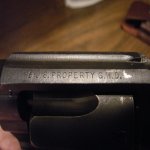




Look at the proof mark, and the case length stamped on the barrel.
Note the .38 S&W Ctge. stamped on the barrel.
Oh crap I missed that. I just assumed the guns were a 38 Special as that was the caliber of the 4" models. As these are in 38 S&W (would have been 5" originally) that barrel at TradeEx would be a perfect replacement.
Cheers
Moe






















