http://www.hodgdonreloading.com/reloading-education/safety/gunpowder-stability
[h=1]Gunpowder Stability[/h] Reloading ammunition is a great hobby and saves money. Commodity cost increases in brass and lead in recent years have resulted in many new and/or returning reloaders trying to stretch their budget.
The following information is provided as an introduction on the stability, storage, and safe handling of modern smokeless propellant.
[h=3]Smokeless Propellant[/h]
The main ingredient of smokeless propellant, comprising from about 55% to 90% of the composition, is nitrocellulose. The process of creating nitrocellulose leaves remnant acid in the material. This acid immediately starts decomposing the finished product. Left alone the decomposition will reach the stage where the propellant becomes unstable and self-ignites. This process resulted in massive explosions at U.S. Government arsenals after World War I.
To increase the life of the smokeless propellant, a stabilizing chemical is used. This “stabilizer” reacts with the acid to slow down the decomposition process. However, as the stabilizer reacts with the acid it is consumed. After the stabilizer is totally consumed, the propellant is no longer protected from the internal acid.
The entire stabilizer / decomposition process is a time and temperature function – the higher the temperature, the shorter the safe life of the powder. Even moderate temperature, over extended time, leads to propellant decomposition. As a rule of thumb, any temperature over that which is comfortable to a person is accelerating the decomposition of smokeless propellants.
Under proper storage, modern smokeless powder can last for decades. However, this does not mean the reloader can ignore how the powder is stored, particularly if in an uncontrolled environment such as a garage or storage building.
http://www.alliantpowder.com/getting_started/safety/storage_handling.aspx#Anchor-How-47857
[h=2]How to Check Smokeless Powder for Deterioration (clip) the URL has way more info[/h]
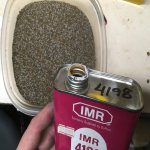
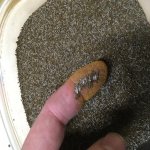
Although modern smokeless powders are basically free from deterioration under proper storage conditions, safe practices require a recognition of the signs of deterioration and its possible effects.
Powder deterioration can be checked by opening the cap on the container and smelling the contents. Powder undergoing deterioration has an irritating acidic odor. (Don't confuse this with common solvent odors such as alcohol, ether and acetone.)
Check to make certain that powder is not exposed to extreme heat as this may cause deterioration. Such exposure produces an acidity which accelerates further reaction and has been known, because of the heat generated by the reaction, to cause spontaneous combustion.
Never salvage powder from old cartridges and do not attempt to blend salvaged powder with new powder. Don't accumulate old powder stocks.
The best way to dispose of deteriorated smokeless powder is to burn it out in the open at an isolated location in small shallow piles (not over 1" deep). The quantity burned in any one pile should never exceed one pound. Use an ignition train of slow burning combustible material so that the person may retreat to a safe distance before powder is ignited.