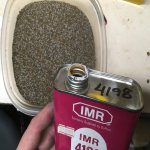
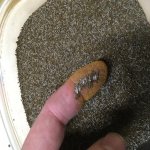
What deteriorated powder looks like - pictures

Longwalker

CGN Ultra frequent flyer
Super GunNutz
Rating - 100%
216   0   2
Location
Saskatchewan
I was loading a bunch of .222 last week and dug out two sealed cans of IMR 4198 that I had bought at a garage sale a couple years ago. Seems my "good buy" wasn't such a great deal after all. Inside of the metal cans were rusty, and the powder itself was full of a rust-like dust. It didn't smell as strong as I expected, a couple other times I've had old power spoil it smelled sharp and acidic. But definitely spoiled. Into the fire it goes - in small quantities.
 

Attachments

  • IMG_8770.jpg
    IMG_8770.jpg
    80.1 KB · Views: 754
  • IMG_8771.jpg
    IMG_8771.jpg
    146.1 KB · Views: 756
Man that sucks. I've never had powder come in steel containers like that, it's always in plastic. 20 yrs plus and it fires perfect.

Corey
 
I have had some IMR 3031 and some IMR 4831 that went just like that.
Also had a big batch of Higginsons 4350 OEM [VV N160] that went bad,
but in an entirely different way. The plastic bags it was in showed small
droplets inside that was some very corrosive acid. The cardboard boxes
the bags were in literally fell apart from the acid, and all ferrous metal
objects in close proximity were rusted badly. I burned over 20 lbs of that
in my firepit outside. Dave.
 
If it's just a bit rust from the can try to sieve it or see if a paper towel picks up the rust particles or something and put in a plastic container. Might work, is worth a try.
 
Ganderite, I respect your opinion, but won't be using that powder. I loaded up about 800 .222 cartridges in my last session with 4198, which may last me another 10 years or so at my current shooting rates with my .222 rifles. I don't want to store cartridges that long that are loaded with powder that may be continuing to degrade in the case. The inside of both powder cans were rusty, but they had been perfectly sealed, unopened, and the rust was not just on the surface, but all throughout the powder.
I have seen that same condition once before ( about 30 years ago ) with some Higginsons "44" powder ( 3031 equivalent) that was packaged in cardboard cartons, the can lids were also rusty, but more than that, rust coloured dust was distributed all through the powder. Way more than would have come off the can lid. Just like both cans in this lot of IMR4198. Acidity of that powder caused corrosion of bullet bases inside the loaded .308 ammo and velocities were erratic. I also worried about corroding the bore of my rifles with the acid produced as the powder degrades. I cleaned the bores of my rifles very soon and thoroughly after shooting, and no harm came to my rifles. Maybe acid would just be burned up when the powder ignites, but i'm not taking that chance.

Sharp Shooter, your Sako is one of three .222 rifles that I use and cherish. Thanks for passing it along!
 
I would try a few loads, but if you want to get rid of it, it makes an excellent fertilizer. Just make sure you don't toss a butt in the garden before it gets washed into the soil.
 
I was thinking, as I suggested "Load it" that I should also say "But shoot it right away."

Load it for a 45-70. And shoot.

That would actually fit my plans for some of the powder. I have a bunch of cast bullets for my 45-70 that should be burnt up too. shoot and clean immediately. I could do that. Thanks for the suggestion.
 
Last edited:
"My" rust would evaporate when I opened the bag or jug, and reappear quickly when they were closed...
 
I have encountered powder like the OP's a couple of times from my old man's stash after he passed. Like Ganderite, I used it but I "winnowed" the rust dust out of it on a windy day before I did use it.
 
Try a strong magnet to see is rust will be picked up. Attraction will be weak, so drop the magnet into the powder.
 
Last edited:
http://www.hodgdonreloading.com/reloading-education/safety/gunpowder-stability
[h=1]Gunpowder Stability[/h] Reloading ammunition is a great hobby and saves money. Commodity cost increases in brass and lead in recent years have resulted in many new and/or returning reloaders trying to stretch their budget.
The following information is provided as an introduction on the stability, storage, and safe handling of modern smokeless propellant.
[h=3]Smokeless Propellant[/h] The main ingredient of smokeless propellant, comprising from about 55% to 90% of the composition, is nitrocellulose. The process of creating nitrocellulose leaves remnant acid in the material. This acid immediately starts decomposing the finished product. Left alone the decomposition will reach the stage where the propellant becomes unstable and self-ignites. This process resulted in massive explosions at U.S. Government arsenals after World War I.
To increase the life of the smokeless propellant, a stabilizing chemical is used. This “stabilizer” reacts with the acid to slow down the decomposition process. However, as the stabilizer reacts with the acid it is consumed. After the stabilizer is totally consumed, the propellant is no longer protected from the internal acid.
The entire stabilizer / decomposition process is a time and temperature function – the higher the temperature, the shorter the safe life of the powder. Even moderate temperature, over extended time, leads to propellant decomposition. As a rule of thumb, any temperature over that which is comfortable to a person is accelerating the decomposition of smokeless propellants.
Under proper storage, modern smokeless powder can last for decades. However, this does not mean the reloader can ignore how the powder is stored, particularly if in an uncontrolled environment such as a garage or storage building.


http://www.alliantpowder.com/getting_started/safety/storage_handling.aspx#Anchor-How-47857
[h=2]How to Check Smokeless Powder for Deterioration (clip) the URL has way more info[/h]
Although modern smokeless powders are basically free from deterioration under proper storage conditions, safe practices require a recognition of the signs of deterioration and its possible effects.
Powder deterioration can be checked by opening the cap on the container and smelling the contents. Powder undergoing deterioration has an irritating acidic odor. (Don't confuse this with common solvent odors such as alcohol, ether and acetone.)
Check to make certain that powder is not exposed to extreme heat as this may cause deterioration. Such exposure produces an acidity which accelerates further reaction and has been known, because of the heat generated by the reaction, to cause spontaneous combustion.
Never salvage powder from old cartridges and do not attempt to blend salvaged powder with new powder. Don't accumulate old powder stocks.
The best way to dispose of deteriorated smokeless powder is to burn it out in the open at an isolated location in small shallow piles (not over 1" deep). The quantity burned in any one pile should never exceed one pound. Use an ignition train of slow burning combustible material so that the person may retreat to a safe distance before powder is ignited.

 
Sharp Shooter, your Sako is one of three .222 rifles that I use and cherish. Thanks for passing it along!

I have since bought a Browning Safari grade heavyweight and it shoots even better with same dose of iMR4198 and 40gr Nosler Ballistic Tips. Thank God because I was really regretting selling that for a very long time. Please tell her i said hi.
 
Back
Top Bottom