What do you do?

daveg01

CGN Ultra frequent flyer
Rating - 100%
27   0   0
Location
Lanark, BANtario
So, for the first time I have now 2 rifles in the same caliber (.270). One for me and one for the wife/son.

I'm about to start working up some loads for the second rifle. I'm assuming that the new rifle's sweet spot will be a different load than for the first rifle.

How do you guys that load for multiple rifles in the same caliber store the rounds so you don't mix them up? Do you just mark the box/container?

Anyone come up with an innovative way to keep them separate?
 
So, for the first time I have now 2 rifles in the same caliber (.270). One for me and one for the wife/son.

I'm about to start working up some loads for the second rifle. I'm assuming that the new rifle's sweet spot will be a different load than for the first rifle.

How do you guys that load for multiple rifles in the same caliber store the rounds so you don't mix them up? Do you just mark the box/container?

Anyone come up with an innovative way to keep them separate?


Magic marker or nailpolish.
Marker the face of the complete cartridge. Or Use nailpolish as a "sealer" for primers, Choose your colours. Black for you, Blue for the wife/son.

Separate containers helps as well. Perhaps even different sorted headstamping...

Several methods available.
 
I have two separate loads for my .270 (130 gr vs 90 gr). To make it obvious to me which is which, I use different cases for each load. Brass for the 130 gr and nickle plated for the 90 gr.
 
Nail Polish or Colored Sharpie's have been my preferred method. Mark the Primer and you are good to go.

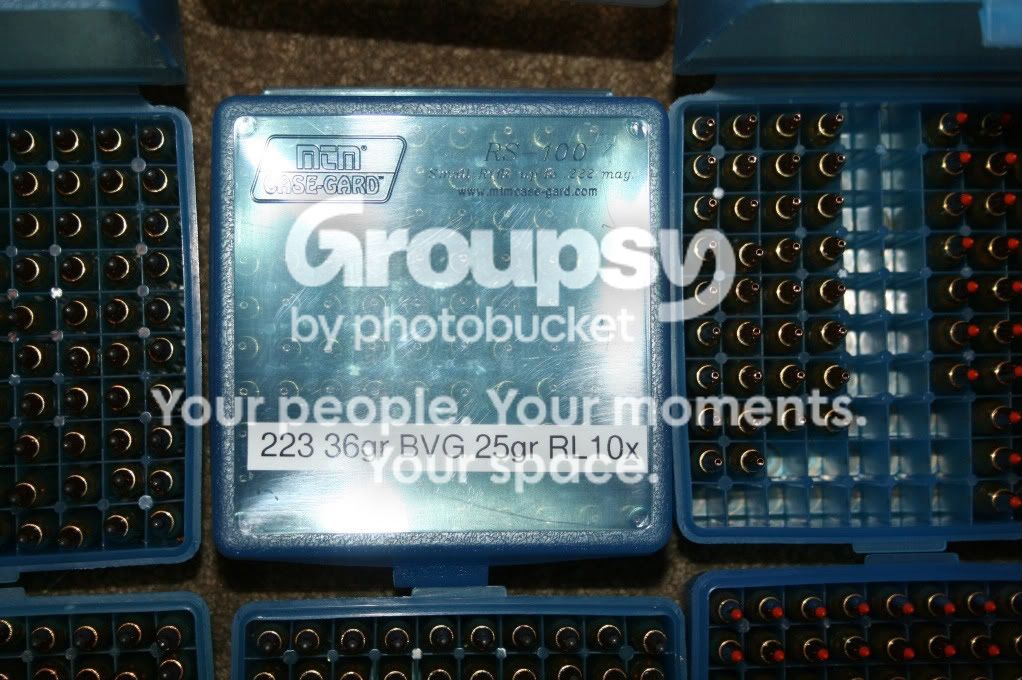
I also keep them in seperate (and well labelled) plastic boxes - they hold 50 handgun or 20 rifle rounds (though i can squeeze 50 22 Hornet's or 223's into the handgun cartridge boxes if I need to).

I use these boxes for storing all my reloads, reqardless of caliber. Makes lifeeasier to find them when i grab a random gun to go shooting with. A Label maker works well for ID on the shelf, and I always leave a copy of the "recipe" for each load inside the box.
 
Like others have said, and like commercial ammo makers do, label the boxes clearly. Go into any gun store and look at the boxes of different loads, calibre, bullets, etc. All the boxes have labels and colours that clearly state what is inside. If it will work for 387 (or whatever) different loads in a store, it will work for me.
 
I use a label maker and different coloured MTM boxes.
IMG_6894.jpg
 
If you went to the store to buy ammunition for the rifles, would you specifie, "This is for gun A, and I want a box also, for gun B, and expect different ammo?
Funny, isn't it. If you were not a handloader you would just buy 270 ammo of the weight bullet you wanted, take your two rifles out and sight them in.
Why wouldn't you do this with your handloads?
Oh, I just remembered why. You've been reading about those "nodes", "sweet spots" and "UFOs."
If your rifles are properly bedded, they will shoot well with any good ammunition, provided they have good barrels and no other manufacturing fault.
If you doubt it, think of this. A team of ten shooters is representing their country in an international shooting match. Do you think each rifle in the team will have ammunition suited to only it? Of course not. Further more, the match ammunition they use will be loaded heavier than off the shelf ammo of the same calibre.
While practicing, if one rifleman's rifle isn't shooting as well as he/she thinks it should be shooting, does that rifleman call for ammunition that suits his/her rifle? Of course not. The rifle is turned in to the armourer, for tune up, or replacement.
Getting back to your two 270s, I would test each rifle as to the maximum load it can safely take. I would then load the ammo a bit lighter.
I would carefully test each rifle at the range, by shooting a group of five shots, one after the other, so the barrels got quite hot. A rifle that walked the bullets in the five shot groups would be taken in for bedding.
When both rifles shoot good groups, without changing poi as the barrels warmed, you are good to go, with any good ammo.
 
If you went to the store to buy ammunition for the rifles, would you specifie, "This is for gun A, and I want a box also, for gun B, and expect different ammo?
Funny, isn't it. If you were not a handloader you would just buy 270 ammo of the weight bullet you wanted, take your two rifles out and sight them in.
Why wouldn't you do this with your handloads?
Oh, I just remembered why. You've been reading about those "nodes", "sweet spots" and "UFOs."
If your rifles are properly bedded, they will shoot well with any good ammunition, provided they have good barrels and no other manufacturing fault.
If you doubt it, think of this. A team of ten shooters is representing their country in an international shooting match. Do you think each rifle in the team will have ammunition suited to only it? Of course not. Further more, the match ammunition they use will be loaded heavier than off the shelf ammo of the same calibre.
While practicing, if one rifleman's rifle isn't shooting as well as he/she thinks it should be shooting, does that rifleman call for ammunition that suits his/her rifle? Of course not. The rifle is turned in to the armourer, for tune up, or replacement.
Getting back to your two 270s, I would test each rifle as to the maximum load it can safely take. I would then load the ammo a bit lighter.
I would carefully test each rifle at the range, by shooting a group of five shots, one after the other, so the barrels got quite hot. A rifle that walked the bullets in the five shot groups would be taken in for bedding.
When both rifles shoot good groups, without changing poi as the barrels warmed, you are good to go, with any good ammo.

Thank you H4831.
My sentiments exactly. We have 2 270s and 2 243s also. We found a load that works for each calibre and sight in the rifles accordingly.
That way the 270 ammo will work in either 270 and the same with the 243 ammo.
 
The OP stated that one .270 is his, the second is for his wife/son. No mention of age, bullet mass, etc...

Did you ever think the loads are different due to reduced power?
100% versus 80% loads using the same components?
 
All good suggestions!

I may end up running lighter loads for the second rifle - we'll see how they like the .270 on the recoil front. Not that its a huge recoil, but my wife is 5'2" and my son is 12 years old so their experience will dictate which way I end up going.

If not I will end up running the same load through both of them in the long run. I'm only looking for "minute of deer" accuracy at this point so like H4831 says as long as the rifle groups I should be fine. I'm not looking to fine tune the load to tighten up .5 MOA or something like that.

It was more of a generic question as this is the first time I'm loading for 2 rifles in the same caliber.
 
My limited experience on this;
I have a CZ527 24" 9" twist and a Rem 7615 16" also 9". I have yet to find a load with bullets from 55gr to 70gr that shoots so terribly in one that I won't use it. For the most part the POI is close in each rifle with the different loads. So I shoot 223 interchangeably in both rifles, adjust scope as required. These are neck sized brass shot in both rifles, I use a body die after a couple of loadings to get reliable chambering in either rifle. My .02.;)
 
A notch can be cut in the rim of the brass with a dremel and small zip-disk. The notched brass can be assigned to one gun, thereby identifying the load, and always using the brass in the same chamber.
 
All good suggestions!

I may end up running lighter loads for the second rifle - we'll see how they like the .270 on the recoil front. Not that its a huge recoil, but my wife is 5'2" and my son is 12 years old so their experience will dictate which way I end up going.

If not I will end up running the same load through both of them in the long run. I'm only looking for "minute of deer" accuracy at this point so like H4831 says as long as the rifle groups I should be fine. I'm not looking to fine tune the load to tighten up .5 MOA or something like that.

It was more of a generic question as this is the first time I'm loading for 2 rifles in the same caliber.

Any factory ammo is capable of "minute of deer' so why reload if you are not looking to maximize your rifles potential.
 
I write on the different loads with a sharpie, as sometimes mine and her loads end up in the same cup holder, a little brake clean at reloading time cleans the shells up so they don't need to be kept seperated then.
 
Any factory ammo is capable of "minute of deer' so why reload if you are not looking to maximize your rifles potential.

Because it is 1/2 the price? Laugh...
Lets assume he is a big 270 shooter and shoots 3 boxes of ammo a year. (far more than most hunters)

Box of cheap 270 hunting ammo (Aka Federal Classic) is still $1.25 per round.
After the first 3 boxes. Cheap Press. And ammo components.
Investment.
Press and case care tools, $300.
$75 in brass, 60 pcs, good for say 5 loads.
$35 a pound of Powder (Load is say 60 grns) equates to 110 loads. = $0.32 per load
Primers, $50 per thou = $0.05 per load
Cheap hunting bullets $25 per 100. $0.25 per load.

So, you will have.
Year One. 60 rounds factory = $75
Year Two. Press for $300, reload cost at $0.62 per round. Saving $0.62 from factory, or $37.20 a year savings.
Brass is good for 5 years worth of shooting.

So 6 years of factory ammo = $450
6 years of reloads (including original factory ammo cost) = $75 + $186 reloads = $261 Nearly $200 savings.
This is where the $300 initial reloading equipment investment comes in... as it would take 8 years of reloads to recoup original costs.

I personally believe that if you only shoot a total of 100 rounds or less a year, reloading is not really a cost effective option...

Of course I do it for the meditation time on the single stage :)
 
Common Bruce, don't you know that each barrel will have different harmonics?

Ben, I'm well aware of barrel vibrations as the bullet goes through the barrel, that is why I stress the rifles have to be properly bedded.
Going to my "bible" on accuracy, the book by Warren Page, I will type this bit that is on two pages, or else I would post a copy.
The Accurate Rifle, by Warren Page, on pages 140 and 141, referring to bedding sporting type rifles.

"Then the barrel groove is cut out so that out at the fore-end tip enough wood is left so the forestock pushes up against the barrel with pretty fair pressure, enough to require signicicant effort to seperate barrel and forestock tip. The theory is that this pressure will cut the peaks and hollows off the vibrations of a relatively slender barrel and relatively violent cartridge."
 
“If you doubt it, think of this. A team of ten shooters is representing their country in an international shooting match. Do you think each rifle in the team will have ammunition suited to only it? Of course not. Further more, the match ammunition they use will be loaded heavier than off the shelf ammo of the same calibre.”

Well, as a shooter, and coach and a team officer on a number of national and international rifle teams, I can assure you that each rifle is different and has its own loads.

If we go to a match where the ammo is supplied and all teams use the same issued ammo, we take several rifles per shooter and each shooter tests the ammo in his guns to find the rifle that likes the ammo. The differences can be startling. I remember going to Bisley one year and discovering that one of my rifles was a tack driver with ammo that most of the other 1000+ shooters found to be mediocre. My rifle grouped around 1 minute with ammo that was 2 to 3 minutes in most other rifles. At 900 and 1000 yards, I missed the bull only twice that week. I won the competition with a record high score.

If the competition is a “bring your own ammo” event, the team executive will specify which bullet the shooters should use (currently the Berger 155.5) and each shooter will develop the load that works best in his rifle. Favourite powders in 308 are VHTN140, N150 and Varget, with a few RL15.

Velocities (pressures) are hot. We are getting around 3,000 fps (30” barrels) but it is interesting to note that the variations in rifles is such that this velocity is obtained with powder charges varying by 2 grains.

My ammo in Pat’s rifle would be very mild and his ammo in my rifle would blow the primer clear out and ruin the brass. Different rifles. Same make of barrels, similar reamers. Seen it so many times I have stopped questioning it and just accept it.

A team will typically field 40 to 50 top notch rifles. If you have been involved with many teams one develops a lot of experience in comparing what would look like identical rifles. The only thing identical about them is that they all accept the same factory round. The results are all over the place, unless each is fed the ammo developed for it.

To answer the OP question, I use 50 round plastic boxes with masking tape/Sharpie labels. I have quite a few rifles in some calibers, so each rifle has its own ammo.

In the case of hunting rifles, I have fewer duplicate caliber rifles, so it may be that the two or three rifles use different bullets, so in addition to the box labels, each round can be classified as to what rifle it belongs to.

I only have two 270's and as it happens, when I bought brass on two occassions, the first 100 were brass and the second 100 were nickle, so that makes it easy not to confuse the ammo.

On a hunting trip, mixed ammo could be a disaster. Especially so if any of the ammo is neck-sized only.

Another thing to watch out for is headstamped calibers not matching the round. My 8mm ammo is all made with 7x57mm brass.

I have used 308 brass to make 243, 7-08, 6.5-08, 358 and even 356.

 
Last edited:
“If you doubt it, think of this. A team of ten shooters is representing their country in an international shooting match. Do you think each rifle in the team will have ammunition suited to only it? Of course not. Further more, the match ammunition they use will be loaded heavier than off the shelf ammo of the same calibre.”

Well, as a shooter, and coach and a team officer on a number of national and international rifle teams, I can assure you that each rifle is different and has its own loads.

If we go to a match where the ammo is supplied and all teams use the same issued ammo, we take several rifles per shooter and each shooter tests the ammo in his guns to find the rifle that likes the ammo. The differences can be startling. I remember going to Bisley one year and discovering that one of my rifles was a tack driver with ammo that most of the other 1000+ shooters found to be mediocre. My rifle grouped around 1 minute with ammo that was 2 to 3 minutes in most other rifles. At 900 and 1000 yards, I missed the bull only twice that week. I won the competition with a record high score.

If the competition is a “bring your own ammo” event, the team executive will specify which bullet the shooters should use (currently the Berger 155.5) and each shooter will develop the load that works best in his rifle. Favourite powders in 308 are VHTN140, N150 and Varget, with a few RL15.

Velocities (pressures) are hot. We are getting around 3,000 fps (30” barrels) but it is interesting to note that the variations in rifles is such that this velocity is obtained with powder charges varying by 2 grains.

My ammo in Pat’s rifle would be very mild and his ammo in my rifle would blow the primer clear out and ruin the brass. Different rifles. Same make of barrels, similar reamers. Seen it so many times I have stopped questioning it and just accept it.

A team will typically field 40 to 50 top notch rifles. If you have been involved with many teams one develops a lot of experience in comparing what would look like identical rifles. The only thing identical about them is that they all accept the same factory round. The results are all over the place, unless each is fed the ammo developed for it.

To answer the OP question, I use 50 round plastic boxes with masking tape/Sharpie labels. I have quite a few rifles in some calibers, so each rifle has its own ammo.

In the case of hunting rifles, I have fewer duplicate caliber rifles, so it may be that the two or three rifles use different bullets, so in addition to the box labels, each round can be calssified as to what rifle it belongs to.

I only have two 270's and as it happens, when I bought brass on two occassions, the first 100 were brass and the second 100 were nickle, so that makes it easy not to confuse the ammo.

On a huntign trip, mixed ammo could be a disaster. Especially so if any of the ammo is neck-sized only.

Another thing to watch out for is headstamped calibers not matching the round. My 8mm ammo is all made with 7x57mm brass.

I have used 308 brass to make 243, 7-08, 6.5-08, 358 and even 356.

How about military shooting teams?
A good friend of mine once went to Bisley as a team member. They used the rifles and ammo given to them.

 
The military teams use issue rifles and issue ammo. I do not know if they have extra rifles in case someone's rifle doesn't like the ammo. I would expect a well run team to have spare rifles, "just in case".

Bear in mind that my comments were intended to say that each rifle is different and will shoot better or worse, depending on the ammo. The significance of better or worse depends on the application. The differences might be lost in the noise of the vagaries of the average hunting rifle.

For a world championship shooting match the differences we think important are probably considered small for minute of moose applications.
 
Back
Top Bottom