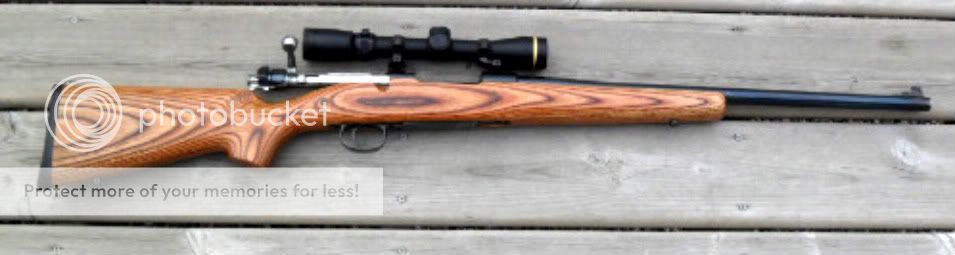
What is the advantage of big bore caliber 45-70

45-70 introduced in 1873 now its 2011 so that is 138 years and still going strong
I have 4 of them in the safe clearly one of my favourites, they can be loaded for anything from mice to elephants ,very cast bullet friendly, huge bullet selection, terrific penetration (if the right bullet is used) and it hardly needs to expand and still makes a big hole!! That is why its a great one after all these years.

+1

The 45-70 is fun to shoot! w:h:

I have an 1895XLR with DRC GRS. I love it! I use it for moose hunting and making it feel like it's raining at the range when I hit a 4 litre water bottle!

I blame mudgunner49 for my 45-70 addiction ;)
 
Think of it like this. The .308 is a sports car and the 45-70 is a freight train. Which will do more damage to a cement wall. A sports car going 150 mph or the train going 50mph.
The car hits the wall and splatters, the train hits and just keeps on rolling.
 
In 1870-71 or thereabouts, when the US was looking for a new cartridge to replace the 50-70 that was their military round at the time, one of the requirements was that the new round be capable of killing a horse at a mile
They chose the 45-70, using a 500 grain lead bullet at around 1250 fps or so
 
They are big and fun to shoot :)
I bought a marlin 1895 and love it, I prefer the pistol grip to the straight stock, but thats just me. Out of all of my guns, that is the one I know I will never ever sell. Never.
 
He hit it right on the head.

X2. I really like my Marlin 1895GS in 45-70 but I'd like it even more if it had a pistol grip stock. With some of the hotter loads using the heavier bullets available, it can be a little rough on the fingers.

Marlin1895GS45-70.jpg
 
Yes, there is something about a big heavy bullet... A previous post had mentioned to essentially take the calculated ft/lbs energy thing with a grain of salt, as it favors velocity... Well, I had been thinking exactly that based on real world experience! I have shot or seen deer/bear shot with 6mm rem, 25-06, 270, 7-08, 7mmRM, 308, 30-06, 300WM, and 325 WSM as well as 12gua slugs.... with my own eyes, i have never seen anything drop a bear or deer (yet) under 50yds that remotely comes close to what a 12gua slug can. It just knocks them down, simple as that. Dead. Yes, If a grizz was charging me, i would feel 100% confident in an old imperial paper 1oz slug...

I do think there is more to it than calculated numbers regarding energy and such - but i dont know what - all I know, from what I have seen, is that as one goes up in caliber, regardless of hyper-velocity, with a good hit within range for selected caliber, bigger has serious knockdown...

my $00.02!!!!
 
If you believe in Taylor Knock Out values(TKO) the 45/70, when loaded with 480gr. cast bullets, is tied with the .416 Rem. in power. The TKO does not take into account bullet expansion, that is just as well because it is such a variable on game. One real surprise in my testing is how effective 500-600grain SOFT CAST bullets are on game, devastating!!
 
It's a fun chambering to shoot, big boom and lot's of recoil. It hit's game like a freight train! Not meant for long range shooting in a guide gun, but people are using them for long range shooting in different style guns.

I use mine for fun and as a good gun to take in big bear country. You're in Quebec? It may be hard to justify one for bear defense, if you really want a lever gun then a .30/30 would do just fine. If you are after a fun toy you can hunt with, get the .45/70!

I prefer mine with a pistol grip so I did this to my guide gun...

IMG_19872.JPG
 
SAM_0008-2-2-1.jpg

458 X 2inch American, just because I can!

BTW, it's dependable, accurate, fun and loud, on a solid/safe Mauser K98 action with spare parts aplenty.
Can use smokeless, black powder, cast or copper jacketed. Handload to your heart's content (even birdshot loads) & I can convert ANY discarded H&H Magnum case for my needs. This can stomp any critter native to our continent into the dirt 3 times before reloading. What's not to love?
 
The wound volume on a live target is essentially a by-product of bullet diameter, bullet weight, and velocity. Of these 3 elements bullet diameter, or rather a bullet's frontal area, is by far the most important. If this was not the case there would be less effort in designing bullets that expand reliably. The majority of the very best big game bullets available produce about 1.5X expansion, and retain a large amount of their original weight, some 85-90%, which produces sufficient momentum to ensure deep, straight line penetration, but more on that later.

If we compare the frontal area of .308" and .458" bullets we get .024 square inches for the .308 and .052 square inches for the .458. That means that the .458 will displace a little more than twice the tissue and bone as it moves through the target, than will a .308, all else being equal. But what about velocity, a .308 bullet might be twice as fast as one fired from a .45/70! This is true, but it will also be lighter, so the momentum is created by velocity rather than mass. It is possible that the .308 bullet and the .45/70 bullet will penetrate equally in a game animal, it is equally possible that both bullets will exit, particularly on a broadside shot, provided both bullets perform as designed. Provided a bullet is supersonic when it hits it's target, a shock-wave crushes and displaces soft tissue and again the bullet with the greater frontal area produces the largest displacement of tissue, and the advantage of 1000 fps for a small bore doesn't make up for the frontal area of the large bore, although an impact velocity of about 2000 fps seems to maximize the potential of the shock-wave. You might point out that varmints are virtually blown to pieces by high velocity impacts by light weight bullets from .17s and .22s. But those bullets are designed to virtually explode on contact with targets of very light resistance. Such a bullet would produce a nasty but superficial wound on a big game animal. When bone is hit by a properly designed big game bullet, the shock-wave has no effect other than to scatter bone fragments in it's wake. A shock-wave will not break bone, but a bone hit by a larger bullet produces a more complex wound, as a larger volume of bone is scattered through the tissue, resulting in greater bleeding.

Straight line penetration is important to ensure that the bullet damages the vital organs we intend it to. If your bullet enters the target and deflects following a path of least resistance, it may not damage the heart or lungs, the result being a wounded animal who will take longer to succumb to its wound. Bullets kill by interrupting the flow of blood enriched with oxygen to the brain, without oxygen the brain dies, and this might happen quickly or slowly depending on the damage our bullet does. To that end, expansion produces several advantages: it makes a larger wound due to its increased size, the center of gravity of the bullet moves forward making the bullet more stable, and the bullet becomes shorter which again aids in stability provided it retains a linear axis to rotate around. If the bullet shortens too much and lo linear shank is left, stability is lost.

 
The variable Boomer is missing is the explosive force created from higher velocity rounds and rapidly expanding bullets. A rapidly expanding bullet will have a much larger wound diameter than the frontal area of the bullet in the "primary" (first portion) wound channel. Once the bullet stops "exploding" then all that Boomer suggests about wound diameters comes true.


To put it in real terms.

My 270 creates a much larger primary wound diameter then my 45-70. However after a few inches (about 6) my 45-70 creates a much larger secondary wound diameter than the 270. The lighter the game (like deer) the more apparent this is.

So, if you want to shoot a deer in the ribs, the 270 will make a bigger wound in the vitals.

If you want to shoot a moose in the shoulder the 270's explosive primary wound diameter will be "used up" in the shoulder and by the time it gets to the vitals you will be relying on frontal area to do the work. In this case the 45-70 with it's large frontal area will make a bigger wound in the vitals.


FWIW the reason a gopher "explodes" when shot with your 22-50 is because the wound diameter is larger than the animal.
 
The wound volume on a live target is essentially a by-product of bullet diameter, bullet weight, and velocity. Of these 3 elements bullet diameter, or rather a bullet's frontal area, is by far the most important. If this was not the case there would be less effort in designing bullets that expand reliably. The majority of the very best big game bullets available produce about 1.5X expansion, and retain a large amount of their original weight, some 85-90%, which produces sufficient momentum to ensure deep, straight line penetration, but more on that later.

If we compare the frontal area of .308" and .458" bullets we get .024 square inches for the .308 and .052 square inches for the .458. That means that the .458 will displace a little more than twice the tissue and bone as it moves through the target, than will a .308, all else being equal. But what about velocity, a .308 bullet might be twice as fast as one fired from a .45/70! This is true, but it will also be lighter, so the momentum is created by velocity rather than mass. It is possible that the .308 bullet and the .45/70 bullet will penetrate equally in a game animal, it is equally possible that both bullets will exit, particularly on a broadside shot, provided both bullets perform as designed. Provided a bullet is supersonic when it hits it's target, a shock-wave crushes and displaces soft tissue and again the bullet with the greater frontal area produces the largest displacement of tissue, and the advantage of 1000 fps for a small bore doesn't make up for the frontal area of the large bore, although an impact velocity of about 2000 fps seems to maximize the potential of the shock-wave. You might point out that varmints are virtually blown to pieces by high velocity impacts by light weight bullets from .17s and .22s. But those bullets are designed to virtually explode on contact with targets of very light resistance. Such a bullet would produce a nasty but superficial wound on a big game animal. When bone is hit by a properly designed big game bullet, the shock-wave has no effect other than to scatter bone fragments in it's wake. A shock-wave will not break bone, but a bone hit by a larger bullet produces a more complex wound, as a larger volume of bone is scattered through the tissue, resulting in greater bleeding.

Straight line penetration is important to ensure that the bullet damages the vital organs we intend it to. If your bullet enters the target and deflects following a path of least resistance, it may not damage the heart or lungs, the result being a wounded animal who will take longer to succumb to its wound. Bullets kill by interrupting the flow of blood enriched with oxygen to the brain, without oxygen the brain dies, and this might happen quickly or slowly depending on the damage our bullet does. To that end, expansion produces several advantages: it makes a larger wound due to its increased size, the center of gravity of the bullet moves forward making the bullet more stable, and the bullet becomes shorter which again aids in stability provided it retains a linear axis to rotate around. If the bullet shortens too much and lo linear shank is left, stability is lost.


Good info Boomer and thanks for sharing.
 
I don't focus to much on energy, its a formula that is mostly based on velosity. The .458's have a huge advantage in diameter.The 308 kills very well, there is just something about the bigger bores :) When going for blood tests would you prefer a thin needle inserted quickly or a thick needle inserted slowly.... LOL :)
 
Absolutely grit. The continued crowing about muzzle energy by the high velocity crowd is based on the formula E=MVsquared. This puts too much emphasis on high velocity. The .45/70 with a bullet over 400 grains hits home with smashing power. It penetrates deeply with a straight wound channel. As far as tissue destruction goes, it is far superior to any high velocity round. My grandfather's hunting pal used on for years and used to say on deer and moose," You can eat right up to the hole."


The muzzle energy fixation led a young engineer friend of mine to use steel high velocity loads in his first gun, a 12 gauge pump, on ruffed grouse and rabbits. He figured out the muzzle energy versus standard lead loads and announced that the high velocity steel had more killing power. Try to tell that to a duck hunter forced to use steel shot. The steel sheds it's velocity faster and has less mass resulting in lower effectiveness on game.
 
Back
Top Bottom