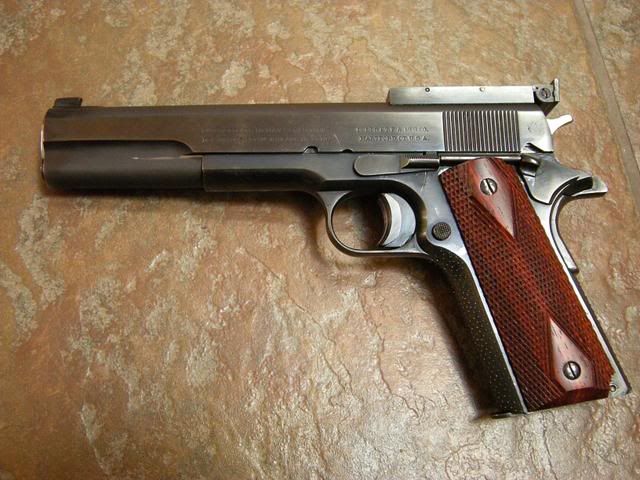
What is the sole purpose of......

The extra barrel length would (at least in theory) improve accuracy and the extra length of the slide and barrel combined will add weight to the front of the gun thereby reducing recoil making for quicker follow-up shots.
 
"Longslide" 1911's....

So, they can make a "long slide" 1911. You get a longer site radius with the longer slide/barrel setup. Was a popular 'conversion' at one time for bullseye and pin guns. You still see it, but not as much any more.

I have an original Colt 1911 commercial government model, mfg in 1914, that someone turned into a longslide, probably 25 years ago or so. 'Smithing job is extremely well done & cost to do something like this today would be up there. But what a way to ruin a piece of history. :(

ColtLS05-1.jpg


That said, I recently shot this oldie and it groups very well at 25 yards.
 
The extra barrel length would (at least in theory) improve accuracy and the extra length of the slide and barrel combined will add weight to the front of the gun thereby reducing recoil making for quicker follow-up shots.

Actually, this is purely a perception thing. The longer barrel doesn't contribute in any measurable way to mechanical accuracy, whereas the longer sight radius does contribute to "realized" accuracy, so it may seem to many people that it does. A small wobble on a site radius of 5" gives a much different result than the same perceived wobble on a 6" radius. The closer the front sight is to the wobble axis (your wrist), the larger the deflection will be with the same relative sight picture.

In terms of recoil, the best way to add weight to a gun for recoil dampening is to do it in the non-reciprocating mass, ie: the frame. That is why we see heavy dust covers on guns now. If the extra weight is reciprocating, it will have momentum, which will tend to try and carry the muzzle higher...or at least continue the recoil impulse over a longer duration. Lighter slides cycle faster and return faster and have less momentum, but go too light and it can get pretty violent and disruptive. Note also that the further the added weight is from your hand, the harder it is to steer the gun. It's just leverage working against you.

To me the extra in of radius doesn't equate to better over-all performance because of the more sluggish feel in cycling and handling. But as an IPSC shooter, the speed at which the gun returns to neutral is more important to me than a small increase in potential accuracy (that I can wring out of the gun with good technique anyway if I need it). Depending on what you want to use the gun for, your mileage may vary. If it's to be a bulle eye gun, the recoil duration doesn't matter.

 
Note also that the further the added weight is from your hand, the harder it is to steer the gun. It's just leverage working against you.


True, and while this is a liability in IPSC shooting, it is usually considered a benefit in bullseye, where dampening the movement of the muzzle aids in stability of the sight picture, and recovery from recoil during timed and rapid fire. This is why so many bullseye guns have muzzle weights.
 
Cool.....thanx guys. I knew if i asked id get awesome answers


Now for this question

What is the difference, IF ANY, between a 1911 Government frame and the Commander frame? Basically, can you put a Commander slide assembly onto a Government frame?
 
The dust cover is slightly shorter on a Commander frame. You CAN put a commander slide on a Gov frame, however, it will look a little wonky as the dust cover will extend past the contour of the slide.

The other way around (gov slide on comm. frame) will leave a 'gap' between the contour and dust cover.
 
Back
Top Bottom