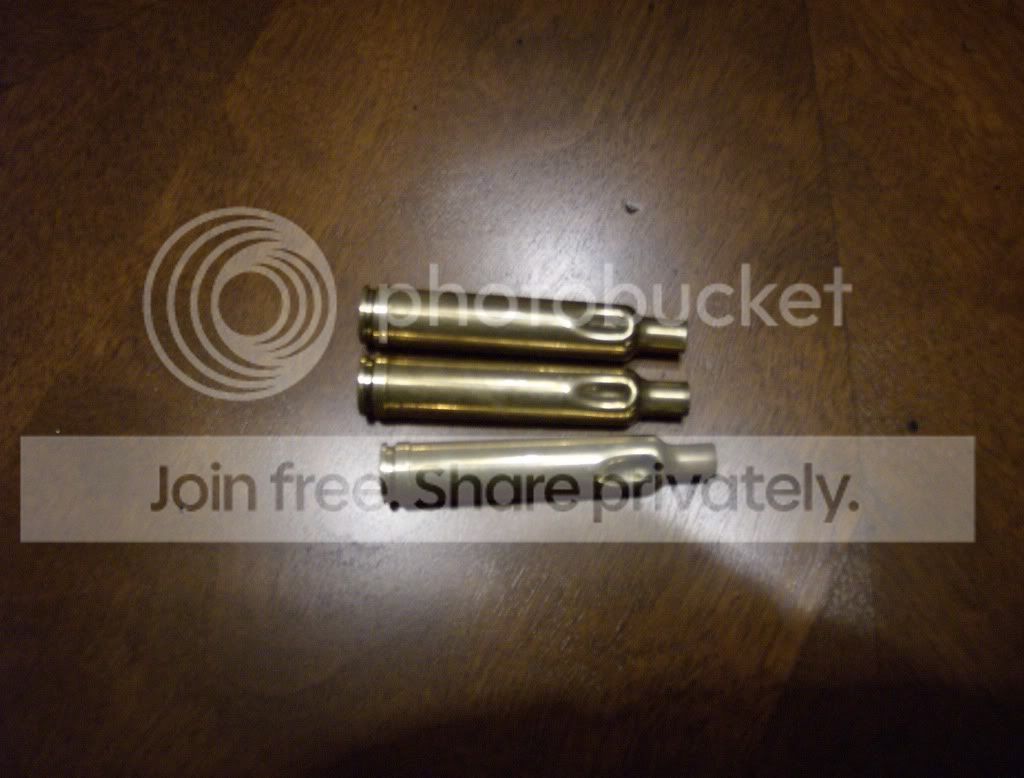
What The Heck happend here?

Whitetail Junkie

CGN Regular
Rating - 100%
4   0   0
Location
AB
Went out to the range today (-25 celcius) To line up my .24 cal Coyote rifle aswell to try out some new loads...I had 24 rounds in total....8, Varget\8, IMR 4064\8 ,RL15......I first shot all the varget and IMR 4064 Loads with no problem,However on the 2nd,4th & 5th shot with the RL15 I got these massive crators near the shoulder of my brass.I decided Not to shoot the remaining 3 RL 15 rounds.

I know that thses RL15 rounds were not over loaded,however i'm not entirly sure what would have caused this to happen....? my only two guesses is that RL 15 is the hottest powder and load For a 55 Grain bullet out of a 240 wby and for some reason its to much pressure for my rifle, ....or It could be I was cleaning my rifle between the different powder loads and maybe I missed some solvent in the chamber and this caused a major pressure sign in my brass! aswell on a side note I noticed that the RL 15 primers did seem to be a little more flattened then the primers from the other loads.

Can anyone add to what happened here? ever see this before? Catnthehat? :redface:

Thanks,WJ
004-2.jpg

003-2.jpg
 
low temperature has lowered the pressure to the point where the necks won't seal and pressure gets by and collapses the case.

Rel15 must be very temperature sensitive.
 
low temperature has lowered the pressure to the point where the necks won't seal and pressure gets by and collapses the case.

Rel15 must be very temperature sensitive.

interesting!!! It was stupid cold out there today....must have been -31 with the wind chill...There were alot of highs and lows on the range today.....Thanks for your response!
 
Yes, I would have to agree that theneck has not swelled enough to seal upon firing, causing gas to escape past the shoulder and crater the body of the case.

Either when you say "not max" you are acually below Minimum as well, or the load you have chosen with the RL15 is bleow minimum in that temperature.

I don't use RL15, so i don't know what it's temperature characteristics are like.

If you still ahve the 3 remaining rounds, I would suggest pulling 1 or 2 of them, checking them for load accuracy, then keeping the 3'rd. Keep it in your warm pocket, get the barrel nicely warm, and shoot the questionable round (I would say it's safe enough to fire one looking at those, not recommended of course, but you are experimenting at this point...) with all thigns at "normal" temps. That shoudl tell you if you have a problem with your load selection or if the RL15 is that temperature sensitive.

Might be the brass is a little too tough as well in the cold, but I'd bet on the powder first.
 
That is different! And expensive! I have seen that with over pressure and split necks, but never considered the under-pressure side of the coin. Definitely something to keep in mind. Well worth verifying the charge. Hard to imagine that a "medium" load could be affected to that degree by the temperature.
 
I don't know ..... you would think the pressure on the inside of the case would be at least as high as on the outside of the case. I've had scores, of loads that did not seal, but all they did was leave me with sooty cases. I don't know what did that. I've never seen anything like that before.
 
Thats one of the strangest things I've seen in a long while.

Never played much with any big magnums but I agree with Win 38-55 that it doesn't look at all like underpressure signs. Particularly if the primers are getting flattened.
 
Usually associated with a lighter load... A hotter primer helps eliminating that, or a faster powder.
 
This is a classic example of low pressure reloads in Weatherby cases. It has been well documented in the past (I seem to recall seeing these pictures in some of my older reloading manuals, as well as in various magazine articles). What is surprising is that this happened with Reloder 15, which is generally temperature insensitive. Unless, of course, as already suggested you were working well down at the minimum or below minimum level in which case I don't know how the powder will react in cold.
As already stated, the neck did not fully expand and some of the gas leaked around and collapsed the shoulder. The dents will iron out the next time they are fired with an appropriate load.
As for using Reloder 15and the other powders listed, they all sound like powders that are not the best for performance in a .240 Weatherby. I might use some of them in a .243 Winchester with light bullets, but since IMR 4350 is generally the slowest powder that I start with in a .243 Winchester, I would have thought that 4350 or slower would be the powder of choice.
In summary, low pressure (with a light bullet as well?).
 
Usually associated with a lighter load... A hotter primer helps eliminating that, or a faster powder.

I'm Sort of getting confused about all this...maybe its the way I worded my original post...I'm not sure....I got the load for my 240 Wby Mag out of the nosler book...

4 Rounds RL 15 @ 49.5 g\ 55 Grain B\T
4 Rounds RL 15 @ 51.5 g\ 55 Grain B\T

I got the cratered cases with both powder charges....Aswell the Nosler book shows that with the 51.5 Grains of RL 15 a 240 wby will push a 55 grain bullet @ 4099'per\sec....This is a Jacked up high velocity load\powder with a 55 grain bullet in the 240 wby.

Thanks everyone for your imput,WJ!
 
I do not reload for the 240

but i have seen brass like that

Some of the causes -- or combinations of causes

Min or below min charge

full length sizing---> shoulder is pushed back and the case shoulder does not seal

and in rare cases when case is filled with a charge less than 80%
position sensitive

and the cold could have some thing to do with it

RE 12 is the lowest volume mass density of the 3 powders

Hope you solve your problem


Went out to the range today (-25 celcius) To line up my .24 cal Coyote rifle aswell to try out some new loads...I had 24 rounds in total....8, Varget\8, IMR 4064\8 ,RL15......I first shot all the varget and IMR 4064 Loads with no problem,However on the 2nd,4th & 5th shot with the RL15 I got these massive crators near the shoulder of my brass.I decided Not to shoot the remaining 3 RL 15 rounds.

I know that thses RL15 rounds were not over loaded,however i'm not entirly sure what would have caused this to happen....? my only two guesses is that RL 15 is the hottest powder and load For a 55 Grain bullet out of a 240 wby and for some reason its to much pressure for my rifle, ....or It could be I was cleaning my rifle between the different powder loads and maybe I missed some solvent in the chamber and this caused a major pressure sign in my brass! aswell on a side note I noticed that the RL 15 primers did seem to be a little more flattened then the primers from the other loads.

Can anyone add to what happened here? ever see this before? Catnthehat? :redface:

Thanks,WJ
004-2.jpg
 
are the primers
proud ?
flush ?
or below ?

Primers below and flat is over pressure

proud and flat can be (some times) headspace / low pressure or over pressure

and by headspace it can mean that the sholder is pushed back
even if it is a belted case

what is the difference in length of the cases that look ok and the ones that don't
(you prepared the brass all the same)?

another thing to do is to weight all 5 cases (brass only) RE12

the 3 with problems are prob lighter ? than the other 2 (more internal volume)

Let us know what you find out
 
are the primers
proud ?
flush ?
or below ?

Primers below and flat is over pressure

proud and flat can be (some times) headspace / low pressure or over pressure

and by headspace it can mean that the sholder is pushed back
even if it is a belted case

what is the difference in length of the cases that look ok and the ones that don't
(you prepared the brass all the same)?

another thing to do is to weight all 5 cases (brass only) RE12

the 3 with problems are prob lighter ? than the other 2 (more internal volume)

Let us know what you find out

Will do!!!...To tell you the truth I dont know what "proud" means...but I'd have to say that all three primers on the wrecked loads are flat...because I looked at the other 16 primers from the varget\IMR 4064 loads I shot and I can see with my eye that the primers are flatter on the 3 wrecked brass compared to the other 16 primers....:bangHead: all 24 brass were the same length aswell all the fired brass is still pretty much within the same length.


My only saving grace to the day was that I managed to get a 0.40" \ 3 shot group at 100 yards with the varget.
 
Back
Top Bottom