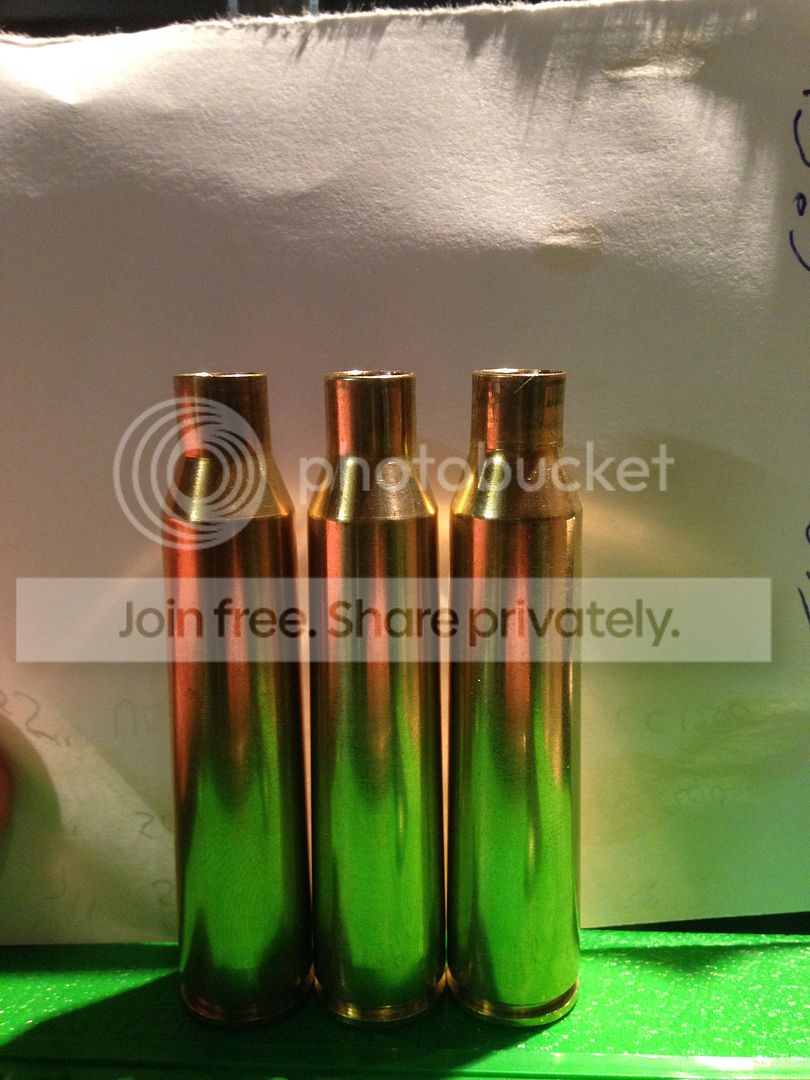
What the heck happened here to my brass?

Kelly Timoffee

BANNED
BANNED
BANNED
EE Expired
Rating - 100%
52   0   0
Was going to load a few more test loads and have been running my brass through my neck sizer prior to loading just to give it that final little touch to ensure a bit more uniformity since it has be moved around in a storage box and been a bit since it was sized and prepped.

Done this procedure a fair bit lately and this is the first I noticed this.Just running them through my neck sizer, bushing style.


I first thought my eyes were playing tricks, the center casing was not neck sized tonight.The outer two are going places at the neck.
 
Last edited:
Don't do that anymore.....

Remember, Neck sizing dies don't fully support the case. Probably wobbled around since it's already been resized. Try a fired case in the neck sizer and see if it makes the necks weird. If it does, the die is not good. If not, it's becuase it's already sized and wiggled around when you neck sized it. That's just a guess, as I've never tried to neck size already sized brass.
 
That one on the far right looks cracked at the base of the neck where the shoulder starts.
Check out the die way up in the neck area.
Also check your expanding ball for conformity.
 
Last edited:
If your brass isn't getting bushing sided than there are a few things to consider.

1. The thickness of the neck is inconsistent from case to case. So sizing some while scraping other parts that are not "centered"
2. The brass is work hardened and is springing back a little to it's original shape. Annealing your brass will help the neck retain it shape.
3. Is your bushing upside down? Most bushing have a tapered end to it.
4. The ones on the end I had a similar experience and found to be one or two scenario. a)Over anneal soft brass is flowing when pushed up into the bushing; b)neck chamber dimension is much wider than the bushing so essentially your forcing brass against the bushings lip and scrapping the sides. Typical with thicker brass like Lapua.

just my two cents.
 
That one on the far right looks cracked at the base of the neck where the shoulder starts.
Check out the die way up in the neck area.
Also check our expanding ball for conformity.


(Insert slowclap here)

Kamlooky,
What happened to your text accent? Why never in my life...
 
I still use the expander in my bushing dies, but I polish them down to where they barely drag in the neck on the upstroke of the press. Their only purpose with a bushing die, it to remove any dents from the necks.
 
I've long been convinced that I could size straighter cases with a good FL die than any neck die. Do you have a concentricity gauge?

You could check to be sure that your die is clean and that there's nothing to forcing the bushing crooked. Does the bushing have room to float and self center?
 
When's the last time you annealed the necks? Or have you ever annealled them?

To me it looks like uneven work hardening caused the brass to give on one side before the other. The work hardening in brass like this occurs unevenly as it's formed. If it was annealed it wouldn't do that.
 
I've long been convinced that I could size straighter cases with a good FL die than any neck die. Do you have a concentricity gauge?

You could check to be sure that your die is clean and that there's nothing to forcing the bushing crooked. Does the bushing have room to float and self center?

Me too.

Which is why I "partial resize" with a full length die set to push shoulders back just enough to chamber in the specific rifle.
 
Just to update info.

The necks were turned, to about 50%.

This is first loading after annealing.I kind of go 2 or 3 firings then anneal.

I should run them on the gauge and see how wobbly they are.

I will take the die apart and throw a peek at it.

If I had to guess , I would look at a mechanical issue, but it just dawned on me...

I don't have a decapping pin in that die and I had two SS pins stuck in the primer hole which stopped me from removing the case from the holder after they got pushed further out and into the holder.I pulled out the holder and case, pushed the pins through and went about business. I bet something went out of align or buggered from that.

The reason for neck sizing for me is to get more life out of the brass and not size the body every time.
 
Last edited:
I you reduce the neck diameter .005 or more with a neck bushing die you can induce neck runout with standard off the shelf factory rifles. This is because the bushing is free to move from side to side and up and down, and when compressing the neck over .005 the case neck can shift and tilt.

Two-Step Sizing and Case Neck Concentricity
by: Germán A. Salazar
http://riflemansjournal.########.com/2010/04/reloading-two-step-sizing-and.html

If you do not have a custom tight neck chamber you are better off with a full length sizing die. I bought a Forster full length bench rest die with the high mounted expander and was amazed at how little neck runout these dies produce. I then bought the Forster expander and spindle assemblies for my RCBS dies and the runout is .001 or less.

A full length resized case is only supported by the bolt face in the rear and by the bullet in the throat. Meaning warped or misaligned cases are much less likely to cause any bullet misalignment with the bore compared to neck sizing only.

As you can see by the OPs photos sometimes too much of what bench rest shooter do filters down to people with off the shelf factory rifles with standard SAAMI chambers. And minimum resizing with full length dies are many times the best way to go with a standard rifle.

Below with a Forster full length die the case neck is supported the by the neck of the die when the floating expander enters the case neck. And thus keeping the neck centered in the die and your chamber.

Sizer_Die_011_zpst2zm6m7y.gif


Below is a RCBS expander assembly adjusted upward as far as it will go on the left and a Forster expander and spindle on the right.

IMG_2141_zps77852ff6.jpg


Below my RCBS .223 die equipped with the high mounted and floating Forster expander and spindle assembly.

IMG_2140_zpsea657d9e.jpg


Above the same RCBS die is also equipped with a Lee lock ring with it rubber o-ring that allows the die to float and self center in the press.

 
I've had issues with a shell holder before. It didn't allow the case to be properly aligned with the die and was causing casings to be way out of concentricity in a full length die. On some cases you could see how the bad alignment was, near the bottom on the cases. After a few firings, a quick check on the gauges showed some really thin spots in the lower case bodies.


 
Back
Top Bottom