
Blue is for practice in Canadian military color coding. This bomb is made to simulate the actual stuff. We still use modular practice bombs to simulate "dropping" mk82-84 General Purpose Bombs. These practice bombs can be fitted with cartridges that will "emit" smoke on impact on the ground.













































You are using an out of date browser. It may not display this or other websites correctly.
You should upgrade or use an alternative browser.
You should upgrade or use an alternative browser.
What the heck is this thing?
- Thread starter Sardaukar
- Start date

I have one of those also but not in as good condition. It had the nose piece removed (I think that would be the detonator) and is painted black. I don't follow why this would be an aircraft practice bomb and not a real, de-activated aircraft bomb.
If anyone is interested, I would provide photos and take offers to buy mine.
If anyone is interested, I would provide photos and take offers to buy mine.

From the thread "what is it".....I think it maybe a Bathythermograph and may indeed be radioactive. good news is radioactive material degrades over time and is most likely inert....but then again you never know. If your hair starts falling out you may want to remove it from under your bed

It's nice if you know what your picking up like some of the members here do. If not, I wouldn't touch any old rounds of any type at any time. Some German soldiers in Shilo,Mb. messed with a 40 mm mortar round back in the 70's and had it blow them up. I'm fuzzy on the details, but it was a lesson not to forget.

unimog_willys
Member
- Location
- Fort McMurray
I don't know....but I wouldn't hold it so close to your crotch......
almost fell off the couch
I don't know....but I wouldn't hold it so close to your crotch......
Hahaha!

Rub it on your crotch ...... I kid take it to your local university they might have a geiger counter
I can see the headlines now.


I know this is late in the conversation but I have a few practice bombs in my collection.
I have two like the one shown and another model of similar size. The smallest one has a removable tip with a firing pin to detonate a shotgun like smoke marker.
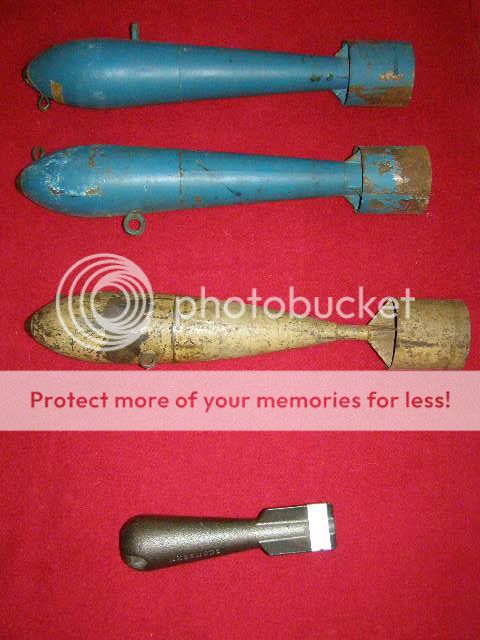
I have two like the one shown and another model of similar size. The smallest one has a removable tip with a firing pin to detonate a shotgun like smoke marker.
Last edited:

FishDoc
CGN frequent flyer
I know this is late in the conversation but I have a few practice bombs in my collection.
I have two like the one shown and another model of similar size. The smallest one has a removable tip with a firing pin to detonate a shotgun like smoke marker.
You always have toys most of us can only see in our dreams!
Keep sharing!
Blah
Probably already been said but I Am on my iPad and do not have time to read the whole thing... S s e 44 or 144, forget which it was... But anyway, it is an 11.5 pound aircraft practice bomb, not sure why jt would e radioactive though
Probably already been said but I Am on my iPad and do not have time to read the whole thing... S s e 44 or 144, forget which it was... But anyway, it is an 11.5 pound aircraft practice bomb, not sure why jt would e radioactive though
Definately a practice round. Not dangerous, and radioactive stickers are used on everything in DND with even the slightest amount of radioactive material. (ie a compass). It probably had a sensor of some type that used a bit of tritium or something. Also, because its marked RCAF, it was produced before 1967 when the RCAF was merged into the rest of the CF.

Brutus
CGN Ultra frequent flyer
I'm just putting this out there as a possibility.
Post WW2 some jets (and jet passenger aircraft) used depleted uranium as a counter balance trim weight in flight control surfaces of jets to help the aircrew fight aerodynamic loads in flight.
Perhaps this practice bomb used DU as a nose heavy weight, so it tends to drop nose first after release from the aircraft, for perhaps more accurate bomb placement from a mock aerial attack.
The warning is because if DU was used here, the only time residual raditaion is leaked is when the DU is heated or worked heavily.
(such as a crack from impact)
I think that big knob on the side is for a replaceable smoke charge myself.
If I were you I'd put that thing under a geiger counter at least. A well equipped NDT facility should have one.
my two bits
Edit: If this is DU, it's very important the outer cadmium plating remains intact. This prevents the source from being breathed into the human body if small particles somehow broke off, or the heat from a fire could release it as well.
A university may be a very bad idea. If it reads hot and someone decides to evacuate the building you may have just made a local news story.
Post WW2 some jets (and jet passenger aircraft) used depleted uranium as a counter balance trim weight in flight control surfaces of jets to help the aircrew fight aerodynamic loads in flight.
Perhaps this practice bomb used DU as a nose heavy weight, so it tends to drop nose first after release from the aircraft, for perhaps more accurate bomb placement from a mock aerial attack.
The warning is because if DU was used here, the only time residual raditaion is leaked is when the DU is heated or worked heavily.
(such as a crack from impact)
I think that big knob on the side is for a replaceable smoke charge myself.
If I were you I'd put that thing under a geiger counter at least. A well equipped NDT facility should have one.
my two bits
Edit: If this is DU, it's very important the outer cadmium plating remains intact. This prevents the source from being breathed into the human body if small particles somehow broke off, or the heat from a fire could release it as well.
A university may be a very bad idea. If it reads hot and someone decides to evacuate the building you may have just made a local news story.
Last edited:


The smallest one is hollow. When the firing pin hits the base of the reversed cartredge inside the body it detonates and sends a colored marker out the tail end to indicate the hit.
Someone mentioned it looks like a practice mortar round. I have a couple of practice mortar rounds in my collection a few for the British 2", 3" and an 88mm or 81mm.
Someone mentioned it looks like a practice mortar round. I have a couple of practice mortar rounds in my collection a few for the British 2", 3" and an 88mm or 81mm.

fat tony
CGN Ultra frequent flyer
My friend was sent on the Mortar course in Wpg back a few years now. It was held just after Xmas leave was over. If they screwed up on the drills, they had to do X number of laps around the Transport bldg, each gun crew had to carry x number of 81mm practice rounds with them - they had to toss it around like a hot potato while doing the laps because it was so cold.
Last edited:






















