Ill preface this with a few caveats - 1. I'm not a USGI expert in any sense. Most of what I am passing on here was acquired from reading lots and I may be misquoting or remembering things. 2. I agree with what Bearhunter and Purple have said. 3. US Milsurps have gotten fairly expensive and navigating "correct" examples can be a minefield, especially up here in Canada.
When it comes to M1903 rifles (or any USGI rifle or pistol generally speaking) - an overwhelming majority of rifles held by the US government will show signs of refurbishment/rearsenal/overhaul/rebuild etc... These rifles saw heavy service throughout their service life, and as with any arm, when parts broke, wore out or became obsolete, they were
generally replaced with functional parts while in Uncle Sam's service. To what degree parts were replaced or repaired, depending of course on what degree the rifle needed it. A WW1 dated rifle for example may have 1920s, 1930s or 1940s parts and components, which would be "
correct" in the sense that the US Government repaired and maintained the weapon during its service life, but wouldn't be "
correct" as in the day it left the arsenal. A very knowledgeable gent on the American Gunboards forum told me on average that following WW1, virtually all M1903 rifles were repaired to various degrees, and the average time a rifle would have been issued before some level of repair was approximately 4 years. I can't speak to these figures myself, but knowing military weapons as I do in both collecting and my own military time, it seems quite reasonable.
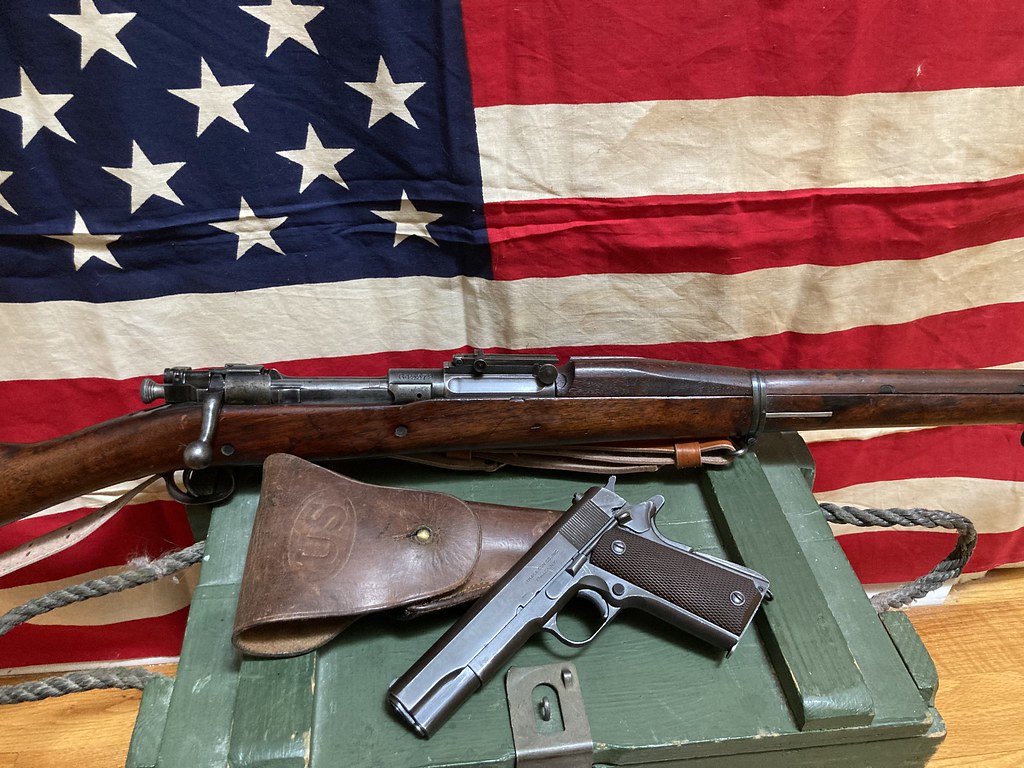
Personally, I was looking for an M1903 that would be representative of what the USMC was issued and used during the early Pacific campaign during WWII. I ended up narrowing it down to a few key elements that
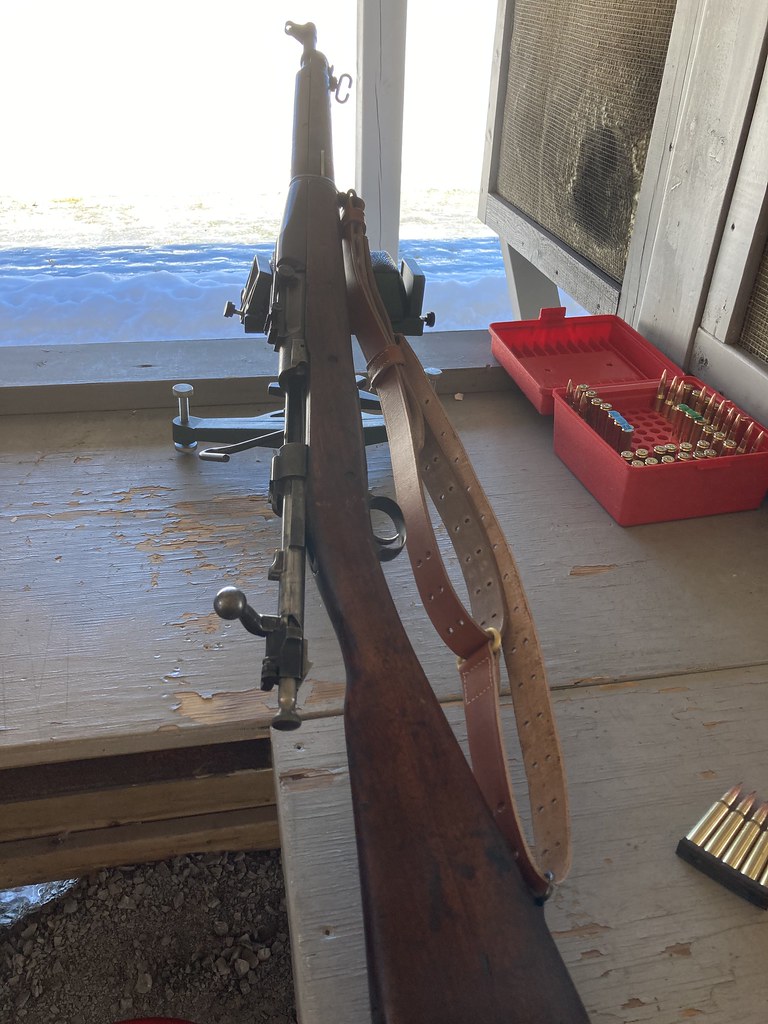
generally fit the bill. I wanted the rifle to be an M1903 and not an M1903A3 pattern rifle, I wanted a rifle with a pre-WW2 dated receiver, and if it did have a newer barrel, to be 1930's dated at the latest. I also wanted something that hadn't been NON-USGI refinished or overhauled, even though a rifle that has gone through Vulcan or had a commercial barrel on it would almost certainly shoot much better. Given that an overwhelming majority of rifles issued to the USMC immediately before/during WWII would have been through some form of refurbishment/rearsenal/overhaul/rebuild etc... during their service life, I was quite happy with a "Government" rework. I ended up finding a very nice Springfield 1917 dated rifle with a 3-17 dated barrel and Remington M1903 stock from the 1941/1942 time period, which fit the bill perfectly and didn't cost anywhere near the amount of what a "correct" 1917 dated rifle would cost me. This rifle is a "low number" rifle that I have and do shoot on occasion with my handloads. More on that later.

[/url]
Rifles that are "all correct" as they left the factory in say 1917 do exist, but are very, very rare, especially up here in Canada. More often then not, when looking at something USGI that is being sold as "all correct", especially up here in Canada, its a rifle that someone has "corrected" by replacing the "updated" or "upgraded" parts with period "correct" parts. The merits of "correcting" a rifle are a whole other topic of discussion, and some people have fairly firm opinions on both ends of that debate, which I generally won't get into. If you do intend to go that route, just be advised that certain parts can be exceptionally difficult to obtain, especially up here, and at the end of the day it is a rifle that has been "modified" from how it left USGI service.
To put it into perspective, the Inglis Hi Power I was issued on my first tour overseas had a restamped slide and had been heavily refinished and had commercial magazines. Certainly not the way this pistol left the Inglis factory in the 1940's, but "correct" for my time period I suppose. If this pistol was released for commercial sale today, I bet most collectors would turn their nose down at it as it isn't "correct". Nothing wrong with that, just offering a different perspective is all. I'd turn my nose down at it as they often had issues with stoppages, but that's a whole other discussion

Personally, from what you are describing, I'd suggest you're
likely looking for something fairly similar to the rifle I have. Keep your eyes on the EE, though they aren't as common as say Garands, No4 Enfields, K98s etc... That being said, they do come up for sale. If you plan to shoot it, look for a fairly clean barrel and solid stock as cracked wood on 70+ year old wood can be a real pain to properly fix. Don't shy away from rebuilt rifles, especially if they bear the typical USGI arsenal rebuild markings - these rifles are likely "correct" for how they left service, and the work done by these arsenals was quite good and part of their service life. The added bonus in my eyes is the rifle was unlikely to be assembled from parts here by a hobbyist, who may or may not have the skills to do such work. Sometimes rifles assembled here by collectors are exceptionally well put together and are great shooters, others, not so much...
With regard to the "low number" and "high number" rifles - essentially Springfield made rifles before serial 800,000 and Rock Island rifles before serial number 285,507 may have heat treating issues, notably in their receivers. Heat treating at the time was generally done by the ole "USGI eye" and was no where near as consistent as the heat treating done later on using proper tools and gauges. Some of these rifles did fail, generally due to over heat treating and the resulting brittle metal - and their issues are real. There is some debate and documentation suggesting that ammunition was a major culprit, though I wont profess to be exceptionally knowledgeable on that. Now how much of an issue this is for any rifles still around today is up for debate, with the general though among some being that if the rifle was so dangerous it would blow up, it likely would have by now. There is some documentation to show that the US government essentially by the 1940s wasn't too concerned any more about low number guns, though of course with war on the horizon and/or already in full swing, beggars can't be choosers. The heat treating issues are real, and there are potential risks involved in shooting them. That being said, I made a personal decision to shoot mine, and while using controlled handloaded ammunition, safety glasses and hearing protection (as always), I personally feel safe doing so with my rifle. Your view may be different, and when it comes to safety, there is no better judge then you to judge your personal risk.
The US boards are an excellent source of information on this, and please done take my advise alone on this issue.
Regardless - read, read and read. Knowledge is your best ammunition here in making what will not be an inexpensive purchase (unless you're crazy lucky!). These rifles are fascinating, their service history varied and interesting, and shooting one is simply awesome. I wish you luck and please don't be afraid to reach out to some of the more advanced USGI shooters/collectors on this board and over on Gunboards under the "American Arsenal" section. There's a lot of guys on here that know their USGI stuff and have years or shooting and collecting knowledge that is invaluable.
As a last piece - here is a great resource on USMC M1903 rifles if they are more what you are after.
https://usmcweaponry.com/pre-war-wwii-usmc-m1903s/