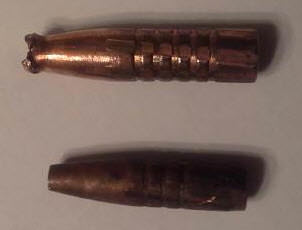
What will switching to mono metal bullets get me?

Between me, my son, and my two hunting partners the barnes tsx, ttsx, and lrx have accounted for well over 100 animals, probably closer to 150... from feral goats in new zealand, to assorted african game, to pretty much all the north american critters except grizz. These have been taken with everything from .243 to .375 at ranges from 5 yds to 540 yds, not a single failure...animals usually dead within 20-40yds. Longest tracking job was a large rutted up bull elk that made it a little over 100yds....chest cavity was soup...certainly not a problem with bullet performance.

to illustrate both ends of the speed range...my son shot a bear at 20 yds with a 257 wby doing somewhere around 3400fps....bear went 20yds and died. I shot a moose with a 200grn lrx out of my 30-06 at 465 yds....velocity at the target would have been in the 1800 fps range....moose went 20 yds and died.

Barnes make small entry wounds and small exit wounds...I suspect much of the assorted internet "barnes pencil through" stories comes from poor shots that require tracking jobs and when the animal is found there is a small exit wound so its easier to blame the bullet than admit to a poor shot. people have gotten so used to the baseball sized exit wounds from bullets of the past that a nickel sized exit hole must have "penciled through".

Will the barnes produce the dramatic bang/flop kills?....generally no...but of all the animals we've taken with them except the one mentioned above...i could throw a baseball to where they died.

will the barnes ever "splash" on the surface or break up and fail to penetrate....never seen, heard, or read of that ever happening

will a double shoulder shot require the front half of your deer to be scrap? nope...much less bloodshot meat with the barnes. I have butchered hundreds of critters for family and friends and have seen some real horror stories with bone hits using cup and core bullets.

The barnes do however have limitations.....i generally chrony and figure out at what distance the barnes will still be doing 2000fps and that is my max range for that particular load. If you want a bullet that will open reliably at 1500fps....barnes isn't it. the trade off for using bullets that will perform at low velocity is generally that the results are less than desirable to some when used at close range/high velocity.

At the end of the day, given that most hunting shots are well under 300 yards, I will take the certain penetration the barnes provides when used at speeds it was intended for over the risk of poor penetration and possibly massive bloodshot that could result from the alternative.

Just my opinion and observation after extensive use with the barnes!
Chris
 
Good post willy. I feel the same way although I haven't killed near the amount of critters that you and your crew have. I personally prefer the nosler etip over Barnes but that's purely because the load I worked up simply shot better with the nosler bullets. I'm sure they perform the same for the most part.
 
....i generally chrony and figure out at what distance the barnes will still be doing 2000fps and that is my max range for that particular load. If you want a bullet that will open reliably at 1500fps....barnes isn't it.
Chris

I had emailed barnes about what the mis speed needed is. Reply I got was that they are suppose to be good for as low as 2000fps but recommended over 2200 for reliable expansion. Barnes however calls the nose deformation expansion.

They also call this expansion

16360388jo-jpg.23270
 
I had emailed barnes about what the mis speed needed is. Reply I got was that they are suppose to be good for as low as 2000fps but recommended over 2200 for reliable expansion. Barnes however calls the nose deformation expansion.

They also call this expansion

16360388jo-jpg.23270

Yes, I have a couple of similar Barnes TTSX bullets. They did not expand, and they were not long range shots either. Eagleye
hmADgyn.jpg
 
It'll get you deeper penetration, for which you trade smaller diameter wounds, slower kills, longer runs, and a lack of apparent shock unless heavy bone is hit.

Is that a trade you want to make?

Dogleg, Absolutly!
I respect that You've proberly used a lot more than I, but this is a real hard nut to crack when telling a 'newbie' or unexperienced fella about Why Monos arnt that good and they are better off with the heavy cup and core .......

that is all!

C&C for LYF
 
This last hunting season was the first time I used mono bullets, both Hornady gmx and Barnes TTSX.

I took 3 deer, 2 bear and a moose using them in a 30-06 and a 7mm Remington mag. The furthest one of these animals(a whitetail buck) went after being hit was about 30 yards...another went a few feet, the rest dropped where they stood.

I never recovered any bullets so I can't say how much they expanded but I was pleased with the results so far. Also the distance of the shots were between 30 and close to 100 yards so impact velocities would have been up there possibly helping with expansion.
 
When shot out of my 7mmstw rifles at 3400 to 3500 fps, the TTSX produces very quick kills on game animals from pronghorn to moose, and at 500 yards the impact velocity is still around 2300fps, which is plenty for proper expansion. However, I wouldn't load a 180gr TTSX for the 308win, and shoot big game at 500 yards and expect dramatic kills.
 
I've taken TTSXs up to 3950 fps in the .257 Weatherby.

I'll submitt that if that isn't enough speed to make it the equal of lead bullets nothing is. It isn't. The TSXs remain a net producer of vacuum. ;)
 
Last edited:
I'll take bullet penetration over bullet expansion in most cases.
If I don't have the necessary speed for expansion, I'll still get acceptable penetration.
 
For medium velocity cartridges like the 7 x 57 and .308 that the OP mentioned, monometal bullets are a solution to a problem that doesn't exist, period.

For your really fast cartridges, which MAY include the OP's .270 if he handloads 130's or lighter, and pushers them hard, then monometals can be a good thing.

Someone mentioned impact velocities of 3000 fps being a good measuring rod to consider using monometals; I completely agree.

I still think the most important thing of all is to know your bullet and how it acts, period. I don't care if you shoot a Hot-Cor or a TSX or a Berger VLD. I shoot them all - I just don't shoot them all the same.
 
Like others have pretty much already explained, I prefer fairly quick opening cup and core bullets while for hunting for medium-smallish game like deer with the cartridges mentioned. If hunting bigger critters like moose or elk with small fast bullets from a .270, I'd prefer a monometal bullets. Reliable penetration becomes more important. A .308 normally used with 165's or a 7x57 with 156 grain bullets are in-between. I like and use both cartridges for both deer and elk, but don't think you'll see a significant penetration advantage on big animals by choosing monometals that are a little lighter, and you may find monometal kills are a touch slower for most game. Might save some meat though.
 
I had emailed barnes about what the mis speed needed is. Reply I got was that they are suppose to be good for as low as 2000fps but recommended over 2200 for reliable expansion. Barnes however calls the nose deformation expansion.

Hmmm....have seen several emails supposedly from barnes over the the years on threads like this and the general gist is that min velocity can be different depending on caliber and bullet weight. but "generally" speaking it seems to be TSX - 2000, TTSX - 1800, LRX 1600

I don't use the tsx in anything anymore....nor do i usually believe manufacturers claims, which is why i have tried to use 2000 fps as my cut-off for the TTSX and the LRX. Never had a single complaint and generally find soup in the chest cavity working within these boundarys.

I don't dispute that there are some barnes bullet failures out there....just like there all with all manufacturers bullets, there does however seem to be more with the TSX from when it first came out, not so many with the TTSX and LRX more recently. I think there may indeed have been a problem with the early barnes that I believe has been addressed.
I have had a bullet failure once in my hunting life....using a 165 interbond out of my 30.06,punched 6 neat clean holes through the lungs of a moose at ranges from 60-100 yds before finally just shooting him in the head....there was literally no damage to the lungs except the 6 neat little 30 cal holes. Called hornady and they informed me they had a problem with that particular batch.....point being, if you look around you will find bullet failures from every single manufacturer out there...including barnes, partitions, accubonds etc

That being said...shoot what "YOU" have confidence in, i'm not trying to convince anyone to switch to barnes...there hard enough to source at times as it is!! Personally, due to a relatively large sample size, while using barnes as they are intended, I have absolutely no reason to consider switching.

I'll submitt that if that isn't enough speed to make it the equal of lead bullets nothing is

could you please explain what you're getting at here please? If your thinking a barnes pushed fast enough should produce grenading, volleyball sized exit holes....they won't, thats not how they are designed to work. they rely on hydraulic action and penetration over fragmentation.

Take care, shoot straight
Chris
 
Last edited:
could you please explain what you're getting at here please? If your thinking a barnes pushed fast enough should produce grenading, volleyball sized exit holes....they won't, thats not how they are designed to work. they rely on hydraulic action and penetration over fragmentation.

What I'm getting at is simple enough. I shoot bullets at animals to kill them. Not to penetrate them, not to go see if I can find them, not so I can weigh the bullet to see if the animal is dead, not to see if they look like my favorite letter or number, not to see if they look like a particular plant or fungus, not to measure the diameter to see if it matches what the advertiser says it should.

I don't care about anything except how fast the animal hits the ground and how fast it dies. Monos don't kill as fast as lead core bullets, and after many hundreds of dead by mono animals I don't see that changing.

In the specific example of the 3950 fps TTSXs the result was a constant series of runners that didn't happen with 115 ballistic tips, 110 grain Accubonds, and 100 grain Sciroccos.
 
What I'm getting at is simple enough. I shoot bullets at animals to kill them. Not to penetrate them, not to go see if I can find them, not so I can weigh the bullet to see if the animal is dead, not to see if they look like my favorite letter or number, not to see if they look like a particular plant or fungus, not to measure the diameter to see if it matches what the advertiser says it should.

I don't care about anything except how fast the animal hits the ground and how fast it dies. Monos don't kill as fast as lead core bullets, and after many hundreds of dead by mono animals I don't see that changing.

In the specific example of the 3950 fps TTSXs the result was a constant series of runners that didn't happen with 115 ballistic tips, 110 grain Accubonds, and 100 grain Sciroccos.

Oddly enough, I am not seeing those runners using the 140-150gr TTSX in my 7mmstw.
 
Dogleg, unless I am mistaken, you seem to have taken offense to my question for clarification? I assure you, no offense was intended, sometimes internet posts can be misconstrued.
As I stated in my earlier post, i encourage everyone to shoot what they have confidence in, and what suits their hunting objectives. Me, personally....I'm primarily a meat hunter and am not willing to trade off 30-40 lbs of bloodshot meat to achieve a dramatic bang/flop vs an animal that runs off 30 or 40 yds. In addition, I also spend a fair amount of time hunting in grizz country and in my own mind I just feel more comfortable knowing the bullet I choose is going to penetrate the skull, or break bones should an emergency protection situation arise.

to each their own....doesn't make anyone right or wrong....just different choices for different reasons. Your experience leads you in a certain direction in your bullet choice, as does mine!

Take care
Chris
 
No doubt you've noticed that .284" bullets are bigger than .257"; so maybe not that odd. I like the STWs too, although I quit using copper bullets in them 20 years ago.

If you stopped using copper bullets in the 7mmstw 20 years ago, you have never used the TSX/TTSX in the 7mmstw, as the TSX/TTSX did not exist 20 years ago.
 
Dogleg, unless I am mistaken, you seem to have taken offense to my question for clarification? I assure you, no offense was intended, sometimes internet posts can be misconstrued.
As I stated in my earlier post, i encourage everyone to shoot what they have confidence in, and what suits their hunting objectives. Me, personally....I'm primarily a meat hunter and am not willing to trade off 30-40 lbs of bloodshot meat to achieve a dramatic bang/flop vs an animal that runs off 30 or 40 yds. In addition, I also spend a fair amount of time hunting in grizz country and in my own mind I just feel more comfortable knowing the bullet I choose is going to penetrate the skull, or break bones should an emergency protection situation arise.

to each their own....doesn't make anyone right or wrong....just different choices for different reasons. Your experience leads you in a certain direction in your bullet choice, as does mine!

Take care
Chris

Takes quite a bit to offend me, so no worries there.

Bit of background on the .257 bullet test, for perspective. My shooting partner and I were culling fallows and reds and were able to take what we had planned, which was five hundred head in seven days. I figure it would be a crying shame to let something like that slip by without trying to learn something from it. My friend thought differently and was quite happy with a pack full of 7mm 120 Ballistic-tips driven north of 3600. Claims he doesn't need to prove what he already knows. Maybe he's right.

We shot from zero to 700 with the little guns, with most being 3-600 yards. As mentioned before I had Ballistic-tips, Accubonds, Sciroccos and TTSXs, and no particular reason to want one to work better than the others. Definitely had a prediction though. The results were that the Ballistic-tips and Accubonds worked very similarily, the Sciroccos are hard hitting crazy penetrators for a lead based bullet (shooting twofers on purpose became a bit of a game) but the odd one out was the TTSX which can only be described as pathetic. Junk was one of the nicer things they were called. The tracking dogs would have got PTSD if I kept using them. Actually, my spotter would have shot me well before that happened. ;)

The grizzly angle is interesting. I've only shot 2 of those, but my thoughts are that on the grand scheme of big they aren't very big,they aren't that hard, and I just cant see their skulls as being any thicker than anything else. The first was in Alaska was shot with a .338 Win Mag with 225 grain TSXs. Nothing very impressive there; I spined it at 68 yards and had one heck of a time shooting the wiggle and roar out of it. The second was hunting with Ardent and more in line with my philosophy of fast and not hard enough for a rhinoceros. It was a frontal shot and went down so hard it was boring. Rifle was a 300 RUM with 180 Accubonds. Some might think that they couldn't knock a crow off a fence post with those but I've killed Asiatic buffalo with them in the same rifle. Sends bears to the big salmon stream in the sky.
 
Back
Top Bottom