What will switching to mono metal bullets get me?

Dogleg, how far were these fallows running on you? I would assume 80 grn ttsx to get that kind of velocity?

I would say we both have a statistically significant sample size...yet our results would appear to be at opposite ends of the spectrum. So, have i and my group had extraordinarily good luck 150 times? Or have you had extraordinarily bad luck in your large sample? Neither seems likely to me.....there's something interesting to be learned here...just not sure what it is!! HaHa!

If you can recall....were there other calibres where you used the TTSX with what you considered to be poor results? if so, what were they?

Reason I ask is I have considered manufacturers minimum impact velocities to be a possible red herring. My thinking is that proper expansion may be a result of velocity combined with bullet energy (ft/lbs).

As an example.....a moose I shot at 460 yds with a 200 grn LRX which should have been moving in the 1800fps range produced one of my few recovered barnes and showed text book expansion and a quick kill,according to the ballistics calculator it would have been carrying about 1600 ft/lbs of energy.
assuming an 80 grn ttsx at 3900 out of your 257, at the same 460 yds it should be carrying around 2350 fps but only around 950 ft/lbs

there is some set of factors that explain our differing experiences, not being a ballistics engineer with a masters degree in bullet making...thats the best seat of the pants theory I can come up with!!

Chris
 
My experience shadows DLs exactly........one thing I found monos will do for you is to make you a better tracker. I too have killed literally hundreds of game animals and I have used many different bullets to do this and I have found the Accubond is an outstanding killing bullet in most of my high velocity magnums. Prior to the introduction of ABs I used Partitions extensively with almost perfect success.


I do use 270 gn TSX in my 375 H&H and have killed a couple truckloads of critters with them and have had great success, but a lot of that has to do with the cartridge and the velocity that particular barrel gives.
In cartridges like my 7X57, 7-08, 308, 9.3X62, 8X57 etc, etc, etc......I use mostly C+C bullets from Speer, Nosler, Sierra.......whatever that particular rifle and cartridge likes.
As another aside when using TTSX and TSX bullets at extreme velocity (say over 3500 fps) both my son and I have experienced severe copper fouling in several rifles, a real PITA............
 
I've gone up to .458 with the TSXs, but in a general sort of way I start liking them a little at the .375 level. That hinges heavily on having an animal hard enough to warrant a bullet that hard, which is another way of saying buffalo. Even then, its no A-Frame and its not even close. There is a special niche which a 270 or 300 grain TSX .375 fills as good as anything. That's where you want or need to shoot animals from jack-rabbit to giraffe size with the same bullet without blowing half the little one off or coming up short on the big guy. General purpose of that magnitude is itself a specialty, that only happens on one continent. Much of what is between the two extremes is better suited for a deer rifle with whatever is on sale at Canadian Tire, but since the African trackers are a wonder to behold little is lost and some memorable experiences are gained.

At .458 level it is quite good as long as you can keep the speed up. I used many light TSXs on buffalo cull, simply to keep the recoil down to get a second wind from the relentless pounding. Thats another specialty niche, not one that many have to worry about in this century or the last.


Never shot animals past point-blank with the 80s. Wasn't much use. Did I mention they were bad?
 
My 5x4 whitetail buck this year was at about 75 yards with a 120gr ttsx out of a 6.5x55 tikka. In high neck, out high ribs, broke shoulder bone a little but not exploded, and somehow ruined very little meat. yay! Lungs were soup and there was about 2 gallons of blood inside the chest, but it went about 30 yards with only the tiniest amount of blood trail coming from mouth/nose only. Entrance and exit wounds were fairly high on the animal and were tight on my finger. I was following footprints and it was snowing really hard. I sure was happy to find it so close after not finding any blood for the first 10 yards.

Makes me think about going back to 140gr partitions, they work great. Hell, Cor-lokts out of that rifle drop deer :)
 
Wow, my experience really is a drop in the bucket compared to some contributors. I value information drawn from large sample groups, and trust it over my own when my cases are isolated. I really appreciate the cull data Dog-Leg shared, as his information is a lot more statistically relavant than a guy like me who hunts for the table. I'll be lucky to harvest 700 deer in my lifetime.

My experience indicates impact velocity is a big factor in bullet performance. I strongly agree that it's important to observe minimums, and these values vary dependent on bullet design and construction. I started hunting with loaner rifles in standard calibers. The first rifle I bought for hunting was a 300 win. Excited by 'hard hitting, flat shooting'. I found myself moving to heavier and heavier bullets, resentful of all the trimming and bloodshot meat come butcher time. With more experience I started to feel overgunned, got a 30-06 that weighed 3lbs less and noticed a big difference with 2000-2500fps impacts vs 2500-3000fps. Slower speed = less trauma for a given bullet. This was especially true of corelok and silvertips, less so for well constructed 'premiums' . Perhaps if good monos were available back then, I would be telling a different story.

Over the years I have seen animals turned inside out (Berger VLD) and pencil holes through the rib cage (Barnes x) - neither of which is ideal. I continue to hunt with 'standard' calibers, usually 30-06, 308 or .270, because moderate weight bullets at moderate velocity have provided consistent results. Consistent results = confidence. Nosler Accubonds have always expanded and penetrated well for me, so that's what I have been using for the last 4 or 5 years. Always had good results with partitions, but the AB's seem generally more accurate.

As modern monolithics go, the only ones I'm curious to try are Peregrine Monolithics - they are made in South Africa and employ a unique bronze tip 'plunger' to pneumatically initiate expansion (similar to the Accubond which has an air cavity behind the plastic tip for rapid 'opening' on contact). Peregrine has a few different designs, but the plainsmaster seems best suited to my general use (deer, elk, moose). As the OP mentioned, due to the lower density of copper, solid copper bullets are longer for a given weight/bore and require a faster twist to stabilize. I shoot a lot on agricultural land now, and have been conscious of my lead deposits, so I think 'lead-free' is a responsible choice for my environment. I was planning on importing a few boxes for testing, but after analyzing the ballistics, i am not so sure. I think the only standard caliber we have that would sling them with advantage is my sister's 7x57 - with a 1:9 twist accuracy seems a lot better with heavy lead based bullets (160gr+). The 140gr plainsmaster might show some gains over the 160AB's having a similar ballistic coefficient, plus the ability to be launched faster, resulting in flatter trajectory and greater energy delivery at range.

Not so good for my .270 - with a 1:10 twist it may only stabilize 120gr plainsmaster, and 120's shed velocity quickly and blow with the wind past 300yd. In a 30-06 1:10 could stabilize a 180gr, but the 1:12 in my .308 will only stabilize the 132gr based on Peregrine's data.

I may still get a couple boxes to fool around with, but it will take some doing to supplant accubonds from my 'go to' spot.

Over the years manufacturers have increased the standard twist rates in a few calibers due to popular demand. Even now, the rifles we buy off the shelf were designed to function with moderate weight lead based bullets. The only advantage I see to monolithic bullets is their environmental appeal. High cost, inconsistent terminal performance, and barrel fouling are all hurdles to be overcome by monolithic manufacturers. Much progress has been made in theast 20yrs, any while I try to keep an open mind, my limited experience suggests we are not there yet.
 
Last edited:
I started shooting barnes abut 3 years ago and I'm a big fan. I got a buddy at moose camp that decided to try them after seeing my success with them. This October he took a quartering shot on a big moose cow. 1 shot she wobbled and dropped before he could chamber amother round. The bullet traveled clear through her body and I know it stopped somewhere in her hind quarter. The effectiveness of the round is something else my buddy freaked out once we got her back to camp and hanging on the rack. Let's just say he's sold on the barnes bullets.

I've shot moose and deer with 2 different calibers 30-06 and 338wm(both tipped) now I can say I've seen what they do in a 7mm(not tipped) all work extremely well. Going to get my old man to try them in his 270wsm next year.

I'm not reloading yet my experience with them is the factory loaded ammo but I will start reloading soon. Never tried the hornady and I've heard nothing great about the federal copper. Can't say how they work or group
 
I have used Hornady 180gr gmx in my 8x57 (8mm Mauser) at 2700 fps. Took a nice 4 point at 300yards, it worked as expected. Also took a couple other deer within 200 yards and had no problems. I was thinking on trying the Barnes tsx but in all reality I tend to lean for heavy cup and core or bonded in the 200gr range.
 
A lighter wallet.

Mostly agree, though I have seen, at least around where I live, that Partitions are perhaps the most ridiculously expensive projectiles that can be found regularly. Box of 300grn .375 Partitions is almost $20 more than the 270grn TSX's in my neck of the woods. I'd like to try the 300grn Game Kings, apparently they have a thicker jacket and perform better than the lighter Game King bullets, they are much cheaper than Partitions and likely would perform well on everything between deer and moose I'm sure. 260grn Accubonds are also high on my list of projectiles to try out.
 
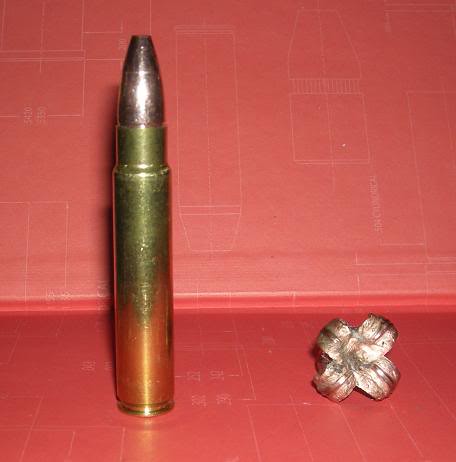
Excellent performance with TSX bullets in 358, 416 and 458 calibers on Moose and Elk. Also work fine on Deer and Bighorn Sheep. This recovered 300gr 416 caliber TSX hit Bullwinkle through the shoulders broadside at about 2450 fps impact speed. 1 shot DRT. I trust these to perform.

35903912964_e34e388fea_z.jpg
35903899164_42c6be7419.jpg
 
I have used the 130 grain GMX in my 270 Winchester Model 70 FWT and they were very accurate. Shot my best groups with them. One ragged hole at 100. Haven't shot any game with them.


The 270 was an original Barnes and they had issues with copper fouling. I used the old Barnes in my 338 as well after using the pictures Nosler 250 grain.
I switched away from Lead based bullets for hunting as I hated getting a piece of lead stuck to a tooth but that could have been from the meat cutter. They are now told I want my meat ground first thing in the morning on a clean grinder and he has complied.
With the advent of the TSX and TTSX I have switched and am satisfied but have no recovery information.
Accuracy and effectiveness are more that acceptable.
The copper bullet is longer that the same weight in a lead based bullet and subsequently the weight has been reduced for my applications. The 160 grain Speer was replaced with the 140 grain TTSX in the 280 and the 100 grain Barnes has replaced the 115/120 grain Nosler/Hornady for the 25-06. The 115 grain Barnes failed in accuracy in the 25-06 and the balance of the box sold.
When the 260 Remington was loaded with the 130 grain TSX it produced three one-shot kills.
 
It'll get you deeper penetration, for which you trade smaller diameter wounds, slower kills, longer runs, and a lack of apparent shock unless heavy bone is hit.

Is that a trade you want to make?

Bang on. I have gone away from monometals.

They like speed, will penetrate very well. Usually you use lighter projectile to keep the speed up. Once the speed drops off, they are horrible.

Like everything else reloading I hoarded them. Need to sell some off.
 
I have never dabbled in mono metal bullets, it seemed years ago when I started to reload like a whole bunch of issues were had with those bullets.
I gather most of those issues have now been resolved.

I’ve been toying with the idea of experimenting with them in either 308win,7x57 or 270win.
I hear that people are shooting light weight bullets as a rule when using these.
My question is out to 300meters with any of these cartridges, what would a lighter weight mono bullet give me that a standard weight leaded bullet won’t give me?

Other than supposedly lead free meat.
my 7x57 seems so far to like heavier bullets.
Would it in theory be ok shooting say a 140gr bullet instead of 160gr bullets out of it given that mono metal bullets are generally longer than cup and core bullets?

If you were to buy some GMX/TTSX bullets which one would you prefer and why?

Also what weight would you pick for 270win, 308 and 7mm Mauser?
I hunt deer, moose and elk.
My current 270 loads are 130gr interlock, 140gr Accubond. 308 165sierra and 7mm 154gr interlock

Monolithic bullets are susceptible to: small entry and exit wounds, very little or no blood trail, animal running a long distance prior to expiring, follow-up shots, loss of animal.
 
Excellent performance with TSX bullets in 358, 416 and 458 calibers on Moose and Elk. Also work fine on Deer and Bighorn Sheep. This recovered 300gr 416 caliber TSX hit Bullwinkle through the shoulders broadside at about 2450 fps impact speed. 1 shot DRT. I trust these to perform.

What possesses people to shoot non-dangerous animals "through the shoulders"? The whole point of these things is to eat them, why shoot them through the blade roasts? ####ing asinine!
 
Monolithic copper bullets perform better at high speeds, but the speed drops off faster, the quicker they are pushed. At regular "big game rifle" speeds, the cup and core perform more reliably, over a wider velocity range. If I was shooting a really hot, high speed cartridge, then I would probably lean toward a solid copper bullet.

Less SD, and less momentum than a heavier cup and core. The solid copper crowd tells me that because they usually lose less mass, that it's equal. I may consider that to be a valid point with a higher speed cartridge at very close range, but I am unwilling to give up performance at longer range, where people are using monoliths under the assumption that they are gaining something.

Cast bullets are the original mono metal, and widely recognized as superior at lower speeds!
 
Back
Top Bottom