Whats Your Choice of Barrel Tuners for 22 Precision

I have a Spearhead tuner on a 20 in factory T1X barrel (KRG Bravo chassis, 1 lb trigger, Riton 5x25 scope). Found 2 adjustments that gave me better results at 100m, but ran out of ammo...Now, if I can find RWS Rifle Match somewhere I'll play with it again when spring comes...
Cheers
 
Only when a shooter has a good rifle/barrel and ammo that shoots very well should he consider getting a tuner. And once he has one, it usually involves a good amount of testing for the best tuner adjustment. Anything else is just spinning the tires.

This is my understanding also. I have played with the idea of praying that some CCI standard would shoot ok and a Tuner could turn it into match ammo though, a few range sessions and the tuner would have paid its self off with the cost of match rimfire ammo! lol
 
I have trouble believing that on a heavy barrelled 22 rimfire, that barrel oscillation is a significant source of inaccuracy. And that by moving the weight slightly alters that oscillation enough to improve accuracy. I can readily accept that on a high pressure centre fire cartridge, the barrel oscillates enough that finding a node might make a difference, but I am skeptical about a heavy barrelled 22 rimfire. I remain open minded, but a better barrel and better ammo would do more for me than a tuner (I speculate!).
 
I have trouble believing that on a heavy barrelled 22 rimfire, that barrel oscillation is a significant source of inaccuracy. And that by moving the weight slightly alters that oscillation enough to improve accuracy. I can readily accept that on a high pressure centre fire cartridge, the barrel oscillates enough that finding a node might make a difference, but I am skeptical about a heavy barrelled 22 rimfire. I remain open minded, but a better barrel and better ammo would do more for me than a tuner (I speculate!).
Airgun

50 Cal

A good one with a transparent suppressor but you can see the barrel move in the ulti high speed
 
I have trouble believing that on a heavy barrelled 22 rimfire, that barrel oscillation is a significant source of inaccuracy. And that by moving the weight slightly alters that oscillation enough to improve accuracy. I can readily accept that on a high pressure centre fire cartridge, the barrel oscillates enough that finding a node might make a difference, but I am skeptical about a heavy barrelled 22 rimfire. I remain open minded, but a better barrel and better ammo would do more for me than a tuner (I speculate!).

I appreciate your expression of healthy skepticism, and keeping an open mind. A wise man knows that he knows nothing. It doesn't really matter what anyone tells you, there is no substitute for seeing it first hand with your own eyes, that is the condition in which one genuinely learns something. You just haven't had the experience yet, that is all. My PRS rifle has a 0.900" barrel, I've got some ammo that will string 4" vertical at 100 yards in it. This ammo might not be the best, but it'll shoot 1.5"-2" groups in other rifles. What else explains this ammo in that heavy barrel stringing vertical so badly? If you didn't live so far away I'd invite you to the range to see it yourself.

There is a clear consensus on tuners, but there are also quite a few loud voices out there muddying the waters with ignorant views. It makes for a very confusing environment for one to dip their toes into. If one sticks with it and tries out many things, eventually something should click and things will start to make sense. It comes back to that first hand experience thing. I don't have a magic formula to offer anyone, I'm only experimenting and hoping to find something that works myself. Come up with an idea, try it out, see what the results are, come up with a new idea and repeat. Sometimes people will give up on it before figuring it out, and in frustration they'll start saying things like tuners are a "myth". It's unfortunate that they feel the need to poison the well. Others might say tuners don't significantly improve groups. That is a misguided assertion and paradoxically, both correct and incorrect. In certain conditions, there isn't a significant improvement to be had, making the statement correct. In other conditions, a tuner absolutely can make a significant improvement, making the statement objectively false. There is also everything in between the two.

One thing I do know is that putting a random style/weight of tuner on a random barrel length/profile is unlikely to result in success. I haven't done anywhere near enough work to even begin to suss out what weight, and distance that weight should hang past the muzzle, is appropriate for the different barrel styles. If you try something and it doesn't work, it doesn't mean that tuners don't work, it just means that was the wrong setup for the barrel. There's a lot to consider, so be careful around those who loudly proclaim it's one thing or the other, they often don't have the experience and understanding to support what they profess.
 
I appreciate your expression of healthy skepticism, and keeping an open mind. A wise man knows that he knows nothing. It doesn't really matter what anyone tells you, there is no substitute for seeing it first hand with your own eyes, that is the condition in which one genuinely learns something. You just haven't had the experience yet, that is all. My PRS rifle has a 0.900" barrel, I've got some ammo that will string 4" vertical at 100 yards in it. This ammo might not be the best, but it'll shoot 1.5"-2" groups in other rifles. What else explains this ammo in that heavy barrel stringing vertical so badly? If you didn't live so far away I'd invite you to the range to see it yourself.

There is a clear consensus on tuners, but there are also quite a few loud voices out there muddying the waters with ignorant views. It makes for a very confusing environment for one to dip their toes into. If one sticks with it and tries out many things, eventually something should click and things will start to make sense. It comes back to that first hand experience thing. I don't have a magic formula to offer anyone, I'm only experimenting and hoping to find something that works myself. Come up with an idea, try it out, see what the results are, come up with a new idea and repeat. Sometimes people will give up on it before figuring it out, and in frustration they'll start saying things like tuners are a "myth". It's unfortunate that they feel the need to poison the well. Others might say tuners don't significantly improve groups. That is a misguided assertion and paradoxically, both correct and incorrect. In certain conditions, there isn't a significant improvement to be had, making the statement correct. In other conditions, a tuner absolutely can make a significant improvement, making the statement objectively false. There is also everything in between the two.

One thing I do know is that putting a random style/weight of tuner on a random barrel length/profile is unlikely to result in success. I haven't done anywhere near enough work to even begin to suss out what weight, and distance that weight should hang past the muzzle, is appropriate for the different barrel styles. If you try something and it doesn't work, it doesn't mean that tuners don't work, it just means that was the wrong setup for the barrel. There's a lot to consider, so be careful around those who loudly proclaim it's one thing or the other, they often don't have the experience and understanding to support what they profess.
I have been looking at tuners for Rimfire off and on for a lot of years.

There is consensus, but certainly not for a universal benefit; consensus is that they help a little or a lot for some, they don't help for others, One brand of the high quality/priced ones does not seem better than others, neither is one brand worse.

I don't go to casinos, so the idea of dropping a chunk of change with maybe a 50:50 chance of seeing a measurable improvement; and maybe a 10% chance of seeing a drastic improvement.

Anecdotes are great, but at this point in time, I am not yet willing to drop a chunk of change on the random chance it will help me. I still believe I am the weakest link, and a tuner will not help me.
 
I have been looking at tuners for Rimfire off and on for a lot of years.

There is consensus, but certainly not for a universal benefit; consensus is that they help a little or a lot for some, they don't help for others, One brand of the high quality/priced ones does not seem better than others, neither is one brand worse.

I don't go to casinos, so the idea of dropping a chunk of change with maybe a 50:50 chance of seeing a measurable improvement; and maybe a 10% chance of seeing a drastic improvement.

Anecdotes are great, but at this point in time, I am not yet willing to drop a chunk of change on the random chance it will help me. I still believe I am the weakest link, and a tuner will not help me.
Yeah when you boil it down a tuner is an adjustable weight, brand is of little relevance. It only matters that the design puts the appropriate amount of weight the correct distance past the muzzle for the particular barrel it is fitted to. That is the big question for which there is practically no guidance. For the barrels typically used in benchrest, 24-26" 0.850"-0.900" straight profile, the Harrells seems to be the way to go. Outside of that, you're on your own.

Plenty to consider on whether or not to use one. What kind of shooting do you do? Is it competitive? Are tuners even allowed in that competition? Are you able to achieve a competitive level of accuracy by ammo testing alone? Outside of benchrest, just ammo testing should get a shooter where they need to be. As a matter of personal interest for casual shooting, I can appreciate financial considerations when a certain outcome is not guaranteed. Buy it and try it isn't a very compelling prospect ¯\_(ツ)_/¯
 
I have trouble believing that on a heavy barrelled 22 rimfire, that barrel oscillation is a significant source of inaccuracy. And that by moving the weight slightly alters that oscillation enough to improve accuracy. I can readily accept that on a high pressure centre fire cartridge, the barrel oscillates enough that finding a node might make a difference, but I am skeptical about a heavy barrelled 22 rimfire. I remain open minded, but a better barrel and better ammo would do more for me than a tuner (I speculate!).
0.5 MOA at 26" (a common length of barrel for benchrest guns) is less than 0.004" of muzzle movement. Typical barrels might swing anywhere from 1.5-2.0 MOA during the firing cycle. Here's a Win52D factory barrel without a tuner in blue, and with a 252-gram Harrell tuner installed set at 0 clicks in orange. As you can see, adding that weight changes how the barrel moves quite a bit. The orange line is being stretched to the right so that things are happening a little bit later, and it also changes the overall shape due to how the different harmonics are now summing compared to how they sum without the tuner installed.
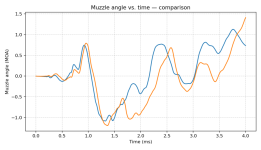
Win52D-factory-barrel-bare-vs-tuner.png

Here are some numbers associated with the blue curve, the bare barrel:
Muzzle launch-angle diagnostics (root-moment pulse):
Modes used: 16 Damping ζ: 0.010
Force source: CSV (force_curve-Win52D.csv)
Exit time used: 2.310518 ms (source: CSV map)
Peak muzzle angle: 1.129 MOA
Peak muzzle angular rate: 8.109 MOA/ms
At t = 2.3105183 ms: angle = 0.737 MOA, rate = 0.987 MOA/ms
Saved plot: muzzle_angle_vs_time.png
Saved JSON: Win52D-factory-barrel-bare-25C.json
Bare natural frequencies: 50.00 Hz, 260.79 Hz, 691.87 Hz, 1335.66 Hz, 2193.98 Hz, 3266.78 Hz, 4554.10 Hz, 6055.94 Hz, 7772.32 Hz, 9703.24 Hz, 11848.69 Hz, 14208.69 Hz, 16783.22 Hz, 19572.30 Hz, 22575.92 Hz, 25794.08 Hz
With lumped masses: N/A

I'm not quite happy with my ammo parameters yet, as the exit time likely should be somewhere in the region of 2.1-2.15 milliseconds, but that doesn't really matter for the sake of this discussion. With the parameters it is currently using, the shot exits at around 2.31 milliseconds and the barrel is swinging upwards at a rate of 0.987 MOA/millisecond. Then after we add the 252-gram Harrell tuner we get this:

Muzzle launch-angle diagnostics (root-moment pulse):
Modes used: 16 Damping ζ: 0.010
Force source: CSV (force_curve-Win52D.csv)
Exit time used: 2.310518 ms (source: CSV map)
Peak muzzle angle: 1.481 MOA
Peak muzzle angular rate: 8.820 MOA/ms
At t = 2.3105183 ms: angle = -0.110 MOA, rate = 5.341 MOA/ms
Saved plot: muzzle_angle_vs_time.png
Saved JSON: Win52D-factory-barrel-old-tuner-25C.json
Bare natural frequencies: 50.00 Hz, 260.79 Hz, 691.87 Hz, 1335.66 Hz, 2193.98 Hz, 3266.78 Hz, 4554.10 Hz, 6055.94 Hz, 7772.32 Hz, 9703.24 Hz, 11848.69 Hz, 14208.69 Hz, 16783.22 Hz, 19572.30 Hz, 22575.92 Hz, 25794.08 Hz
With lumped masses: 47.94 Hz, 202.77 Hz, 614.12 Hz, 1316.05 Hz, 1898.08 Hz, 3187.93 Hz, 4296.17 Hz, 5583.63 Hz, 7771.75 Hz, 8963.51 Hz, 11453.60 Hz, 14000.10 Hz, 15718.40 Hz, 19438.48 Hz, 21684.80 Hz, 24831.07 Hz

Now we've got the barrel swinging upwards at a rate of 5.341 MOA/millisecond when the shot exits. The ammo itself is going to change the upswing rate you ultimately need for a 50-yard tune by a little bit, but it would generally need to be somewhere in the 5-6 MOA/ms region to provide the optimal amount of positive compensation for that distance. The bare barrel's 0.987 MOA/ms value is nowhere near that. That means you're going to be largely at the mercy of the ammo's velocity variation because this slow upswing rate isn't going to provide very much positive compensation. That amount of positive compensation, 0.987 MOA/ms, will have a small effect, but where shots impact is largely going to be governed by muzzle velocity. But with the tuner installed, that 5.341 MOA/ms will be fairly close to the optimal amount of positive compensation needed for 50 yards. That means it is going to be doing a fairly decent job of altering the launch angle just enough for the muzzle velocity differences.

At least, if the ammo were very consistent in its ignition and burn behaviour it would do a fairly decent job of giving the appropriate amount of positive compensation. Burn rate differences from shot to shot in the primer compound and the powder, plus the amount of powder, and the bullet weight will all affect the variance in shot exit time, even when the muzzle velocity is the same. So you still see variance on target due to that. But the barrel itself will be doing a pretty decent job at its portion of the total job. This is why you still need good target ammo, and why a tuner isn't going to make Remington Golden Bullet shoot just as well as Lapua Midas+. You get better shot exit timing consistency with better ammo. And that's just as important as a barrel helping you as much as it can.

Every barrel is different. Their dimensions change what the base natural frequencies are, its harmonics, and those are what sum to give the overall shape of the movement trace. And you'll need a particular amount of added weight to change those frequencies by an amount that will be helpful for your intended target distance. As you can see in the second set of figures, the ones for when the tuner is installed, it lists both the bare natural frequencies and what they've been changed to by adding the lumped mass. The two sets of frequencies are fairly different. And that'll mean when you sum the individual waveforms at those frequencies you'll get an overall trace that is also quite different. And so, benchrest performance requires that you have a barrel contour and length that will show movement a bit faster than what you need for your target distance, and then you need to add a certain amount of weight to slow it down just enough to give good positive compensation. A given amount of weight changes how a given barrel moves in a particular way. Change the amount of weight and it'll change its behaviour again. In other words, you can't just throw a random tuner on a random barrel and expect it to give good results. You have to have a good starting point, and you have to alter things by just the right amount with just enough added weight. I have three different screw-on weights for my Harrel. Here's what happens if I throw on the lightest one, an 82-gram aluminum one, for a total weight of 334 grams instead of the 252 grams that was used in the previous example. The graph is the same as before, only now with a green line added for the tuner with the weight installed.
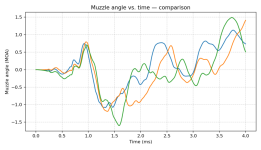
Win52D-factory-barrel-bare-vs-tuner-weight.png

Now we have a huge problem. Not long after we pass the 2.0-millisecond mark, and we are now expecting the round to exit shortly, the barrel is in a downswing. A barrel in a downswing is providing negative compensation. That means the muzzle velocity variance is actually producing more elevation variance on target. It is making things worse. Here's the data for that setup.

Muzzle launch-angle diagnostics (root-moment pulse):
Modes used: 16 Damping ζ: 0.010
Force source: CSV (force_curve-Win52D.csv)
Exit time used: 2.310518 ms (source: CSV map)
Peak muzzle angle: 1.599 MOA
Peak muzzle angular rate: 10.122 MOA/ms
At t = 2.3105183 ms: angle = -0.223 MOA, rate = -1.479 MOA/ms
Saved plot: muzzle_angle_vs_time.png
Saved JSON: Win52D-factory-barrel-old-tuner-25C-82weight.json
Bare natural frequencies: 50.00 Hz, 260.79 Hz, 691.87 Hz, 1335.66 Hz, 2193.98 Hz, 3266.78 Hz, 4554.10 Hz, 6055.94 Hz, 7772.32 Hz, 9703.24 Hz, 11848.69 Hz, 14208.69 Hz, 16783.22 Hz, 19572.30 Hz, 22575.92 Hz, 25794.08 Hz
With lumped masses: 44.70 Hz, 203.53 Hz, 689.95 Hz, 1123.78 Hz, 2183.49 Hz, 2875.39 Hz, 4526.23 Hz, 5484.68 Hz, 7712.51 Hz, 8962.94 Hz, 11738.97 Hz, 13316.06 Hz, 16602.93 Hz, 18547.83 Hz, 22302.49 Hz, 24660.65 Hz

Now we see it is swinging at -1.479 MOA/ms at shot exit. So instead of giving slower shots a higher launch angle it is aiming slower shots downwards even more than it is aiming faster shots. It is amplifying the elevation on target giving you even worse performance. The amount of weight is now horrible for that particular barrel length and contour. It is hurting your score rather than helping it. You must have a suitable barrel and a tuner that is suitable for that barrel. Pairing random barrels and random tuners together does not work.

And in case you're curious about how much of a difference the tuner's range of click adjustment makes, that 5.341 MOA/ms at 0 clicks without the screw-on weight installed becomes 5.304 MOA/ms at 500 clicks, which is moving the outer portion outwards by 0.5 inches, when talking about that particular barrel. Not a large change. How much difference that makes will naturally vary depending on barrel spec, and whether or not you've added screw-on weights. The adjustment range of the tuner is more or less supposed to allow you to account for small ammo differences and temperature differences throughout the year. You've got to play with barrel specs and amount of total tuner weight to make large changes.

 
Last edited:
Nice contribution _Shorty. I have experienced tuner/weight combinations that put a rifle into 'negative compensation'. It is very striking when it happens.

I finally got my Harrell fitted to the 1913 and have been unable to find any magic at two different weights. I went back to the Starik and started keeping ARA UL scores ... I'm 2124 on 74 targets. Can't argue with those results. I'll try the Harrell again on the next case/lot of ammo. The Starik is a much more subtle instrument ... lighter overall and but with larger increments.

 
A friend of mine got a set of screw-on weights that went in 1-ounce increments. That was nice for doing some investigation into how much weight the barrel was happy with. It was surprising to see how much vertical stringing there was with a certain amount of weights installed. I like using 1/4-ounce (about 7 grams) stick-on lead wheel weights normally used for balancing car tires for that investigation for even finer steps.
 
I have trouble believing that on a heavy barrelled 22 rimfire, that barrel oscillation is a significant source of inaccuracy. And that by moving the weight slightly alters that oscillation enough to improve accuracy. I can readily accept that on a high pressure centre fire cartridge, the barrel oscillates enough that finding a node might make a difference, but I am skeptical about a heavy barrelled 22 rimfire. I remain open minded, but a better barrel and better ammo would do more for me than a tuner (I speculate!).
A tuner cannot, will not make bad ammo nor bad barrel good. All it can do is change the 'tune' of a good barrel to hopefully, agree with quality match ammo you can find

in super simple terms, let's say the match barrel has a tune of 7... and match ammo has a tune of 9... and you have a weight with the ability to change the barrel tune +/- 3. There is a good chance, you can make this combo work.

Conversely, if the barrel and ammo tune is WIDER then what the 'weight' can change, nothing you do with that weight will provide the desired outcome.

Ideally, you want a naked barrel and ammo combo to work... less fussing, less chance for things to go wrong. However, given the lack of ammo options, sometimes you have to 'force' the barrel to like the ammo you can find.

And here, a tuner of sufficient mass is a necessary evil...

Jerry
 
Thinking about adding a tuner to my CZ457 VPC .22lr. I know about the Red Knob Tuna Can and just watched Eric Cortina’s video about EC V2 tuner. What’s your experience? Anyone have better tuna’s recommendations? And how much do they really tighten your groups?

And does the cost justify the increase in accuracy? Not interest in looking cool but confirming results that make the $300+/- investment a worthwhile addition.
See my post above, a tuner isn't good nor bad (assuming it is machined properly and doesn't rattle loose). The goal is to find a weight that suits your system. A tuner too heavy or light, leads to poor results. If you can, test a few weights to see where your barrel wants to tune. I have run 6ozs to 16ozs on various rifles and barrels to get the end results I wanted.

The heaviest tuner will usually have the largest affect... so if you had to choose one, the Red Knobb is the heaviest I am aware of. Especially good choice if shooting PRS and need the forward weight.

If that CZ has a sporter chamber, I wouldn't invest in a tuner for it as the chances of really improving accuracy is low.

Jerry
 
Back
Top Bottom