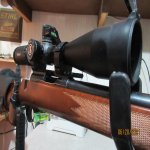
Wheeler Level Level, All junk?

Always make sure to test levels before using them, I've found a ton levels are off.

I have a Wheeler set and both of them are properly level, but I have absolutely seen the same brand be off and had to be returned.

Also, one thing a lot of people think is "off" is that a scope may not necessarily be centered left/right on the rifle (Especially if you have a picatinny rail and rings) as it may push the scope off to one side and make it look "off". That's why I really like the Warne rings as they are vertically split and clamp evenly on the picatinny rail and make sure it's perfectly centered on your rifle.
 
Even good levels can loose their accuracy over time, often from rough handling on a job site. A thing to remember is that not all scopes have the reticle center and squared perfectly within the body of the scope. This more often occurs in less expensive scopes but can appear from time to time on higher end scopes. Using the flat part of the scope (most often the adjustment cap) can sometimes be misleading when the reticle axis is not square and level to adjustment cap. This point is more important in high accuracy rigs but is still important with value/budget set ups. Phil.
 
I don’t know I guess I lucked out, I bought the wheeler level level at Can Tire and mine seem to read true compared to my other shop levels. That being said though IMO the only way to get a perfect level on the crosshairs is with a plumb bob. Quit often the crosshairs are not in perfect alignment with the adjustment turrets and the turrets and caps are quite often rounded and not flat making the level useless for this purpose.
 
Levels

Measure it with a micrometer, mark it with chalk, and then cut it with a torch! Understand?
I was once tasked with installing a large piece of equipment that needed to be level. I was very unfortunate in that I had an engineer working with me. He had a high precision level and he was determined to get this equipment level. The problem was, the level was a 12 inch level and the framework of the equipment was made from structural steel! With the 12 inch level, he told me raise that corner, turned the level 90 degrees, lower that corner! The frame had more runout over the 12 foot length! If he got it perfectly level at one end, moving the level across and checking each foot, it would be, low, really low, high, low, really high,,,,, The frame just wasn't straight! I went out and bought a 5 foot carpenter level, set it in the middle, leveled it side to side and end to end, job done.
Use the right tools for the job. That precision level was very expensive, don't know the exact price, the carpenter level was about 40 bucks and did the job. Horizontal is a little difficult, vertical, all you need is a plumb line, gravity will take care of the rest!
BTW, a simple check of a level, rotate it 180 and see if the indicated level changes.
 
Last edited:
Crap, now I need to go check my wheeler level ��

I think actually if you are going to measure or test anything, have to verify your tool or meter is accurate. Perhaps why Mitotoyo Micrometers come with a gauging standard, whereas many less expensive things do not. Yes, a Canadian Tire $16 caliber might read out to 5 decimal places - but says right on the package that it is accurate to plus or minus 3 places. Any decent construction company will have a place to check your tape measure - so check 30 of them - going to be chucking quite a number. If guy up on rafters calls for a 19 7/8" 2x4 and you deliver a 20 1/16" by his tape, going to be "sparks"...
 
plumb line is very efficient as well as any wall of home if they re squared ...


I considered setting up in my back yard and using the big window on a neighbours house as a climb line since they are always looking out the window ....... but they may not appreciate my sense of humour so I decided not to take that suggestion from that voice inside of my head LOL
 
Back
Top Bottom