









































You are using an out of date browser. It may not display this or other websites correctly.
You should upgrade or use an alternative browser.
You should upgrade or use an alternative browser.
Where To Wear Your Holster
- Thread starter Max Owner
- Start date



Johnn Peterson
CGN Ultra frequent flyer
- Location
- Chemainus B.C.
This thread is funny. Carrying in the bush is not "real world".
You dont know what you dont know.
What you say may well be true, but it all depends on the use you have in mind for a sidearm. For me, it would be hunting, but in the meantime, enlighten us please as to what the "real world' is.
This thread is funny. Carrying in the bush is not "real world".
You dont know what you dont know.
No bush at the end of the world eh.....bummer.

I'll buy the safety issue. It is the only good reason I could think of as well (though in the remote bush, I'd rather fire an accidental round into the ground off to my left rather than somewhere straight down in the vicinity of my foot as the Cougar landed on my head). However, the undercover cop with the pistol in his fanny pack would have the same problem as crossdraw. When I draw from my crossdraw holster, I'd say the barrel is pointing at a 45 degree angle toward the ground off to the left. From that point it would sweep a rising arc toward the target.The main reason is the actual draw of the gun, when you draw from crossdraw you sweep 90 degrees and point your muzzle at everything from 9:00 to 12 o'clock. From strong side... you move the gun straight up and if you should squeeze a shot prematurely it would hit the floor or the BG's legs!
It is also easier to miss when you move horizontally than vertically!
It's all about safety!
OK
okcorral1881
CGN Ultra frequent flyer
- Location
- East of Toronto
Perhaps I'm missing something, but cross draw, yes, you do sweep 90 degrees, usually left to right. Shoulder rig, same 90 degrees, left to right. From the hip mounted, same 90 degrees except vertical.
Yes but the 90 degrees you sweep left to right, your muzzle could point many buystanders, your partner etc. (we're talking a city officer)
OK
Johnn Peterson
CGN Ultra frequent flyer
- Location
- Chemainus B.C.
I'll buy the safety issue. It is the only good reason I could think of as well (though in the remote bush, I'd rather fire an accidental round into the ground off to my left rather than somewhere straight down in the vicinity of my foot as the Cougar landed on my head). However, the undercover cop with the pistol in his fanny pack would have the same problem as crossdraw. When I draw from my crossdraw holster, I'd say the barrel is pointing at a 45 degree angle toward the ground off to the left. From that point it would sweep a rising arc toward the target.
To me anyway, it's starting to look more like an issue of firearms training and handling issues rather than a question of method of conveyance.

Johnn Peterson
CGN Ultra frequent flyer
- Location
- Chemainus B.C.
Yes but the 90 degrees you sweep left to right, your muzzle could point many buystanders, your partner etc. (we're talking a city officer)
OK
In hunting situations and quite probably the circunstances of a LEO,
as/post # 47.
okcorral1881
CGN Ultra frequent flyer
- Location
- East of Toronto
I'll buy the safety issue. It is the only good reason I could think of as well (though in the remote bush, I'd rather fire an accidental round into the ground off to my left rather than somewhere straight down in the vicinity of my foot as the Cougar landed on my head). However, the undercover cop with the pistol in his fanny pack would have the same problem as crossdraw. When I draw from my crossdraw holster, I'd say the barrel is pointing at a 45 degree angle toward the ground off to the left. From that point it would sweep a rising arc toward the target.
I agree with you in the bush crossdraw is perfect...for cowboy shooting or horseback carry and shooting it's perfect but for an officer in uniform in a city...as they say it's a step closer to an accident!

Also, as to the crossdraw vs. etc. discussion, note that the way LEO carries they draw and the gun is pointing forward (possibly shooting, they should be trained to come up shooting if necessary) and they push the gun forward till both hands meet and the sights line up. The big thing is right away the muzzle is pointing at Mr. Badguy. That doesn't happen with a crossdraw position as discussed previously.
Shoulder holsters are notoriously slow and awkward to access. Great for the detective or secret squirrel type who should be carrying but not expected to use it. Shoulder holsters share some of the same downfalls as cross draw as well, namely the ease at which someone can either strip you of your gun or stuff the draw.
Cross draw is also known as a deadman's draw. Reaching cross body takes more time than reaching strong side. It also telegraphs your intentions long before you ever have a chance at putting lead down range. Again, stuffing the draw or stripping you of your gun with such a holster is childs play.
As for the issue about "safety". That's complete crap and no one who carries a firearm professionally gives a rats a$$ if the muzzle happens to sweep someone behind or beside them as they draw their gun. Trigger finger discipline is more than enough to keep those scary self thinking baby killers from going off.
Strong side or slightly further back is where the most speed and concealment is had.
TDC
Cross draw is also known as a deadman's draw. Reaching cross body takes more time than reaching strong side. It also telegraphs your intentions long before you ever have a chance at putting lead down range. Again, stuffing the draw or stripping you of your gun with such a holster is childs play.
As for the issue about "safety". That's complete crap and no one who carries a firearm professionally gives a rats a$$ if the muzzle happens to sweep someone behind or beside them as they draw their gun. Trigger finger discipline is more than enough to keep those scary self thinking baby killers from going off.
Strong side or slightly further back is where the most speed and concealment is had.
TDC
Some interesting points raised in this discussion. The point about a faster draw and sweep straight ahead and up is a good one. However, for a fellow in the bush with an antique pistol with an 8" barrel, strong side draw means the grip is practically in my armpit before the muzzle clears the holster, which make the draw slow and awkward. Of course, in the city with modern pistols, the barrel length is much shorter and I agree that the strong side draw is faster and sooner on target.
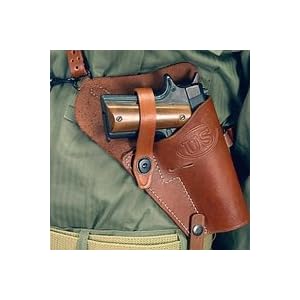
I don't agree that a cross draw worn as in my photo is 'child's play' to be stripped of my gun. Maybe if the cross draw holster is at the 9 o'clock position, but not if the grip is almost right in front of your stomach. In that position, I have two hands to secure my pistol. Strong side, I have only one. I've seen two videos of actual situations where a LEO was stripped of his weapon, shot and killed. In both cases, it was two BG's on one LEO, where the first BG managed to grab/pin the LEO's right arm or both arms. The second BG relieved him of his weapon and shot him. Had the LEO's weapon been in a crossdraw holster on his stomach, he could have still bent either arm at the elbow to secure his weapon and, quite possibly grip the holster in his left, pulling it slightly back while gripping his weapon in his right, drawing it out. The point is that while his upper arms were pinned and immobilized, his lower arms could easily swing forward but there was nothing there to grab. The problem with securing your weapon strong side when your upper arms are pinned or gripped by one BG is that it is more difficult to reach around with your left arm to your 3 o'clock position, if you can move either upper arm at all. At least, that seemed to be the problem in the two videos I saw.
There seems to be an assumption that ones right hand is always near the butt of your strong side. I don't find that at all. I'm always doing something, or working on something, with my right hand just inches from the grip. Still, I do agree with the point that if your right hand is already hanging by your side, with a modern pistol strong side draw is faster (though I still think it is less secure if your right arm gets pinned). Of course, I will say outright that I have zero training on securing a pistol, but I have had (unfortunately) years of experience in fighting in my younger days, on a very regular basis and I can't imagine walking into a threat with my hands hanging down by my sides. They were always in front (or at least one was).
On the other hand, the context within which my experience is, is in the remote wilderness, where BG's are not the problem nor are innocent bystanders off to one side in the swamp. The primary consideration for me is wearing the holster in a comfortable position that is out of the way and not banging into rocks, canoe gunnels, or constantly snagging on trees and brush during a portage. Strong side or a 9 o'clock cross draw is very impractical in those circumstances. Chances of a problem are low and speed of draw is not likely going to be a factor with a bear or Cougar. I have encountered several black bears and one very large cougar over the years, two of which were threatening .... one bear charged me for reasons that are beyond me and broke off at the last second and another bear caught me walking through the bush with a stringer full of Jackfish. He stood up and eyed me for several seconds, figuring out whether he wanted my fish or not, and then he decided to leave. In either case, I would have had lots of time to haul out my pistol if I had had one at the time ..... which convinced me I should always have something at hand, especially since I've been taking my wife and kids into the remote wilderness for the past 20 years on canoeing, camping trips and the rifle is always cased and unloaded because of the kids in camp ... and the bears and Cougar never showed up when they were expected to, always when they were not expected.
With regard to how LEO's should wear their pistols, I have zero training and know sweet tweet about it. I just know what works for me in the bush and what I've seen re. LEO's with their right arm or both arms pinned when their forearms could still have moved forward to grab a gun holstered across their stomach and, at the very least, secure it with both hands. But, as I said, that is not the context I'm in, in the remote wilderness with an antique pistol and cutting firewood, making a meal, portaging, fishing, taking a dump, etc. Draw speed and securing my pistol are not issues. The most important thing is keeping it out of the way of my work in a comfortable position so it is at least at hand should a bear or cougar cause a problem for me or my wife and kids, when the rifle is usually cased and unloaded 50 feet away. That may not be the 'real' world, but it is the only world in which I pack iron.
I don't agree that a cross draw worn as in my photo is 'child's play' to be stripped of my gun. Maybe if the cross draw holster is at the 9 o'clock position, but not if the grip is almost right in front of your stomach. In that position, I have two hands to secure my pistol. Strong side, I have only one. I've seen two videos of actual situations where a LEO was stripped of his weapon, shot and killed. In both cases, it was two BG's on one LEO, where the first BG managed to grab/pin the LEO's right arm or both arms. The second BG relieved him of his weapon and shot him. Had the LEO's weapon been in a crossdraw holster on his stomach, he could have still bent either arm at the elbow to secure his weapon and, quite possibly grip the holster in his left, pulling it slightly back while gripping his weapon in his right, drawing it out. The point is that while his upper arms were pinned and immobilized, his lower arms could easily swing forward but there was nothing there to grab. The problem with securing your weapon strong side when your upper arms are pinned or gripped by one BG is that it is more difficult to reach around with your left arm to your 3 o'clock position, if you can move either upper arm at all. At least, that seemed to be the problem in the two videos I saw.
There seems to be an assumption that ones right hand is always near the butt of your strong side. I don't find that at all. I'm always doing something, or working on something, with my right hand just inches from the grip. Still, I do agree with the point that if your right hand is already hanging by your side, with a modern pistol strong side draw is faster (though I still think it is less secure if your right arm gets pinned). Of course, I will say outright that I have zero training on securing a pistol, but I have had (unfortunately) years of experience in fighting in my younger days, on a very regular basis and I can't imagine walking into a threat with my hands hanging down by my sides. They were always in front (or at least one was).
On the other hand, the context within which my experience is, is in the remote wilderness, where BG's are not the problem nor are innocent bystanders off to one side in the swamp. The primary consideration for me is wearing the holster in a comfortable position that is out of the way and not banging into rocks, canoe gunnels, or constantly snagging on trees and brush during a portage. Strong side or a 9 o'clock cross draw is very impractical in those circumstances. Chances of a problem are low and speed of draw is not likely going to be a factor with a bear or Cougar. I have encountered several black bears and one very large cougar over the years, two of which were threatening .... one bear charged me for reasons that are beyond me and broke off at the last second and another bear caught me walking through the bush with a stringer full of Jackfish. He stood up and eyed me for several seconds, figuring out whether he wanted my fish or not, and then he decided to leave. In either case, I would have had lots of time to haul out my pistol if I had had one at the time ..... which convinced me I should always have something at hand, especially since I've been taking my wife and kids into the remote wilderness for the past 20 years on canoeing, camping trips and the rifle is always cased and unloaded because of the kids in camp ... and the bears and Cougar never showed up when they were expected to, always when they were not expected.
With regard to how LEO's should wear their pistols, I have zero training and know sweet tweet about it. I just know what works for me in the bush and what I've seen re. LEO's with their right arm or both arms pinned when their forearms could still have moved forward to grab a gun holstered across their stomach and, at the very least, secure it with both hands. But, as I said, that is not the context I'm in, in the remote wilderness with an antique pistol and cutting firewood, making a meal, portaging, fishing, taking a dump, etc. Draw speed and securing my pistol are not issues. The most important thing is keeping it out of the way of my work in a comfortable position so it is at least at hand should a bear or cougar cause a problem for me or my wife and kids, when the rifle is usually cased and unloaded 50 feet away. That may not be the 'real' world, but it is the only world in which I pack iron.
Some interesting points raised in this discussion. The point about a faster draw and sweep straight ahead and up is a good one. However, for a fellow in the bush with an antique pistol with an 8" barrel, strong side draw means the grip is practically in my armpit before the muzzle clears the holster, which make the draw slow and awkward. Of course, in the city with modern pistols, the barrel length is much shorter and I agree that the strong side draw is faster and sooner on target.
I don't agree that a cross draw worn as in my photo is 'child's play' to be stripped of my gun. Maybe if the cross draw holster is at the 9 o'clock position, but not if the grip is almost right in front of your stomach. In that position, I have two hands to secure my pistol. Strong side, I have only one. I've seen two videos of actual situations where a LEO was stripped of his weapon, shot and killed. In both cases, it was two BG's on one LEO, where the first BG managed to grab/pin the LEO's right arm or both arms. The second BG relieved him of his weapon and shot him. Had the LEO's weapon been in a crossdraw holster on his stomach, he could have still bent either arm at the elbow to secure his weapon and, quite possibly grip the holster in his left, pulling it slightly back while gripping his weapon in his right, drawing it out. The point is that while his upper arms were pinned and immobilized, his lower arms could easily swing forward but there was nothing there to grab. The problem with securing your weapon strong side when your upper arms are pinned or gripped by one BG is that it is more difficult to reach around with your left arm to your 3 o'clock position, if you can move either upper arm at all. At least, that seemed to be the problem in the two videos I saw.
There seems to be an assumption that ones right hand is always near the butt of your strong side. I don't find that at all. I'm always doing something, or working on something, with my right hand just inches from the grip. Still, I do agree with the point that if your right hand is already hanging by your side, with a modern pistol strong side draw is faster (though I still think it is less secure if your right arm gets pinned). Of course, I will say outright that I have zero training on securing a pistol, but I have had (unfortunately) years of experience in fighting in my younger days, on a very regular basis and I can't imagine walking into a threat with my hands hanging down by my sides. They were always in front (or at least one was).
On the other hand, the context within which my experience is, is in the remote wilderness, where BG's are not the problem nor are innocent bystanders off to one side in the swamp. The primary consideration for me is wearing the holster in a comfortable position that is out of the way and not banging into rocks, canoe gunnels, or constantly snagging on trees and brush during a portage. Strong side or a 9 o'clock cross draw is very impractical in those circumstances. Chances of a problem are low and speed of draw is not likely going to be a factor with a bear or Cougar. I have encountered several black bears and one very large cougar over the years, two of which were threatening .... one bear charged me for reasons that are beyond me and broke off at the last second and another bear caught me walking through the bush with a stringer full of Jackfish. He stood up and eyed me for several seconds, figuring out whether he wanted my fish or not, and then he decided to leave. In either case, I would have had lots of time to haul out my pistol if I had had one at the time ..... which convinced me I should always have something at hand, especially since I've been taking my wife and kids into the remote wilderness for the past 20 years on canoeing, camping trips and the rifle is always cased and unloaded because of the kids in camp ... and the bears and Cougar never showed up when they were expected to, always when they were not expected.
With regard to how LEO's should wear their pistols, I have zero training and know sweet tweet about it. I just know what works for me in the bush and what I've seen re. LEO's with their right arm or both arms pinned when their forearms could still have moved forward to grab a gun holstered across their stomach and, at the very least, secure it with both hands. But, as I said, that is not the context I'm in, in the remote wilderness with an antique pistol and cutting firewood, making a meal, portaging, fishing, taking a dump, etc. Draw speed and securing my pistol are not issues. The most important thing is keeping it out of the way of my work in a comfortable position so it is at least at hand should a bear or cougar cause a problem for me or my wife and kids, when the rifle is usually cased and unloaded 50 feet away. That may not be the 'real' world, but it is the only world in which I pack iron.
You're right, long barreled pistols can present issues for strong side carry. A lowered holster can solve this, but cross draw does as well.
The incidents of officers being stripped are not solely due to where they wear their guns. Poor situational awareness/tactics, failing to react quick enough and being out numbered play a role. I never said you couldn't stuff a draw from a strong side holster, I simply said it was easier to stuff a draw with the crossdraw holster. For the LE, speed is the name of the game and strong side is the fastest practical option. Keeping your gun away from people is easier done with a strong side. Think about cuffing a suspect, a cross draw puts your pistol close to the guys hands. Same deal if you had to go hands on. Generally you face your opponent when fighting which would put your gun between you and him, not a great plan.
TDC
You are right about where the weapon would be, but if my hands are in front and another BG steps in from the side or behind, my weapon is wide open, especially if the fellow in front is keeping my hands busy. I have seen countless situations where the LEO has his hands engaged doing something and the strong side pistol is wide open for some fool to try to go for it. That being said, I know nothing about LEO training in these things. It seems that a major part of training must be in controlling the situation, including where all the BG's are standing and how far away they keep, etc. while you are engaging one of them. The bush is a very different place where the bears seldom go for a fellow's gun and the criteria are totally different.Generally you face your opponent when fighting which would put your gun between you and him, not a great plan.
You are right about where the weapon would be, but if my hands are in front and another BG steps in from the side or behind, my weapon is wide open, especially if the fellow in front is keeping my hands busy. I have seen countless situations where the LEO has his hands engaged doing something and the strong side pistol is wide open for some fool to try to go for it. That being said, I know nothing about LEO training in these things. It seems that a major part of training must be in controlling the situation, including where all the BG's are standing and how far away they keep, etc. while you are engaging one of them. The bush is a very different place where the bears seldom go for a fellow's gun and the criteria are totally different.
Exactly right. There is no perfect solution. Allowing unknowns to enter your peripheral or circle behind you is bad form. For the majority of confrontations where the individual(s) is in front, the strong side holster is ideal. If a bear is reaching for your gun in the bush, I would be very concerned.
TDC
Johnn Peterson
CGN Ultra frequent flyer
- Location
- Chemainus B.C.
You are right about where the weapon would be, but if my hands are in front and another BG steps in from the side or behind, my weapon is wide open, especially if the fellow in front is keeping my hands busy. I have seen countless situations where the LEO has his hands engaged doing something and the strong side pistol is wide open for some fool to try to go for it. That being said, I know nothing about LEO training in these things. It seems that a major part of training must be in controlling the situation, including where all the BG's are standing and how far away they keep, etc. while you are engaging one of them. The bush is a very different place where the bears seldom go for a fellow's gun and the criteria are totally different.
Good post Kirk
.
okcorral1881
CGN Ultra frequent flyer
- Location
- East of Toronto
That may not be the 'real' world, but it is the only world in which I pack iron.
Kirk, don't you find it sad that we are surrounded by ''real world experts'' on handgun carry but unfortunately they won't share their real life experience
!!!So much knowledge lost!
OK
What you say may well be true, but it all depends on the use you have in mind for a sidearm. For me, it would be hunting, but in the meantime, enlighten us please as to what the "real world' is.
Real world as in you use it against predators of the two legged variety.
Johnn Peterson
CGN Ultra frequent flyer
- Location
- Chemainus B.C.
Real world as in you use it against predators of the two legged variety.
Fair enough and I wasn't trying to twist your tail. The real world for me or my focus, would be use in the field in a hunting scenario. Not being a LEO or having to contend with the circumstances they come up against, that set of conditions wasn't my point of interest.