












































You are pulling a classic bait-and-switch by projecting the strict structural claustrophobia of a fat . 300 Norma Magnum container onto a modern, linear .300 PRC engine......bylooking at the actual engineering blueprints, working from the inside out:
No.1) The Cartridge Runway:
Because the .300 Norma features a massive, oversized .585" case head, standard sheet-metal magazines (like MDT's .338LM/.300NM lines) are forced to use thickened internal guide walls and heavy front binder blocks just to keep that fat case tracking straight without tilting. That internal armor is what completely steals your runway, choking your maximum loading space down to that restricted 3.735" to 3.750" ceiling you keep singing about.
No.2) The .300 PRC Advantage:
Because the PRC utilizes a highly efficient, standard-width .532" footprint, its dedicated CIP magazine shells do not need those space-stealing internal side blocks. A true .300 PRC CIP magazine leaves a completely open, unblocked internal runway clearing up to 3.840"+ internally. This allows a handloader running ultra-long projectiles like the 245gr Berger EOL to seat them cleanly forward, maximizing net powder volume and keeping the bullet from acting like a piston. If the inside max was 3.750" like you claim, standard factory .300 PRC ammo (which has a SAAMI max spec of 3.700") would have a useless 0.050" of clearance.
No.3) The Magazine Casing & Magwell:
The sheet steel walls of a premium box are roughly 0.035" thick on each side. When you add those steel walls to the 3.840"+ internal clearance, the physical exterior length of the metal box itself measures right around 3.850 inches. Because a steel magazine box cannot friction-bind under field conditions, the physical cutout in the aluminum chassis frame--the magwell opening--is precision-machined to be roughly 3.900 inches long to accept that box shell
My S.A. Gen 7 chassis natively cuts a wide 3.900" magwell opening to accept a clean steel 3.850" box shell, giving my long-loaded 245gr rounds a full internal runway to feed and cycle flawlessly with zero uncompressed powder bottlenecks.
It kinda seems you are trapped inside the feeding defects of your own fat-case architecture and trying to force what I have as rifle to live in your restricted world. When you have time grab a digital caliper and measure a real CIP magwell before trying to write the rules.
By the way, any luck on the GRT feedback yet??
Or did the software's net capacity fields and bolt thrust metrics layout the exact compressed powder nightmare I told you it would?
Near 10%± up the sides of a sunk 245 berger that is totally wasted energy to push the Berger, but fantastic energy to pound the bolt face an̈d lugs!
Cheers
1) Your point is incorrect. I'll have to check out some MDT .338 magazines at the shop, but this doesn't sound right. I've had hundreds of these magazines pass through my hands and I don't recall them being shorter because of a binder plate. In my original .338 (proprietary mag) , the internal was 3.7 and the AICS are not shorter. The AICS magazine is 3.85" OAL OUTSIDE dimension. The magazine cut that is on the AICS stocks that I make is one size and accommodates both the .300 PRC and the .338 Lapua magazine.
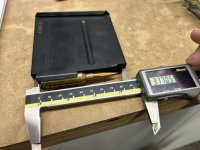
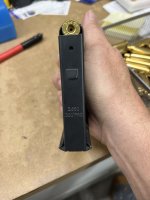
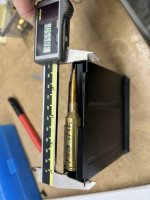
2) This tells me you've never handled a rifle, or loaded for one with a 3.85" AICS magazine.
3) This point is incredibly wrong. How do how do you add .035" X 2 to the "3.84"+ internal clearance", and get 3.85" exterior length? If your chassis has .05" front to back clearance, that magazine is going to nose down hard and rounds won't feed. Neither of these points make any sense.
Your logic that the .300 PRC has less projectile intrusion is completely backwards. As I stated in another post that the Norma is shorter, which you acknowledged. Looking at this picture, if you loaded BOTH to the same OAL that will fit in the magazine to a length that will function, of 3.725", the projectile will intrude into the Norma's case LESS than the PRC. It's obvious the neck shoulder junction is farther back than the PRC. How you argue against that is confusing. Your 'long skinny' theory holds no water, or powder for that matter. You chastised me for comparing ELR cartridges to BR cartridges and then yourself make a parallel to artillery rounds. I'm pretty sure ELR rounds are closer on the spectrum to a BR round than an artillery round.
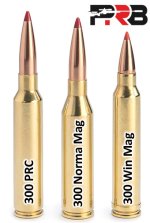
You're obviously passionate about your position, and I'd like to know if this is something you've learned through thousands of rounds and many barrels worn out winning ELR and KO2M competitions? I'd like a bit of provenance to back up what you're claiming, not 'trust me bro'. I have this vision in my head right now.

I love my 300 PRC, it's cheaper to shoot than the .585 case stuff, as an affordable ELR round, top of the pile. If I was going to get serious and compete again, there are others I'd pick. Most likely an improved .338 Lapua case either in .338 or .308. The XC intrigues me, but the brass end of things is a negative when I'm sitting on over 2K .338 Lapua brass.
If it's a short action, it's 100% a 6.5 PRC, I've seen it do amazing things. Hornady knew what they were doing, taking the belts off of cases, something that should have been done decades ago when we moved from the .300 H&H to all things with an actual shoulder to headspace off of.