Who repairs SMLE's?

slicknick

CGN Ultra frequent flyer
Rating - 99.2%
238   2   0
Location
Calgary, Alberta
I don't know what I did, but it must've been something....

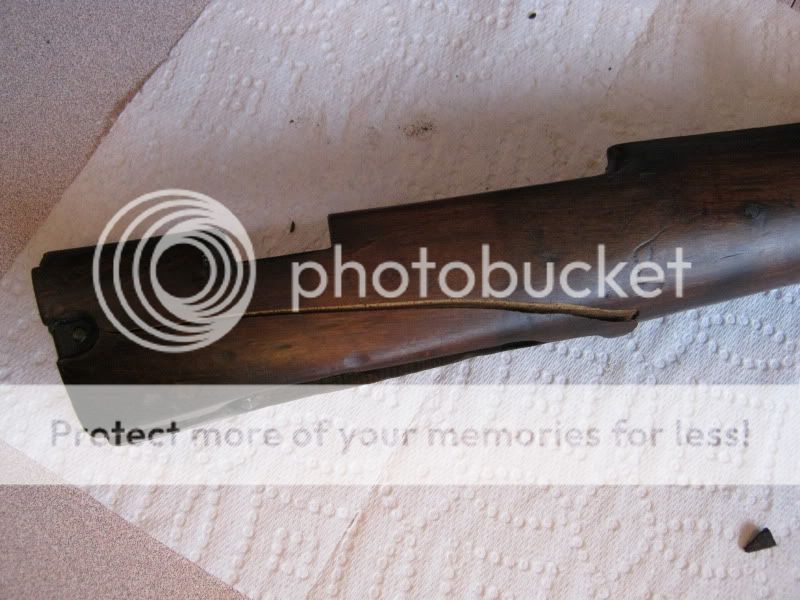
I went to take Gido's .303 out today and found a big crack going from the front action screw over onto the side of the reciever and all the way to the butt socket. I then removed the magazine to try and get a better look and a small piece of wood fell out! Now I can't find the damn wood!

I put surplus wood on Gido's old sporter when I was about 16 and haven't shot since I went to college. As best I figure is that I didn't get all the old oil/ grease out of the stock and a shift in temperature caused the wood to swell and crack.

I live in a small house without a shop/garage and the fiance won't like me taking over the kitchen table for a resto project. I also don't know what I'm doing. Ergo, I need a line on someone who knows a bit about repairing stocks and doing a proper refinish of the wood. Does the CGN community know someone (in AB, if possible) who does this kind of work?

Regards,

Nick

P.S. - (Pictures are coming)
 
Repairs

.
It looks like you have three choices.
A. Repair the stock
B. Replace the forestock
C. Wait until your Fiancee is out of the house. (I would not recommend replacing her as it could really be expensive.)

However, more information is definitely needed. Markings and pictures help to identify the proper model of rifle.

When you say "303", there are several models. Since you "removed the magazine," we will assume we are dealing with the Lee-Enfield System. The No. 1 rifle is identified by the rear sight half way up the barrel. The Number 4 rifle has a peep sight mounted on the rear of the action. These are the two most common models and the parts are different in them.

If a Number 1 SMLE rifle, look at the right side of the butt socket and the model number will be there, along with a date. The Number 4 rifle is similarly marked with a name or makers code number on the butt socket. There are other less common models.

You have not said if the rifle is a Sporter or Original Military rifle. If you have to replace the forestock, it makes a big difference in price as Sporterized stocks are relatively inexpensive but original Military stocks could cost you a lot more. With such a crack as you describe, it is probably easiest, simplest and cheapest to replace the forestock. Sporterized Lee-Enfield wood can be found for sale in the EE regularly, but you have to know the correct one. All this would involve is using a screw driver.

In any case, pictures are invaluable. If you post some pictures, then we can get a much better idea of what you have and what you need done.
.
 
Mea culpa, I should've been more specific. It is a No.1 Mk. 3 that was one of the plethora of sporters available in the 50's and 60's. I put into a set of DP wood so I could have something that resembled the classic military SMLE but also breathed life into Gido's old rifle.

An update on the stock:

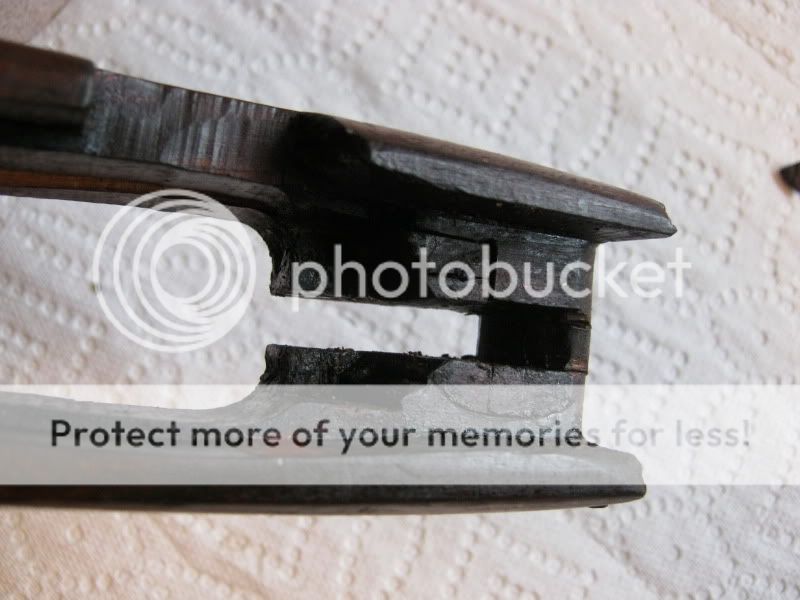
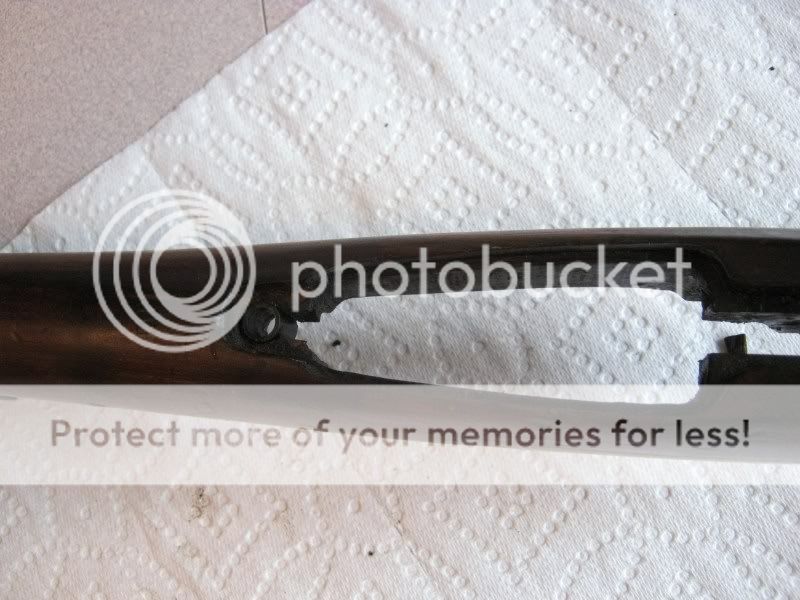
I removed the stock from the action and little bits of wood started falling off. The pictures should show what I'm talking about but, suffice to say, it's a real mess in there.

IMG_0855.jpg


IMG_0854.jpg


IMG_0853.jpg


As this is a mix-master I think I'll try to do the best I can as I don;t think this stock set will be much good to anyone without major work being done to it regardless. I'm at my Dad's for the weekend so I can do some tinkering without incurring the wrath of the Mrs.
 
.
Looks like a later model Indian made stock. It has "The Damned Crack" and the draws are chewed up and rounded over.

Try e-mailing Marstar as they got quite a bit of No. 1 wood from Greece a few months ago.

With the oil soaked wood on this one, it would be difficult to glue it back together even with epoxy. Replacement is probably the best way to go.
 
Nope, made sure the butt was as it should be (was given very detailed instructions by the guy I bought the wood from). It think years of hard use, teenage ignorance, and a cool cabinet came together for this one.
 
Gorrilla Glue, will put the "crack"/break back together but as mentioned, that stock needs so much more work done to it.

Go over to MilsurpKnoweldge site and check out the threads there, on just such occurrences and the proper fixes.

The ways, receiver bed at rhe rear, are pooched. It won't matter how well you fix the crack, the rifle won't shoot well until the "ways" are properly restored.

Look up Peter Laidler's posts on Milsurps. He has posted photos and diagrams that anyone can follow. You will need a few days, for the glue to dry properly, before you start to fit the receiver to the stock. Be careful. You need to keep the ways square to each other and the receiver.

I have a few very early No1 rifles that had the ways set with copper shims that were screwed into the wood. Lovely work but again, much care is needed.
 
Quite agree with BOBFORTIER, especially if $$ is a factor, although I generally use Brownell's Acra-Glas GEL.

I use the thinnest bed of AG GEL that I can possibly get away with. I'm not interested in doing a book-style bedding job; I just want to RESTORE the bedding to what it should be. I have this strange idea that, just perhaps, the factory that built these things might have a rough idea how they are supposed to be done.

Further, I don't use the Release Agent included with the AG GEL, but rather a very THIN coat of GREASE on the metal. I was using that pretty blue grease (highly visible for wiping off afterwards) but ran out, so now I am using this red grease. Almost out of the red, it looks, so I will have to find another tube of pretty blue ESSO UNITOL. You only need enough to coat the metal visibly: no ripples or heaps, just a super-thin, barely-visible coating that wipes off when you are done.

And I don't mix up a whole big bunch, either. Generally, I can rebed six stocks with a single AG GEL kit; the book sez ONE. All I want to do is bring the bedding back to what it was when new.

BEFORE you start with any repairs, though, get a spray-can of brake-pad or brake-drum cleaner and use that. Four bucks at the auto wholesale and worth every penny. It will pull soaked-in oil right OUT of the wood and leave you a surface which will accept your repair materials. You may have to spray several times. Spray, wipe off, respray an hour later, wipe down again. Keep going until no OIL comes out on a paper towel. Now your wood is DRY. It is now time to start with your repairs.

That stock looks awful right now but if you take it ONE STEP AT A TIME, it can be done and the repairs won't even show unless you look REALLY hard.

Go for it!
.
 
I agree with Smellie, it's a good candidate for learning how to do it right.

On the other hand, there are replacement forends which could be found.

I'd say: repair it, and do find a spare too! :)
 
Thanks for all the great advice in this thread, I now hae a place to start.

Looks like my Old man is going to become the steward for this project with me helping whenever I can. As this stock is a mess and not much good to anyone, we've decided we can at least try.

This is probably going into become a long-term project for us and I hope we'll have it done by hunting season.

Incidentally, upon closer inspection of the mess around the back end of the forestock, it is obvious it has been pinned together before. We found a couple square-ish chucks of wood being held in loosely by small brass pins.
 
Do you need a military-length fore end or do you simply need a cut-down sporterized one? in that case, I have lots of these unusable pieces of firewood in many colors lying around.
Show me the buttstock and I'll send you a matching one for the price of shipping.
PM me.
PP. :)
 
Anything is repairable, even this one. However, the wood looks to be oil soaked and crumbling. If you could work magic and put humpty back together again, I think that there will be likely problems further down the road.

Indian wood is not known to be always the best, although some of the early wood sets are made from imported english walnut. Not sure what species of local wood they used on subsequent runs.

You would be trying to turn a sow's ear into a ...sow's ear.

It appears that the damage is likely caused by poor bedding, the draws and trigger guard did not hold and recoil has hammered it all to hell
Get yourself another forearm and read up on bedding. The fit of those draws and the trigger guard are critical, otherwise you get a crack forming at the front trigger guard screw and..........

Perhaps you are up for the challenge, but an armourer would not waste his time making a dodgy repair, he would replace the fore arm I am sure. Just my tuppence worth.
 
Do you need a military-length fore end or do you simply need a cut-down sporterized one? in that case, I have lots of these unusable pieces of firewood in many colors lying around.
Show me the buttstock and I'll send you a matching one for the price of shipping.
PM me.
PP. :)

I'll nominate P.P. for CGN'er of the month! do we have a second'er?
 
Do you need a military-length fore end or do you simply need a cut-down sporterized one? in that case, I have lots of these unusable pieces of firewood in many colors lying around.
Show me the buttstock and I'll send you a matching one for the price of shipping.
PM me.
PP. :)

Damn decent of you but I still have the sporter wood that was on this rifle before I did the swap.
 
@Kayceel:

You're right. ANY chemical should be used only if there is adequate ventilation and a constant air interchange.

There are warnings on the can, of course, but many people don't read them. In the case of the brake-drum/brake-pad cleaner, the stuff is oddball enough that people just might read the instructions and pay attention. It gases off into the air at a ferocious rate, too, really calls attention to itself.

We use a LOT of different chemicals in our society. Sometimes the ones that we least suspect can do us in. I spent almost a year in a motorcycle shop in which the atmosphere was SATURATED with varsol. Come off work and your skin and clothing were covered with the stuff. Owner didn't care because it wasn't him spending 16 hours a day breathing the stuff. That was 20 years ago and that was when my health really started downhill. Of course, there is no disability because no forms were ever filled out: it didn't happen, like so MANY other industrial screw-ups.

But do be careful with the brake-cleaner; it IS a chemical and it is NOT supposed to be breathed.

But it just does such a GREAT job of removing old oil from wood!
.
 
Back
Top Bottom