












































You are using an out of date browser. It may not display this or other websites correctly.
You should upgrade or use an alternative browser.
You should upgrade or use an alternative browser.
Wilson Seaters?
- Thread starter chuck nelson
- Start date

Reloading: Seating Die Runout
Seating Die Induced Runout - A Comparison
by Germán A. Salazar
https://www.google.com/url?sa=t&rct...e-Runout.pdf&usg=AOvVaw0PTrUzbIFGXpTquMkz6CtT
The Rankings
And now, the moment you've been waiting for...
#1 - Redding Competition Seating Die (sliding sleeve type, threaded die)
The Redding, which I expected to finish high, did what I thought couldn't be done - it
produced rounds with an average runout that was less than the average case neck
runout of the brass used. In none of the ten rounds loaded did the Redding increase
the runout; it either held exactly the same or it decreased. The Redding, with an
Average Runout Change of -0.0003" is the winner. The negative sign, of course,
indicates a reduction in runout.
However, it's important to note that we're using a mathematical calculation that gives
a result that is smaller than the precision with which we can measure runout, so take
the numbers as what they are - smaller than we can reliably guarantee and more of a
ranking indicator than an exact measure of probable runout results. This applies to all
the dies.
#2 - Wilson (chamber type, for arbor press)
I expected the Wilson to come out on top, given it's long-standing reputation as the
best seating die and its near universal use in Benchrest shooting. It didn't quite work
out that way, but the Wilson was very good, with only three rounds increasing runout
and an equal number decreasing, the remainder were zero-change. Wilson Average
Runout Change: +0.00015".
#3 - RCBS Standard Die (standard threaded die)
I expected the RCBS to be dead last, maybe by a big margin; was I ever wrong! I
was really surprised, quite pleasantly, by the RCBS die's performance. Three runout
increases, an equal number of decreases and four zero-change made for a very
creditable score. RCBS Average Runout Change: +0.00025".
#4 - Vickerman and Hornady (tie) (both partial sliding sleeve, neck only, threaded
dies)
These dies share a lot in common, being of universal use for a given caliber, in this
case, .30 caliber. You can seat bullets in anything from a .300 Savage to a .300
Winchester Magnum with these dies as they just capture the neck of the case in order
to align it with the bullet. However, as your Economics professor taught you, there is
no free lunch. That universality of application reduces precision, though certainly not
to a level that would render them useless. With more increases in runout than
decreases, the Hornady lost ground. The Vickerman had a lot of zero-change rounds,
but increased 0.002" on a couple and that really hurt it's average performance. So,
the Hornady and Vickerman with an Average Runout Change of +0.0006",
bring up the rear - very much to my surprise. These are very useful dies, however
and let's keep some perspective, with an ARC of about half a thousandth, I wouldn't
be concerned about using them for Highpower match loading.
Update - November 7, 2009
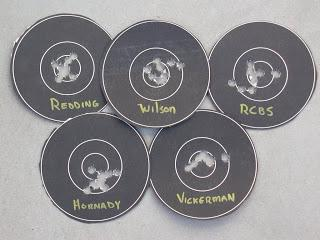
Below is a picture of the targets fired with the ammo loaded for this article (it only
took two months to find a free day for this!). All firing was done at 100 yards, prone,
iron sights with the CSS RT10 Tubegun. All targets have 10 shots, the same 10 that
were in the runout test for each die. I shot the Hornady die ammo first and the group
was a bit low, so I made a small elevation change for the remainder. The RCBS die
ammo certainly looks like the worst, and the Redding the best, but I suspect things
might shift around a bit on a rerun of the test. Conditions were ideal for this testing
and I'm satisfied enough with the way I shot that I don't plan to repeat it. I think all
groups were fired in a consistent manner, none being better ot worse than the others
in terms of overall execution. You can click the picture to enlarge it for more detail.
The targets is the NRA 100 yard Smallbore target, with a center X ring that is 1" in
diameter and the 10 ring is 2" in diameter. I shot on the full target and just cut out
the centers for the picture.
Seating Die Induced Runout - A Comparison
by Germán A. Salazar
https://www.google.com/url?sa=t&rct...e-Runout.pdf&usg=AOvVaw0PTrUzbIFGXpTquMkz6CtT
The Rankings
And now, the moment you've been waiting for...
#1 - Redding Competition Seating Die (sliding sleeve type, threaded die)
The Redding, which I expected to finish high, did what I thought couldn't be done - it
produced rounds with an average runout that was less than the average case neck
runout of the brass used. In none of the ten rounds loaded did the Redding increase
the runout; it either held exactly the same or it decreased. The Redding, with an
Average Runout Change of -0.0003" is the winner. The negative sign, of course,
indicates a reduction in runout.
However, it's important to note that we're using a mathematical calculation that gives
a result that is smaller than the precision with which we can measure runout, so take
the numbers as what they are - smaller than we can reliably guarantee and more of a
ranking indicator than an exact measure of probable runout results. This applies to all
the dies.
#2 - Wilson (chamber type, for arbor press)
I expected the Wilson to come out on top, given it's long-standing reputation as the
best seating die and its near universal use in Benchrest shooting. It didn't quite work
out that way, but the Wilson was very good, with only three rounds increasing runout
and an equal number decreasing, the remainder were zero-change. Wilson Average
Runout Change: +0.00015".
#3 - RCBS Standard Die (standard threaded die)
I expected the RCBS to be dead last, maybe by a big margin; was I ever wrong! I
was really surprised, quite pleasantly, by the RCBS die's performance. Three runout
increases, an equal number of decreases and four zero-change made for a very
creditable score. RCBS Average Runout Change: +0.00025".
#4 - Vickerman and Hornady (tie) (both partial sliding sleeve, neck only, threaded
dies)
These dies share a lot in common, being of universal use for a given caliber, in this
case, .30 caliber. You can seat bullets in anything from a .300 Savage to a .300
Winchester Magnum with these dies as they just capture the neck of the case in order
to align it with the bullet. However, as your Economics professor taught you, there is
no free lunch. That universality of application reduces precision, though certainly not
to a level that would render them useless. With more increases in runout than
decreases, the Hornady lost ground. The Vickerman had a lot of zero-change rounds,
but increased 0.002" on a couple and that really hurt it's average performance. So,
the Hornady and Vickerman with an Average Runout Change of +0.0006",
bring up the rear - very much to my surprise. These are very useful dies, however
and let's keep some perspective, with an ARC of about half a thousandth, I wouldn't
be concerned about using them for Highpower match loading.
Update - November 7, 2009
Below is a picture of the targets fired with the ammo loaded for this article (it only
took two months to find a free day for this!). All firing was done at 100 yards, prone,
iron sights with the CSS RT10 Tubegun. All targets have 10 shots, the same 10 that
were in the runout test for each die. I shot the Hornady die ammo first and the group
was a bit low, so I made a small elevation change for the remainder. The RCBS die
ammo certainly looks like the worst, and the Redding the best, but I suspect things
might shift around a bit on a rerun of the test. Conditions were ideal for this testing
and I'm satisfied enough with the way I shot that I don't plan to repeat it. I think all
groups were fired in a consistent manner, none being better ot worse than the others
in terms of overall execution. You can click the picture to enlarge it for more detail.
The targets is the NRA 100 yard Smallbore target, with a center X ring that is 1" in
diameter and the 10 ring is 2" in diameter. I shot on the full target and just cut out
the centers for the picture.
- Location
- Western Manitoba
Does anyone use these with an arbor press? How do you find concentricity compared to other “competition” seaters? I’m also interested in OAL consistency. Thanks.
Perhaps you might read recent posts on this - you ask how concentricity compares, then you say you are looking for OAL consistency - Over All Length - most any seating dies is going to contact the bullet somewhere near the ogive of the bullet - not at the tip. As a result, most dies will seat that contact point very repeatably. However, as has been posted several times, bullets vary in length from that contact point to their tip. Hence, perfectly seated ogive length will give you variance in Over All Length. The previous post (#2) was about concentricity, aka "runout", which is not OAL - it is a measure of the relative alignment of the axis of the bullet with the axis of the cartridge.
The one thing that’s come out since German wrote that is the 21st century arbour press. You can measure seating pressure and batch sort that way. Which just opens up for another string of arguements. German knows his stuff, and i miss reading a new segiment to the riflemans journal.

I wrote this blurb about my first Wilson seater. The quality seems second to none. I won't be switching back to press mounted seaters
https://www.canadiangunnutz.com/forum/showthread.php/1847413-Wilson-Arbor-Seating-Dies-WOW!!
https://www.canadiangunnutz.com/forum/showthread.php/1847413-Wilson-Arbor-Seating-Dies-WOW!!
Rifleman's Journal has been archived, there is a link on it in Accurate Shooter's Forum, titled "The Rifleman's Journal archived" from Feb 9th 2019, by crowsnest 2002. Provides links to a lot of his articles that are still available.
The Rifleman's Journal
Index of Articles
https://web.archive.org/web/20150312110235/http://riflemansjournal.########.com/p/articles-index.html
Index of Articles
https://web.archive.org/web/20150312110235/http://riflemansjournal.########.com/p/articles-index.html





















