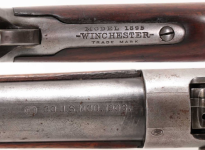
Winchester 1895 .30-03

Chas

CGN frequent flyer
GunNutz
Rating - 100%
389   0   0
A new member of our deer hunting group brought a rifle for me to look at last night. He originally said it was .30-40 Krag but it is marked as a .30 Government 1903. He hasn't fired it with .30 -06 ammo.

I didn't have my cellphone to take pictures (so dont post this thread is useless without photos) and this one is beyond my realm of expertise.

It's a takedown model, bluing has faded to grey, worn thin on rear of barrel, no pitting but a couple of rust freckles. Bore looks good with no pits or rust. Stock has a metal crescent curved butt plate (ow!) with no finish on it. The butt has been cracked and repaired (nicely) with 2 brass pins. Rear sights look to be original.

Is there any collectors interest in .30-03 rifle variants over the .30-06 rifles? He wants to sell and I told him to take it to our LGS for an appraisal as I have no idea on value of this rifle.

Any thoughts?
 
I'm by no means any kind of expert on Winchester lever guns, and in particular on the Model 95.
However, from what I gather any Model 95 chambered in the 30-03 are scarce items. I have one here that I purchased several months ago and it is the first one I ever personally had my hands on. Knew of them certainly but any that I saw were definitely not in 30-03.
My rifle is a non-take down model with a crescent buttplate stock but with a 24 inch heavier weight barrel profile than another 95 I have in 30-40 with a longer, slimmer profile barrel. I would rate my 95 in 30-03 to be in solid good plus condition with a bit of bluing still showing here and there. No cracks in the wood or excessively dinged up in any manner.
I paid 1350.00 for mine, not sure how that might carry over as to pricing yours but thought it may help you to know that.
The 30-03 cartridges I have here are original factory loaded REM-UMC 30-1903 headstamped rounds loaded with 225 gr. round nosed bullets. Case length on these rounds are 2.556-2.558 inches. So about 62-64 thousandths longer than 30-06 cases. The only difference between the 30-03 versus the 30-06 is in that slightly longer neck of the 30-03. So you can fire 30-06 ammunition in these 30-03 rifles but most authorities say to exercise some caution when doing so and avoid hotly loaded handloads or factory ammunition.
For my rifle I am reforming 270 Win and 280 Rem brass to give me some extra neck length over 30-06 brass for my handloads which I'm loading with moderate powder charges.
Hope some of this may be of interest to you. Cool gun in a very scarce chambering.
 
The original Winchester 95 rifles actions will stretch over time if shot a lot with 30/06 ammo. The modern miroku made replicas don t suffer from this defect do you being made with stronger metallurgy
 
30-03 is basically a 06 loaded with heavier bullet weight. Personally I would make sure any 06 load you shoot thru it is not loaded to high end of the pressure gauge.

Unless I am having a senior's moment, that is not true; there was more to it than the weight of the bullet.

As I recall, the 30-03 (which was only the US military's new chambering after the 10 U.S. aka 30/40 Krag for just a couple of years). It was their first rimless round, and it only lasted a couple of years from it's introduction in 1903 to when the US military decided to shorten the case up a tiny bit three years later, becoming what we now call the 30-06.

Depending on the condition of your friend's 1895, some collector might be interested in paying him some pretty nice coin for that rifle to add to his collection. Winchester lever action collectors in particular. I'm the 3d generation of our family that owns an 1895, so I became a bit informed about them while learning more about the history of this model of Winchester.

I have my Grandfather's 1895 that was manufactured in 1898, and it is chambered and marked as "30 U.S" - 30/40 Krag. It doesn't have any further lettering on the barrel as you may have indicated is on your friend's rifle. If it only says "30 U.S.", then it is chambered in 30/40 Krag.

However, if it has additional lettering beyond that, then it possibly could be a 30-03. I recall reading that Winchester hoped to get in on the new 30-03 when it was released to replace the 30 U.S./30-40 and so started offering the 1895 in that new caliber. Supposedly not many were made as the hunters of the day preferred the other calibers the rifle was offered in.

Between that and the US military doing away with the 30-03 design and converting what arms they had chambered in that caliber to the final 30/06 chambering, not many 1895's in that chambering were made. Which is why anyone having one would probably be of interest to Winchester collectors.

30-03 ammunition hasn't been made for probably well over a century, but a standard 30/06 cartridge will fit and fire just fine.

The bore may or may not need a lot of love and attention due to the primers that were in use at the time. And some 1895's (mine at least) have barrels that are very overbore. The bore on my 30 U.S. slugs at .313" versus something closer to .308" - like a barrel intended for an 1895 to be chambered in .303 British ended up in the 30/40 line for chambering and installation.

The rifle when it was passed on to me and I started working on it couldn't even begin to group. After I slugged the bore, saw how oversize it was and added a custom bullet mould for it to better fit the ball seat, groups came down to a pretty respectable 2.5 MOA.

There's absolutely nothing wrong with the manufacturer and model design of the rifle. If it works for the owner as is, then he isn't losing much by sticking with it. If it has been used by generations of his family, that alone makes it worth a lot.

BTW, in my opinion, there are not very many gun stores these days where you can take an older rifle or shotgun in to ask about and get an informed opinion. The people in most of them aren't old enough to have grown up reading about, seeing, etc rifles of that age. About ten years ago I was in a gun store waiting on service when a guy walked in with an old Newton take down rifle. The other guy behind the counter told him they didn't sell used guns and would have a hard time selling but maybe he could get $75 somewhere. The counter guy looked to be in his early 50's by his appearance.

Your friend may have a really fun rifle there.
 
For what it’s worth value-wise, I don’t think any more than any other 30-06, unless someone specifically wants that 30-03 stamp. Love these old 95s!
 
The fact that the rifle is in a rare calibre and is also a take-down model will likely make it of considerable interest to collectors. Since it is a take-down model, it was quite possibly a special order item, and as such there may be records on who ordered it.
Your friend might want to consider getting a factory letter for the rifle from the Cody Firearms Museum in Wyoming (just do a google search on that, and it should come up). It will cost about $90US, but would also add at least that much value to the gun if it was sold.
Just my thoughts....
 
Chas:

So then, being a 30-03 instead of the more common 30-06, your friend has a fairly rare 1895 Winchester that a lot of Winchester lever action collectors would want to make offers on. Is the rifle special to him, or a rifle he bought somewhere in his travels?

If it came down to him through his family (as mine did through my grandfather as the original purchaser and then my father), it would have to be worth a LOT of money before I sold it rather than kept it for hunting in areas well suited to a lever action. My grandfathers/fathers/mine makes hunting trips every year into the riparian areas along the sides of the Kootenay river here where there's lots of elk, whitetails, and moose as well hanging out.

A chance at a bull or buck at 150 yards is the longest we ever get hunting in that bottom land. 60 - 100 yards is more like it. Perfect opportunity to hunt with a rifle like this that you have a connection to your forefathers with. And I'm not leaving much on the table in terminal performance at those ranges by leaving my usual 30 Newton and 35 Whelen rifles I do most of my hunting with back in the truck.
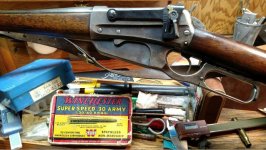
5___  0000001.8.JPG

My grandfather hunting for the family with this 1895, up the Bull River, circa about 1942, picture would have been taken by my Dad.

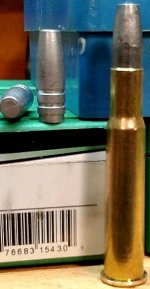
5-73.JPG

00001.5.JPG

If the rifle is a special keeper and the rifle bore is in poor condition for various reasons and the rifle isn't delivering on what he expects for grouping ability, there's a few things he can choose to do. That is, if he's comfortable with some careful home gunsmithing that requires little to no tools of destruction.

I'd suggest he first take it to a gunsmith that has enough experience working with valuable old rifles to see what the gunsmith can find or believes is contributing to poor grouping ability. And then I'd run the suggestions given below past him.

(and I'll mention at this point that Bill Leeper guided me on much of what is detailed below and we talked old guns and our fathers and grandfathers while I lapped this 1895 in his shop, so this process has the approval of a damned fine gunsmith. That's the kind of gunsmith you should be looking for to talk with about your rifle.)

1. Slug or pin the barrel. The rifle bore itself and the ball seat before that. He may find as I did with my grandfather's 30 U.S. (30-40 Krag) that the bore is far greater than it should be for a .30 caliber barrel. I improved the accuracy quite a bit by switching to reloading .303 bullets intended for reloading 303 British. If that makes him happy with whatever improvement he gets, he's good to go!

Pins are relatively inexpensive to buy per each if you don't have a nearby machinest or machine shop that will allow you to bring the rifle in so they can do it for you.

Buying your own pins (if you're ultimately headed towards ordering a custom bullet mould from somebody like Tom at Accurate Moulds) will allow you to seat them in a slightly expanded case neck to determine at what point that pin size makes contact with the sides of the ball seat. The measurement from the base of the case to the top of the seated pin will help you determine measurements for your mould design from the base of your seated bullet at the shoulder/neck junction to where the bullet first makes contact with the ball seat.

2. If the bore is in rough shape but otherwise good for size, or the ball seat is well oversize from a hundred years of the primers of the day eating away at it or insufficient cleaning, he can go through the process of pouring lead laps and with clover compound lap the bore (i.e. the lands and grooves) out. You keep track on your progress by measuring your lap at the times when you almost completely withdraw it to load it with more clover compound (if you pull it completely out, it can be a pain in the azz aligning with the lands and grooves to reinsert it). Lots of info already on the 'net on how to properly lead lap bores.

Once the lapping is done, then he can try reloading jacketed bullets again to see if grouping ability has improved by reconditioning the bore.

If he wants to pursue it further, or enjoys doing it the old way, he can cast and then spend the time getting a good fit with a hunting style cast bullet like the loading shown above.

If he's the same as most here who think of the idea of bullet casting as a pain in the azz, then this won't be an option he wants to bother with. He could try buying commercially cast bullets, but my guess is that there's only a 50/50 chance that buying cast bullets will provide a sufficiently good fit in the critical ball seat area at whatever size they arrive at to get the very best performance.

Good enough to shoot for fun, but probably not less expensive than loading and shooting either .308 or .311 jacketed bullets as plinkers.

If he's all in with working up a cast bullet hunting load, there's a pretty good chance (especially if he started out with a poor and/or large bore prior to lapping) that he will get a cast bullet load that groups better than commercially loaded ammunition or reloading jacketed bullets.

A related advantage is that the grouping of cast bullet reloads starts falling apart when you get upwards towards the working pressures of factory ammunition, so his best grouping load will result in hunting loads with more than enough velocity and weight that they're not much behind the normal velocities for jacketed loads, but are putting lower operating pressures on the shoulders of that old boy. Minimizes future wear and tear on the rifle.

That cast hunting load in the picture above is a 184 grain powder coated bullet with a mean muzzle velocity of about 2165 fps. I don't have any idea of what commercial 180 grain loads for the 30/40 are advertised at, but that load is more than sufficient for anything within range of the original buckhorn sights.

Lots of guys casting for 30/06 rifles who know what they're doing as bullet casters end up with 180 - 220 grain bullets of around 2400 - 2500 fps. But you do have to have more than just a casual familiarity with good cast bullet preparation and techniques to get that. Not hard, but you won't figure it out with just a few minutes of reading. Lots of help available on the Web through a number of forums that have subforums dedicated to cast bullet hunting loads.

3. A very expensive final option which would eliminate most collector value would be to send it to a specialist who would put a barrel liner in and chamber it to normal 30-06 (or back to 30-03). Wouldn't be my choice when I can get more than acceptable hunting groups by other means, but it is one last option.

Which leads to the last thing: about those original sights. If your friend is getting upwards in years and is well into the time of Old Mans' Eyes, good luck seeing that front sight in the razor blade slit at the bottom of that original buckhorn rear sight. I don't know how my grandfather did it at his age as seen in that picture above.

But there's a way to address that as well without any permanent alterations to the rifle.

 

That's a cool and collector-valuable rifle to own!

Was it a find somewhere that you recognized the collector value especially as a 30-03 beyond being an 1895?

Or are you the latest generation of your family to have it passed on to you?

My only regret - and it is a tiny one - about my ownership of my grandfather/father's 1895 is that I would rather my grandfather had ended up buying one in .303 British to match my interest in No. 4 Mk1 rifles, or 30/06 to go along with my first hunting rifle, a surplus Enfield 1917. My dad probably bought that 1917 for about $11 from the empty wooden nail barrels full of barrel-down surplus Enfields, Lee Enfields and Mausers that were at one side of Vic ####'s Hardware And Goods store in the early 1960s. I wanted the cool looking No. 5 jungle carbine because of the cool factor of that cone on the muzzle and that rubber butt plate... that would have killed me. But no, I got the 1917 instead.

(I've always suspected that I got that rifle for hunting as an eight year old kid because Dad thought lugging that heavy sucker up and down the mountains behind him and shooting it with that grossly too-long trigger pull would put some shoulders on me and toughen me up a bit.)

So how does that 30-03 group for you and do you regularly take it out hunting where you are?
 
A new member of our deer hunting group brought a rifle for me to look at last night. He originally said it was .30-40 Krag but it is marked as a .30 Government 1903. He hasn't fired it with .30 -06 ammo.

I didn't have my cellphone to take pictures (so dont post this thread is useless without photos) and this one is beyond my realm of expertise.

It's a takedown model, bluing has faded to grey, worn thin on rear of barrel, no pitting but a couple of rust freckles. Bore looks good with no pits or rust. Stock has a metal crescent curved butt plate (ow!) with no finish on it. The butt has been cracked and repaired (nicely) with 2 brass pins. Rear sights look to be original.

Is there any collectors interest in .30-03 rifle variants over the .30-06 rifles? He wants to sell and I told him to take it to our LGS for an appraisal as I have no idea on value of this rifle.

Any thoughts?
I think you nailed it with the taking it to a local gun shop for ident. and a possible appraisal.

He can then add a 20 or 30 % an actual known value for his return of the consignment.
 
That one (Win 1895 with bayo 7.62 cal) , I believe went for over $2500 euros.
That's before any auctioneer fees, buyers premiums, taxes, shipping or import fees.

:cry:
 
Last edited:
Back
Top Bottom