Chas:
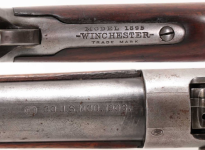
So then, being a 30-03 instead of the more common 30-06, your friend has a fairly rare 1895 Winchester that a lot of Winchester lever action collectors would want to make offers on. Is the rifle special to him, or a rifle he bought somewhere in his travels?
If it came down to him through his family (as mine did through my grandfather as the original purchaser and then my father), it would have to be worth a LOT of money before I sold it rather than kept it for hunting in areas well suited to a lever action. My grandfathers/fathers/mine makes hunting trips every year into the riparian areas along the sides of the Kootenay river here where there's lots of elk, whitetails, and moose as well hanging out.
A chance at a bull or buck at 150 yards is the longest we ever get hunting in that bottom land. 60 - 100 yards is more like it. Perfect opportunity to hunt with a rifle like this that you have a connection to your forefathers with. And I'm not leaving much on the table in terminal performance at those ranges by leaving my usual 30 Newton and 35 Whelen rifles I do most of my hunting with back in the truck.
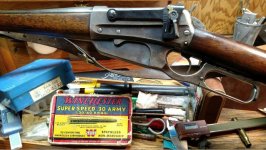
My grandfather hunting for the family with this 1895, up the Bull River, circa about 1942, picture would have been taken by my Dad.

If the rifle is a special keeper and the rifle bore is in poor condition for various reasons and the rifle isn't delivering on what he expects for grouping ability, there's a few things he can choose to do. That is, if he's comfortable with some careful home gunsmithing that requires little to no tools of destruction.
I'd suggest he first take it to a gunsmith that has enough experience working with valuable old rifles to see what the gunsmith can find or believes is contributing to poor grouping ability. And then I'd run the suggestions given below past him.
(and I'll mention at this point that Bill Leeper guided me on much of what is detailed below and we talked old guns and our fathers and grandfathers while I lapped this 1895 in his shop, so this process has the approval of a damned fine gunsmith. That's the kind of gunsmith you should be looking for to talk with about your rifle.)
1. Slug or pin the barrel. The rifle bore itself and the ball seat before that. He may find as I did with my grandfather's 30 U.S. (30-40 Krag) that the bore is far greater than it should be for a .30 caliber barrel. I improved the accuracy quite a bit by switching to reloading .303 bullets intended for reloading 303 British. If that makes him happy with whatever improvement he gets, he's good to go!
Pins are relatively inexpensive to buy per each if you don't have a nearby machinest or machine shop that will allow you to bring the rifle in so they can do it for you.
Buying your own pins (if you're ultimately headed towards ordering a custom bullet mould from somebody like Tom at Accurate Moulds) will allow you to seat them in a slightly expanded case neck to determine at what point that pin size makes contact with the sides of the ball seat. The measurement from the base of the case to the top of the seated pin will help you determine measurements for your mould design from the base of your seated bullet at the shoulder/neck junction to where the bullet first makes contact with the ball seat.
2. If the bore is in rough shape but otherwise good for size, or the ball seat is well oversize from a hundred years of the primers of the day eating away at it or insufficient cleaning, he can go through the process of pouring lead laps and with clover compound lap the bore (i.e. the lands and grooves) out. You keep track on your progress by measuring your lap at the times when you almost completely withdraw it to load it with more clover compound (if you pull it completely out, it can be a pain in the azz aligning with the lands and grooves to reinsert it). Lots of info already on the 'net on how to properly lead lap bores.
Once the lapping is done, then he can try reloading jacketed bullets again to see if grouping ability has improved by reconditioning the bore.
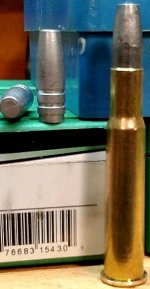
If he wants to pursue it further, or enjoys doing it the old way, he can cast and then spend the time getting a good fit with a hunting style cast bullet like the loading shown above.
If he's the same as most here who think of the idea of bullet casting as a pain in the azz, then this won't be an option he wants to bother with. He could try buying commercially cast bullets, but my guess is that there's only a 50/50 chance that buying cast bullets will provide a sufficiently good fit in the critical ball seat area at whatever size they arrive at to get the very best performance.
Good enough to shoot for fun, but probably not less expensive than loading and shooting either .308 or .311 jacketed bullets as plinkers.
If he's all in with working up a cast bullet hunting load, there's a pretty good chance (especially if he started out with a poor and/or large bore prior to lapping) that he will get a cast bullet load that groups better than commercially loaded ammunition or reloading jacketed bullets.
A related advantage is that the grouping of cast bullet reloads starts falling apart when you get upwards towards the working pressures of factory ammunition, so his best grouping load will result in hunting loads with more than enough velocity and weight that they're not much behind the normal velocities for jacketed loads, but are putting lower operating pressures on the shoulders of that old boy. Minimizes future wear and tear on the rifle.
That cast hunting load in the picture above is a 184 grain powder coated bullet with a mean muzzle velocity of about 2165 fps. I don't have any idea of what commercial 180 grain loads for the 30/40 are advertised at, but that load is more than sufficient for anything within range of the original buckhorn sights.
Lots of guys casting for 30/06 rifles who know what they're doing as bullet casters end up with 180 - 220 grain bullets of around 2400 - 2500 fps. But you do have to have more than just a casual familiarity with good cast bullet preparation and techniques to get that. Not hard, but you won't figure it out with just a few minutes of reading. Lots of help available on the Web through a number of forums that have subforums dedicated to cast bullet hunting loads.
3. A very expensive final option which would eliminate most collector value would be to send it to a specialist who would put a barrel liner in and chamber it to normal 30-06 (or back to 30-03). Wouldn't be my choice when I can get more than acceptable hunting groups by other means, but it is one last option.
Which leads to the last thing: about those original sights. If your friend is getting upwards in years and is well into the time of Old Mans' Eyes, good luck seeing that front sight in the razor blade slit at the bottom of that original buckhorn rear sight. I don't know how my grandfather did it at his age as seen in that picture above.
But there's a way to address that as well without any permanent alterations to the rifle.