Winchester M1917 question about these pictures!

Alfonso

CGN Regular
Rating - 100%
53   0   0
Location
Okanagan
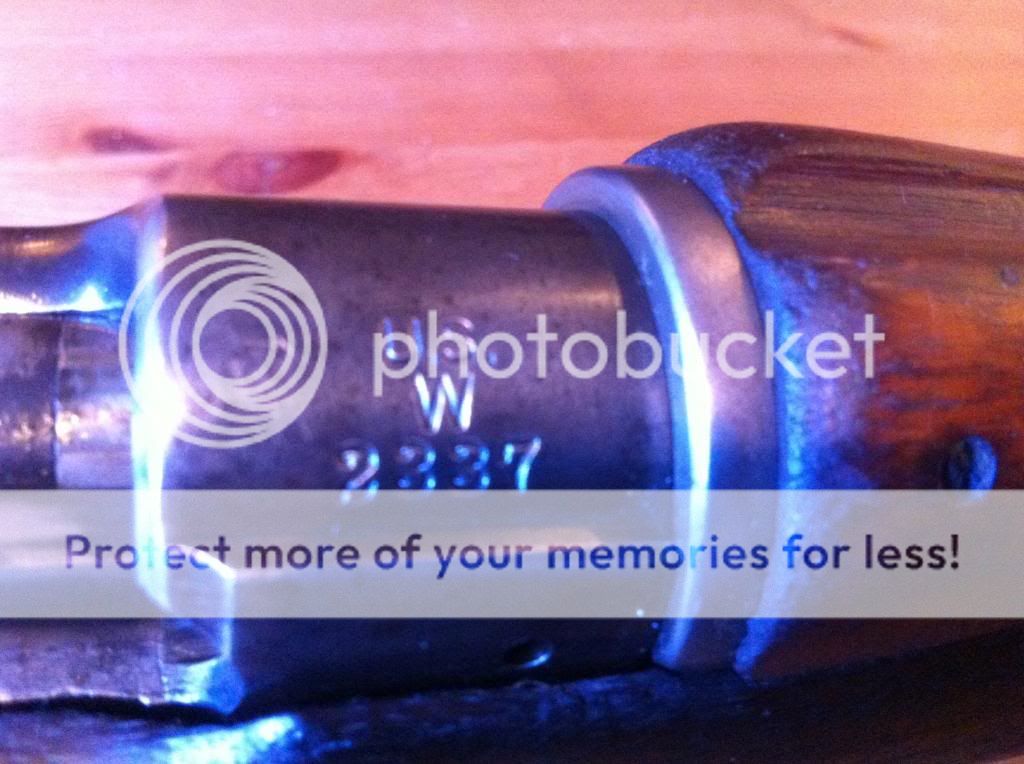
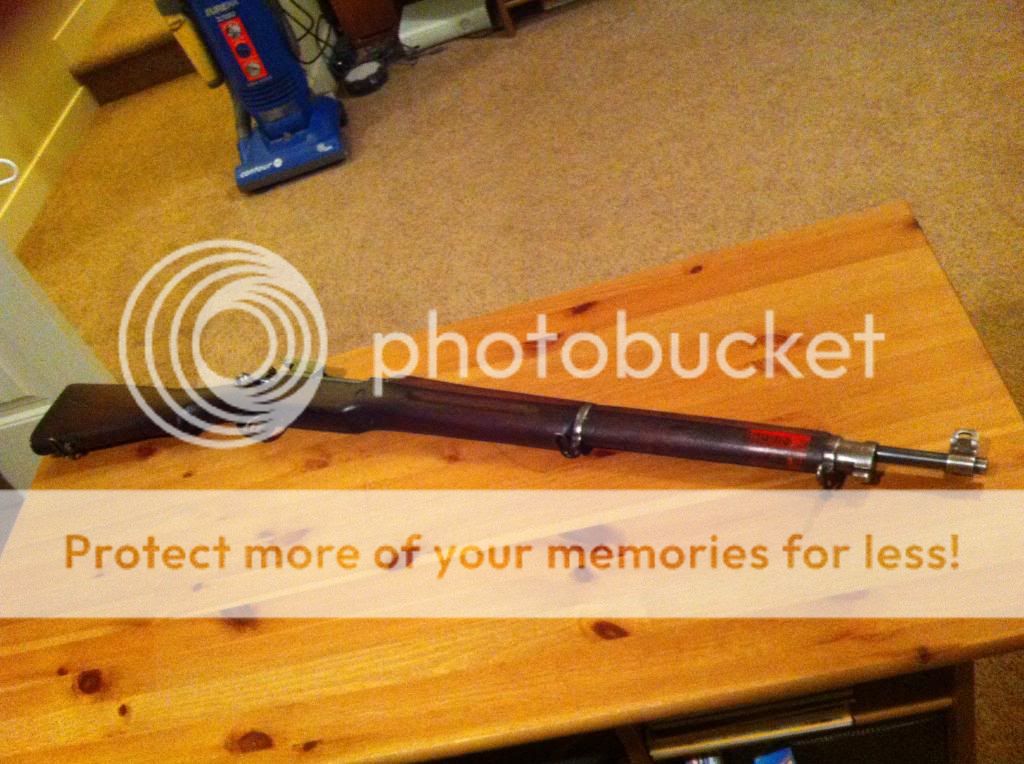
I just purchased a Winchester M1917 from a fellow CGNer. As you can see from the pictures the receiver does not bear the full name "Winchester" but just the "W" which I know would be on other parts throughout the gun? The serial number seems quite low? Could this be such an early rifle that it was before Winchester stamped their full name. It has the red band so this def. went to the UK? Can someone maybe piece together an explanation as to the receiver questions?

Many thanks,

IMG_0816_zpsde3b73b7.jpg


IMG_0818_zps738f9065.jpg


IMG_0815_zpscc416e76.jpg


IMG_0819_zps741122ee.jpg
 
Wow, really low serial. I think this is a non-compliant rifle. Therefore no WW1 service. However a great piece. I am sure Smellie will chime in with an explanation. Beautiful rifle BTW.
 
I just noticed that not only is it missing the full name of "Winchester", it is also missing "Model of 1917"

Perhaps its a production sample before its official designation was given. Very cool.
 
Very low serial number. Here is alot of info on the M1917:
http://www.odcmp.org/503/rifle.pdf

Not sure about the marking, but with a 6-17 barrel it likely is one of the first off the line in August 1917

Yes I found this on line earlier and this is what peaked my interest: These were delivered on the 18th of August, but Winchester had already started production, having produced about 10,000 rifles by the time the drawings were
9
finished. As might be imagined, the first 10,000 Winchesters did not have the interchangeability of parts that Springfield required, and many of the original parts are not interchangeable with Winchester’s own later production. Once a rumor gets started of course, it is extremely difficult to get stopped, and urban legend has it that General Pershing himself specified that no Winchesters should be delivered to France. True? Who knows, but a specimen of the original 10,000 Winchesters is an extremely valuable collector’s item.

Interchangeability is one thing but what about shootability? I'm hoping this is ok to shoot as I wanted a shooter as well, upon inspection of my gunsmith off course.
 
Skennerton's book, The US Enfield, has a photo of Winchester M1917 s/n 1. The receiver markings are the same as this rifle which is one of the early production pieces made before standardized drawings were furnished to the three manufacturers at which time the standardized marking pattern would have been adopted. The upper handguard has been replaced at some time as the Brits painted a red band around both the forestock and upper handguard.

I'd say it saw WW1 service in US hands and was then sent to the Brits as a lend lease piece early in WW2. The US held large numbers of M1917s in reserve stocks after WW1. In addition to being furnished to Britain, Canada, China and the Free French in WW2, they were also used for training and to equip reserve units in the US.

As far as shooting it I'd verify the soundness of the receiver (no cracked receiver ring) and correct headspace and then go to it.
 
Earliest M-1917 I have seen, although I do own P-'14 s/n W305.

As PURPLE has mentioned, this will be a rifle from when they were tooling up for the production.

The rifle itself was designed in .276 Enfield and modded to .303, with much of the work being done by Winchester, who also did the benchmark tooling for all three plants.

When the US declared war in April of 1917, the Government started talking about sending 4 million men, which was a pretty ambitious project for a country which had less than HALF a million modern rifles and only limited factory capacity which could NOT keep up with the demands of a 4-million-strong Expeditionary Force. So the adopted the P-14 but in .30-'06 and they wanted them RIGHT NOW thankyouverymuch.

The redesign of the rifle went very quickly. This is a JUNE rifle, the declaration of war was a week into April and it took TIME to talk with Winchester and the two Remington plants. It is not surprising at all that the rifle bears every evidence of being what boils down to a production sample.

What is REALLY interesting is the fact that it has SURVIVED.

I would REALLY like to compare it to a late-1918 rifle, with both on the bench at the same time.

A VERY NICE toy!

WOW!
 
When I'm back in town this weekend I'll take detailed photos and post them on this link. The rifle is in surprisingly good shape.
 
In spite of the M1903 Springfield having been the standard US Army rifle since 1903 the need to outfit a greatly expanded force in WW1 completely outstripped the combined capacity of Springfield Armory and Rock Island Arsenal to produce sufficient M1903s. A total of some 868,000 M1903s had been produced since 1903 and Rock Island had actually suspended production and then resumed it in 1916 when war seemed inevitable.

Fortuitously the Brit pattern 1914 contracts at Eddystone, Remington and Winchester were just winding up when the US entered the war in April 1917, so there was a warm production base available with tooling and a trained workforce which got into production of the Model 1917 adapted for the .30-06 round in short order. Model 1917 production by these 3 makers totalled some 2.5 million rifles over a period of 18 months, about 3x the US arsenal production of M1903s over the previous 14 years. As it turned out most of the US Divisions in France were equipped with the "war emergency" Model 1917s, rather than the standard M1903s.

The Model 1917 turned out to be a fine battle rifle made of strong high grade steels with an elevation adjustable aperture sight, rugged sight protection and the #### on bolt closing feature which provided a mechanical assist for primary extraction, an important advantage with a hot, dirty rifle. The M1917 was so well regarded that consideration was given to adopting it as the standard US army rifle post WW1. This didn't happen for a couple of reasons. Firstly, the target shooting element championed the more refined rear sight of the M1903 which is adjustable for both elevation and windage, and secondly, because the US Govt owned production facilities for the M1903. As much as I like the M1903 for shooting, it's sighting system is inferior to that of the Model 1917 as a fighting rifle.

The Pattern 1914 rifle, which was the progenitor of the M1917, was designed to replace the SMLE, and most would agree that it had many improved features compared to the SMLE. In the case of the Pattern 1914 the Brits were awash in SMLEs after WW1, plus they had no production facilities for this rifle, which conspired against the replacement of the SMLE by the P14. As it turned out both the very advanced P14s and Model 1917s were destined to live out their service in reserve roles.

The Danish Reserve Army was the final user of the Model 1917 rifle after WW2. These rifles were held in reserve until the late 1980s/early 1990s when they were released to the surplus market and many were imported into Canada. Some Danish hallmarks included serial numbering of bolts and stocks, the use of a roll pin type front sight on some rifles and the incorporation of a milled out notch at the rear of the receiver ring on some rifles.

 
Last edited:
What was the old quote?
The Germans made the best hunting rifle
The Americans made the best target rifle
The British made the best combat rifle

Of course we are talking about a WW1 time frame

Since 30-06 is marked in red on the forend, I should think that particular rifle was issued to the Home Guard as they didn't want someone trying to shove a 303 round in the chamber
 
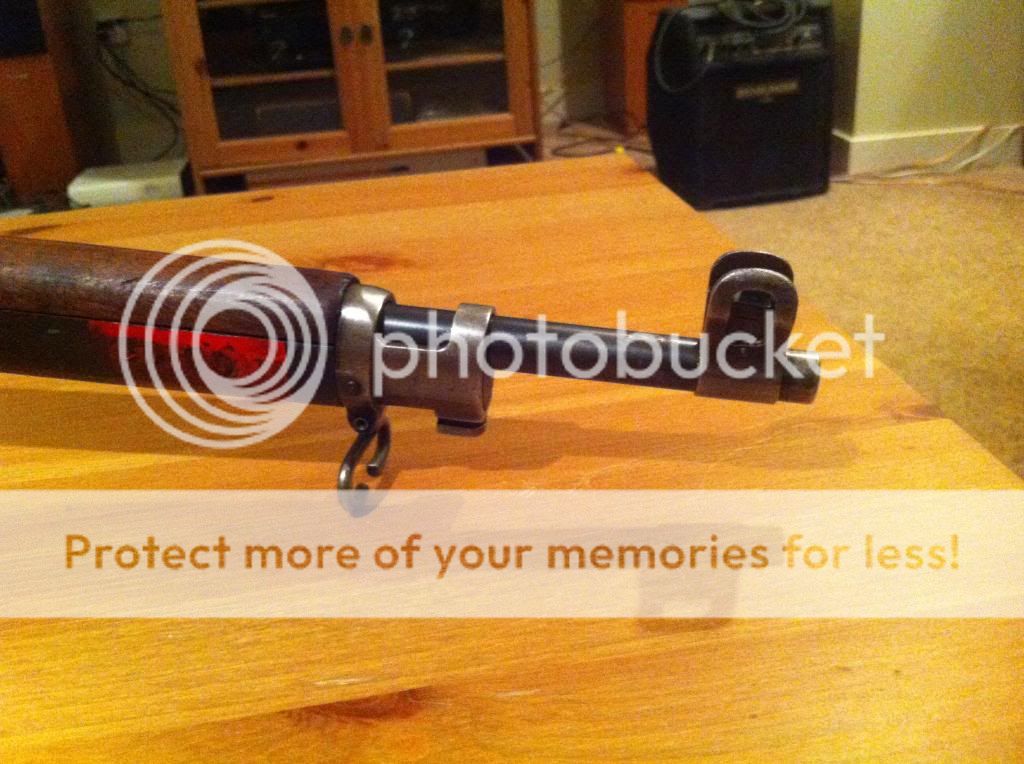
As with any MILSURP value depends on originality, condition, and availability. The barrel on this one has been shortened which is a major devaluation. We would need to see/hear more about metal and wood finish and condition and any swapping in of Remington and Eddystone made parts. Bore condition has been trumped by the fact that the barrel has been shortened from the original. A low s/n would be a curiosity and would command a higher price if the barrel was unaltered. Nice Model 1917s appear to be selling in the $650-$850 range nowadays.


 
I don't believe the muzzle has been cut at all. If you're referring to the second picture, that appears to just be caused by the angle that the photo was taken from.

A proper sideways shot of the front sight/muzzle area would put the question to rest though.
 
I don't believe the muzzle has been cut at all. If you're referring to the second picture, that appears to just be caused by the angle that the photo was taken from.

A proper sideways shot of the front sight/muzzle area would put the question to rest though.

Tanis is right. The bbl/muzzle has not been shortened. All measurements have been verified. The bbl is in great condition. Great rifling, lands, bright bore, no pitting. All parts have been verified and all "W". This is an all matching rifle.
 
Back
Top Bottom