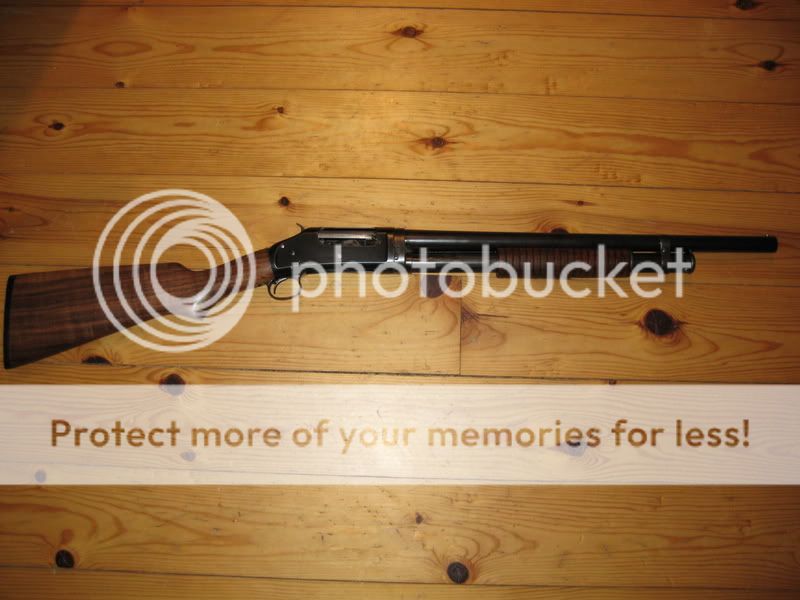
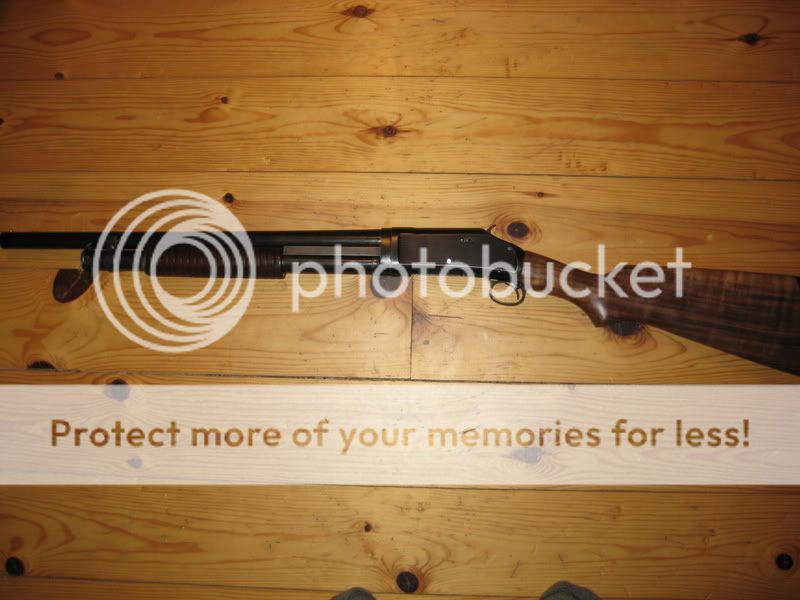
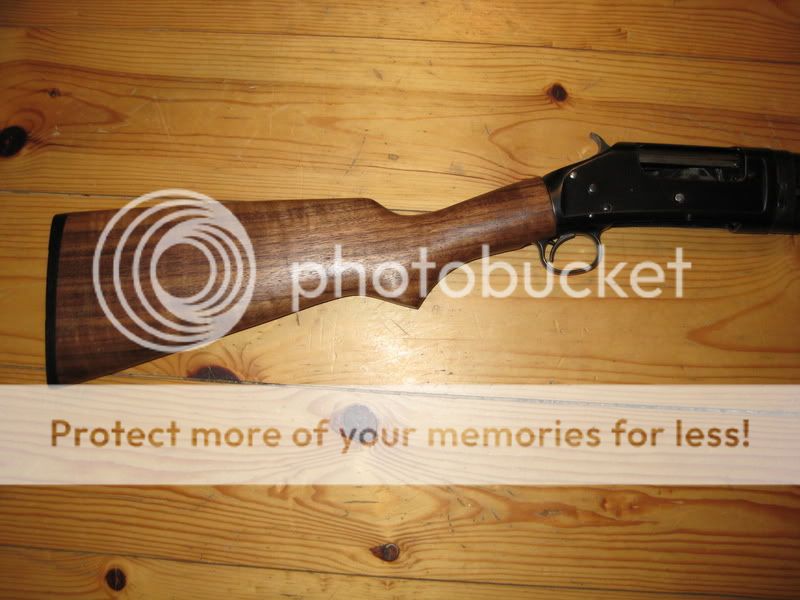
Last time I bought an 1897 butt stock from Western Gun Parts, they were $99 unfinished and $109 finished (plus shipping and tax). Finished meant stained but not oiled.
I wouldn't buy a finished one, because you will almost certainly need to sand or carve small amounts of wood away in order to get the stock to fit the individual gun properly. As soon as you do that, you're re-staining the whole piece anyway.
If the stock is sound and you can achieve the needed LOP with a recoil pad, that would be the cheapest and easiest route to go. If there are deep black oil stains in the wood at the wrist where the butt stock meets the back of the receiver, or if there are cracks in the same spot, a new butt stock may be advisable. A weak stock at the wrist can be a safety hazard.
Assuming the gun is in average condition for its age, it's worth $200 to $275 with the stock as is. With the stock repaired, it would be worth $375 to $450. The 1897 is by far the most durable pump gun ever built. It has a rich history that ranges from riding with the Texas rangers and being instrumental in the Old West from Alaska to Nova Scotia, to helping turn the tide in wars all the way from WWI to Korea.
The gun was chambered for 2 9/16" shells. It will safely accept modern 2 3/4" nitro shells, although the recoil will be less with 2 1/2" shells, if your friend wants to use those. Another way to mitigate the shorter chamber is to open up the forcing cone a bit. No reason not to do this, but I personally have never found the need. I shot 2 3/4" heavy game loads in my 16 gauge 1897 for 20 years before I found out that the chamber was slightly shorter. So, it's not a big issue, but one that can be resolved if the recoil is more than your friend is accustomed to. This may also explain why the previous owner was interested in a recoil pad.