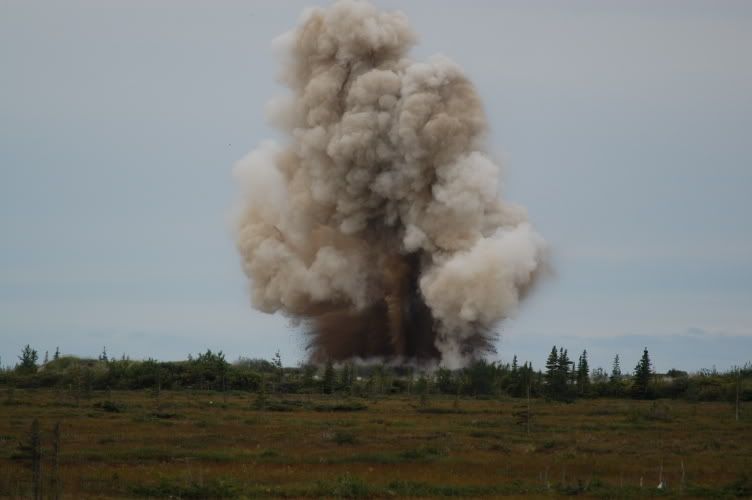
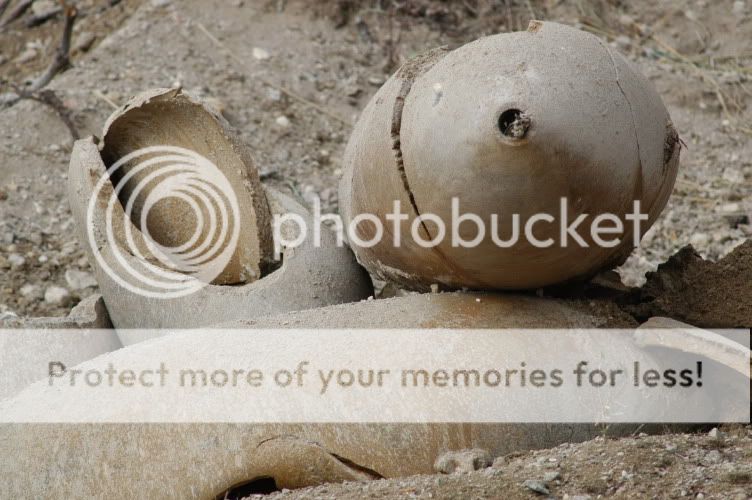
So shooting at it in a gravel pit is a bad idea?
Hahaha, you just know over half of this board thought the same thing.













































So shooting at it in a gravel pit is a bad idea?


including manditory x-rays to guarantee that it is not in any way containing a war chemical such as mustard, phosgene,

Did the French use chemical weapons?
In the old days the recommendation would be to dispose of "in deep water."
Casualty of Hobby (click here) http://www.nationalpost.com/news/story.html?id=517839
U. S. Civil War enthusiast killed cleaning artillery shell
Mary Vallis, National Post
Published: Friday, May 16, 2008
Sam White loved researching history so much he used to joke he wanted to be blasted from an American Civil War cannon when he died.
Instead, the passionate relic hunter was cremated and remembered at a simple ceremony near his Virginia home.
Mr. White, 53, was working on a Civil War artillery shell the size of a beach ball in Chester, Va., on Feb. 18 when it exploded.
Shrapnel flew across the street, crashing through a neighbour's porch roof. The blast left a crater in Mr. White's driveway and prompted a two-day evacuation of his suburban neighbourhood.
"When we got to the entrance of the subdivision, it looked like something out of a sci-fimovie, with police, fire trucks, ambulances, bomb squad," his widow, Brenda White, recalled in an interview yesterday.
Three months later, she is still finding shards of safety glass in the driveway.
Officials from the Bureau of Alcohol, Tobacco, Firearms and Explosives (ATF) are soon expected to complete an investigation into Mr. White's death.
Mrs. White hopes it will answer many unanswered questions, including what type of shell caused the blast and what happened to his shoes.
In the meantime, scores of relic hunters who spend their weekends searching for Civil War memorabilia with metal detectors fear Mr. White's death may make their hobby more difficult to enjoy -- and lead to the destruction of artifacts, instead of preservation.
When officials at the nearby Petersburg National Battlefield recently unearthed a 20-kilogram mortar shell while building a road, they immediately called the local bomb squad.
The shell was blown up at a dump rather than being disarmed and preserved.
Surrounding counties are also contemplating new regulations that would govern what happens when live shells are uncovered.
"It's created somewhat of a hysterical response," said Ben Greenbaum, a friend of Mr. White's and president of the Central Virginia Civil War Collectors Association.
Collectors say active shells from the Civil War are relatively safe to handle, in part because the black powder has deteriorated in the 140 years since the conflict.
Only a handful of injuries and deaths from the shells have been reported in the past 50 years.
While most of the thousands of U. S. relic hunters get permission to search on private property, some cross the line by sneaking onto protected federal sites or digging up graves.
A Virginia man was recently charged with stealing an intact shell from a brick building in Petersburg, Va.; police later destroyed it.
Friends and family say Mr. White, a retired UPS deliveryman, was one of the most honest and diligent collectors around.
His expertise and passion for Civil War relics were even known overseas.
He simply loved history and loved to share it with others.
Having grown up near Petersburg, where a famous Civil War siege began in 1864, Mr. White spent weekends roaming Virginia hunting for artifacts. He and son Travis plunged into the James River near Hopewell, Va., to look for century-old ammunition and weapons buried in the muck.
Mr. White also ran a Web site, Sam White Relics, through which he sold cannonballs, bullets and other artifacts.
He also offered his services disarming and preserving Civil War ordnance for $35 each.
"I've done approx. 500 artillery projectiles and still have all my fingers (I must be doing something right, knock on wood)!" said the site, which has since been taken offline.
Mrs. White said her husband also did work for the National Park Service--proof to her that he knew what he was doing.
According to friends and family, he had successfully unloaded 1,500 to 2,000 artillery shells over the years.
Mr. Greenbaum considers Mr. White's death a "quirk of fate." His wife calls it a "freakish accident."
While the ATF's findings have not yet been released, Mrs. White said officials have suggested her husband was not doing anything wrong.
"It was something in the shell itself. They called it a manufacturing defect," she said.
There may have been a pocket of black powder in the bottom of the shell that was not visible, she explained.
While she was not home at the time of the explosion, Mrs. White was told her husband had deactivated the shell and was cleaning its exterior, possibly with a small hammer or hand grinder.
Rumors are also flying through Mr. White's community of collectors.
Mr. Greenbaum said he believes the exploding artifact was a spherical naval shell brought by another collector, which would have been manufactured with extra precautions to make sure it could explode under water.
"I think it was totally a tragic accident," he said.
"I'd like people to learn something from this. Learn that you need to know what you're doing, and take all sorts of precautions so you or others don't get hurt."
mvallis@nationalpost.com

Made me nervous too, its in the hands of a friend of mine at CFB Kingston , he's with the explosives unit. He didn't know what kind of shell it was either, he said he would see if he could find any info on it, but since I had the pics I figured I'd tap into the resources on CGN.