












































You are using an out of date browser. It may not display this or other websites correctly.
You should upgrade or use an alternative browser.
You should upgrade or use an alternative browser.
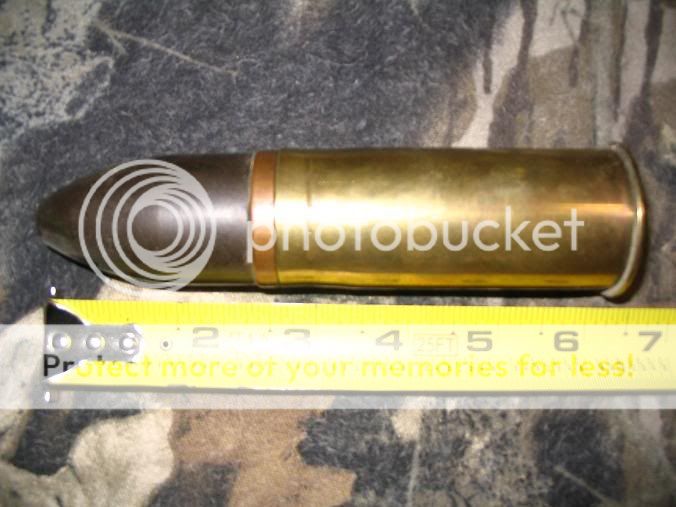
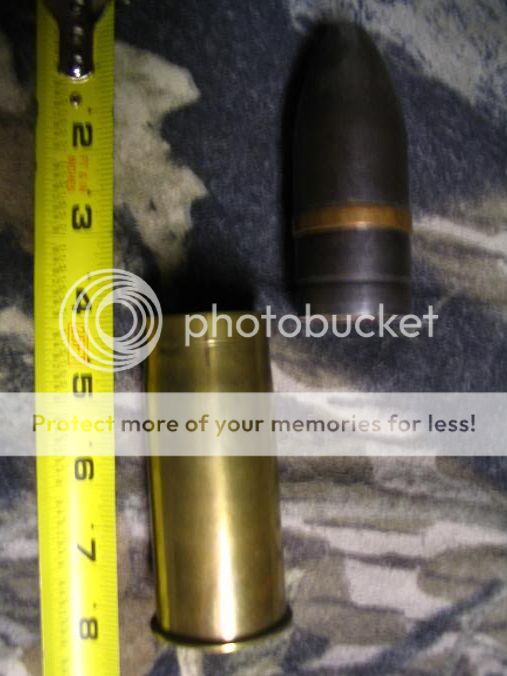
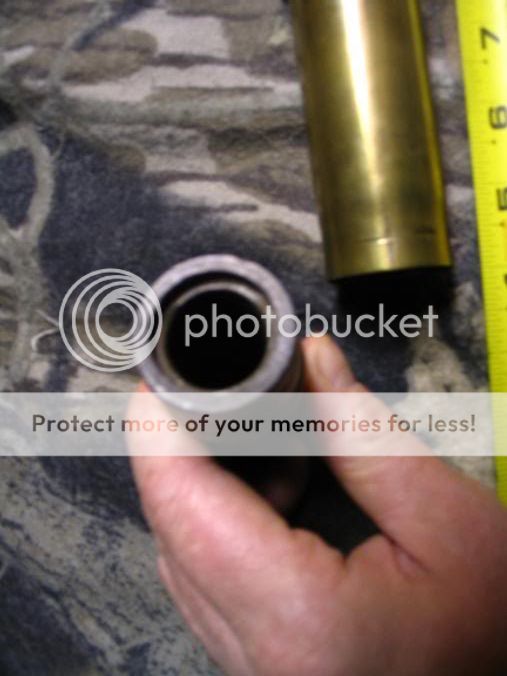
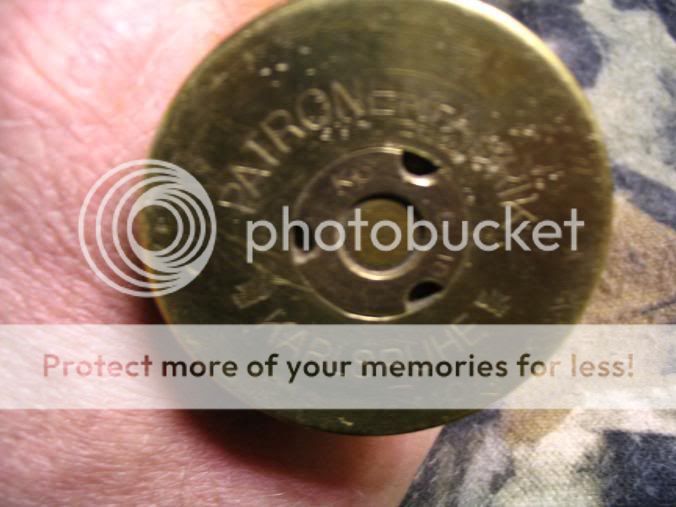
World War 1 shell
- Thread starter ally
- Start date


- Location
- WMU248 near Edmonton
Ah yes, I've seen that hesco before 

My sister bought a house a couple of years ago (in NB), and they decided to blow an new layer of insulation into the attic before winter came. Low and behold, there was a cache of WW1 and WW2 rounds and shells up there! The previous owner must've been a little questionable in his sanity!
They called the local police department for assistance, they came and got them, and asked if she wanted any of them. She said sure, if they're safe. The destroyed a bunch of the more unstable ones, but brought her back a box full of disarmed shells and rounds. Guess that's another difference between small town cops and big city cops; the LEOs in NB saw it as a chance for their people to get some practice!
Dads in the process of making a kind of shadowbox for the small rounds, and a shelf-like display for the shells. It's pretty cool, but was pretty scary too!
See if there's somewhere in Kingston that they can safely disarm it for you. It'd make a nice showpiece!
The previous owner must've been a little questionable in his sanity!They called the local police department for assistance, they came and got them, and asked if she wanted any of them. She said sure, if they're safe. The destroyed a bunch of the more unstable ones, but brought her back a box full of disarmed shells and rounds. Guess that's another difference between small town cops and big city cops; the LEOs in NB saw it as a chance for their people to get some practice!
Dads in the process of making a kind of shadowbox for the small rounds, and a shelf-like display for the shells. It's pretty cool, but was pretty scary too!
See if there's somewhere in Kingston that they can safely disarm it for you. It'd make a nice showpiece!
Based on my experience, one of the most dangerous things is a street cop who think he knows about explosives or munitions. On their EOD training (only if they are EOD qualified), they are taught only the basics of military munitions. This is done to ensure that they don't do something stupid that would endanger their lives or the lives of others. A smart cop will call military EOD for assistance as they are trained to.
Oh by the way, a camera tower that needed to be removed.

Shot at 2006-02-16
Oh by the way, a camera tower that needed to be removed.
Shot at 2006-02-16


Interesting find there.
As other have pointed out, figuring out what the filler is will be key to determining if the thing can be deactivated safely or not (assuming that it isn't already). Your typical police and/or military EOD guys will NOT be trained, or equipped to perform such a task, these days they are pretty much taught to blow this stuff up rather than to fiddle with it.
IF it is a live shell, you are essentially looking at a glorified hand grenade, with the associated danger. Probably not much danger unless you drop it, toss it in a fire, shoot it, or drive over it with a truck.
Picric acid is rather nasty stuff, that was used extensively in WW1 and WW2 as a filler in small caliber artillery, mortar bomb, hand grenades, mines etc... As well as a "booster" (sometimes you need quite a bang to set off a large piece, so the blasting cap/fuze/detonator/whatchamacallit sets off a small charge known as a "booster" which in turns sets off tyhe main charge. The stuff <may> be in use to this day for all I know.
The problem of course is that it is an acid (even though it is a solid, and not a liquid like the acids you probably played around with in high school), which tends to want to eat up the bare metal that the shell consists of and produce salts known as picrates.
While picric acid itself is <somewhat> stable ("sensitive" to flame and shock), picrates aren't, and have been known to be EXTREMELY sensitive to friction, which is why just trying to unsrew the fuze is a bad idea.
As other have pointed out, figuring out what the filler is will be key to determining if the thing can be deactivated safely or not (assuming that it isn't already). Your typical police and/or military EOD guys will NOT be trained, or equipped to perform such a task, these days they are pretty much taught to blow this stuff up rather than to fiddle with it.
IF it is a live shell, you are essentially looking at a glorified hand grenade, with the associated danger. Probably not much danger unless you drop it, toss it in a fire, shoot it, or drive over it with a truck.
Picric acid is rather nasty stuff, that was used extensively in WW1 and WW2 as a filler in small caliber artillery, mortar bomb, hand grenades, mines etc... As well as a "booster" (sometimes you need quite a bang to set off a large piece, so the blasting cap/fuze/detonator/whatchamacallit sets off a small charge known as a "booster" which in turns sets off tyhe main charge. The stuff <may> be in use to this day for all I know.
The problem of course is that it is an acid (even though it is a solid, and not a liquid like the acids you probably played around with in high school), which tends to want to eat up the bare metal that the shell consists of and produce salts known as picrates.
While picric acid itself is <somewhat> stable ("sensitive" to flame and shock), picrates aren't, and have been known to be EXTREMELY sensitive to friction, which is why just trying to unsrew the fuze is a bad idea.


Hotwheels81
CGN Ultra frequent flyer
- Location
- South of GP
Come to think of it, a lot of guerrilla forces in the past went about recovering unexploded ordnance from the battlefield, cut them open with handsaw to retrieve the explosives inside. Worked for them. Just don't try it at home.
they still do this.
sometime's certain "thing's" get left out in the open too... and if your crazy enough to try to pack away the bait and get spotted... your target practise...
a book that changed my perspective on warfare and i HIGHLY recommend to anyone who is remotely interested in some of the world's dirty little secret's
ht*p://www.amazon.com/Aftermath-Remnants-Landmines-Warfare-Devastating/dp/067975153X/ref=sr_1_4?ie=UTF8&s=books&qid=1227770741&sr=1-4
i still find the odd piece of "history" in some of the area's i walk thru left over from when CFB Vernon was an active training area.... some of this stuff is litteraly in your back yard... if you dont know what it is or if it's questionably live let the D.O.D take care of it...

fat tony
CGN Ultra frequent flyer
Grove that's fascinating! I once read a book called "Gunboat Frontier"; it was regarding the special policing the Royal Navy provided to British Columbia and (believe it or not); Washington State and maybe Oregon in the late 19th century, usually some young native man would be implicated in some serious crime (usually murder or something like that), the local authorities would issue a warrant for the person, and the Royal Navy would be brought in to provide a posse to go and collect the person, sometimes the community would be fortified with wooden forts, according to this book, the Chiefs would consider it prestigious to have their community attacked and or shelled by a Royal Navy ship! There was a chapter in which they sent out a company or more of troops armed with '45 caliber rifles' to collect a suspect. Quite a good read, if you can find it.
http://en.wikipedia.org/wiki/QF_1_pounder_pom-pom


There was one of these historic guns at Fort Anne National Historic Park back in the early 1980's it was on 'outside display' it looked like the #######s just backed a truck up and shoved it out the back, lying in full contact with the earth, the RCN museum also had another one of these on outside display.
http://en.wikipedia.org/wiki/QF_1_pounder_pom-pom
There was one of these historic guns at Fort Anne National Historic Park back in the early 1980's it was on 'outside display' it looked like the #######s just backed a truck up and shoved it out the back, lying in full contact with the earth, the RCN museum also had another one of these on outside display.
Last edited:

I don't think the French used english terms on most of thier ammoThe PDP on the case stands for (I beleive) Point Detonated Primer......careful not to drop it, eh?
Update your sources, the 37-85 and Deny are a known tie, as is the casing designation.First off, "PDP" stands for "Poudreries de Paris" meaning Powder mills of Paris. Where did you come up with "Pinchard Denys" ??.
Here, lots of easy to find free reading on French rounds for folks.
http://www.histavia21.net/Old-Munavia-21org/le_marquage_pd_ps.htm
Like I say, lots of 37mm rounds and casings came back, you can still find them at yardsales, antique stores etc. Most of the casings are beat to crap, but the projectiles usually are in good shape.
My Turn. I got this sitting in the garage.
Hey I heard about this!
What a neat find!
And cool that you managed to get it.

I forgot that there's a couple of "out of print" books on the subject, complete with excellent color plates, in the Technical Articles for Milsurp Collectors and Re-loaders (click here)http://www.milsurps.com/forumdisplay.php?f=25
1905 Treatise on Ammunition (click here)http://www.milsurps.com/showthread.php?t=3318
1915 Treatise on Ammunition (click here)http://www.milsurps.com/showthread.php?t=3291
Regards,
Badger
1905 Treatise on Ammunition (click here)http://www.milsurps.com/showthread.php?t=3318
1915 Treatise on Ammunition (click here)http://www.milsurps.com/showthread.php?t=3291
Regards,
Badger

Could you weight the shell? Might not that give you a quick idea if it is loaded or not?
If it is heavy, they you would know it is live and should be destoyed.
If it light, then you can consider the next step.
If it is heavy, they you would know it is live and should be destoyed.
If it light, then you can consider the next step.






















