Wrong scope for the job!

Jetjock

Regular
Super GunNutz
Rating - 100%
19   0   0
Location
Calgary
Back from an unsuccesful Elk hunt in Northern Alberta, (did get Whitetail buck however). I had mounted a Zeiss Conquest 4.5 X 12 on my 300 Wby Mag as I had envisioned open spaces where the magnification would be an asset. Instead, I spent most of the week in the bush where 50 yds was about the furthest one could see through the bush. Ended up switching to my 30:06 which had a Leupold 3 X 9 and even at 3 power not ideal. In retrospect, I thought back to the 6 deer and 2 moose I had harvested over the last 15 years and realized that the longest shot was around 200 yds and the closest at 30. Since I intended to use the 300 Mag as my Elk/Moose rifle, I sold the Zeiss and bought a mint Leupold VX 3, from a fellow CGN member, which has a range from 1.75 X 6 - 32mm 1" tube. After sighting in this scope I am pleased with the change. At the lowest power, I can even see the barrel at the bottom of the heavy Duplex recticle and much brighter when the light is poor.

I think I fell victim to the long range hype that is the focus of most of the Sporting mags these days. For long range shooting I agree the more magnification the better but for general hunting of big game, lower power scopes are more useful IMHO. What's your take?
 
My eyes need the higher magnification to identify an immature moose from 100+ yards. If you are shooting mostly in thicker brush, then yes, I can see low mag being of benefit. To each their own needs.
 
There is no perfect anything, you try to select the best "all round" equipment for the conditions you expect to hunt in and the creature you are pursuing.
I recently put a 1.5 -6 on my dedicated in the bush / climb the mountains in search of deer rifle expecting close shots in the timber. The very first hunt I found myself
in the timber looking down a draw at a buck a good 300yds away in that thick timber, over cast day low light.
It took me forever with 6 power to determine if in fact it was a buck or just branches I was seeing as it stood there like a statue looking at me.
I was wishing I had one of my 4 - 14 scopes at that time but that was a rare occasion to get that kind of range in the timber where I hunt.
 
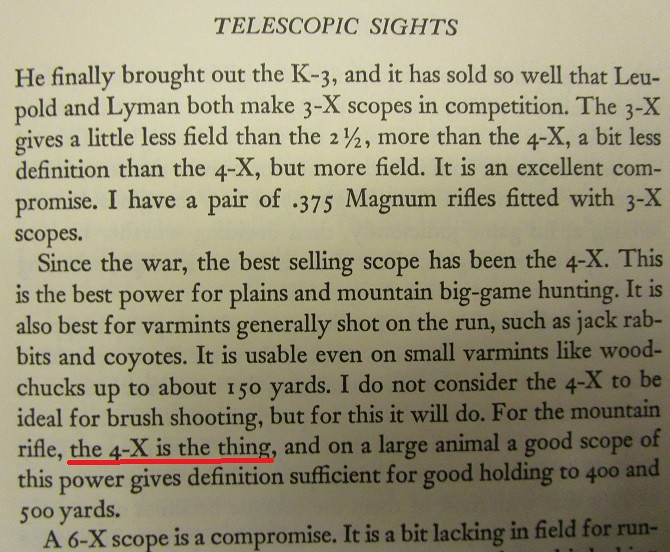
O'Connor's view on big game scopes which is still relevant I believe -

38059925382_959bef9ac9_b.jpg


26314360139_f5ee76e7ab_b.jpg


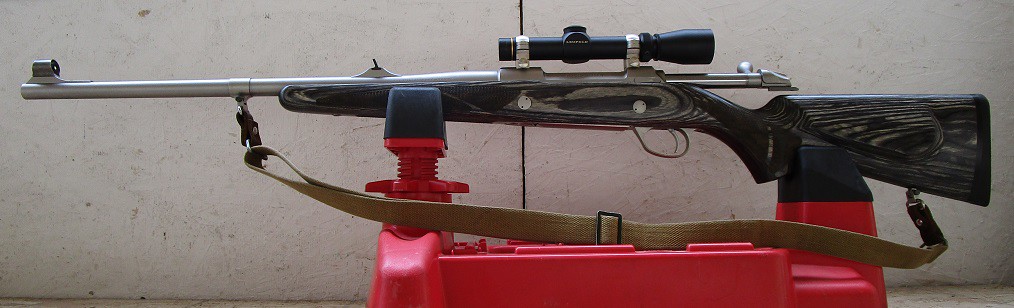
Longest shot I've made to date was downing an Elk at about 400 meters with my .416 using a Leupold M8 Compact 4x28mm (3.6x actual magnification) - no problem.

Most of my hunting rifles have low power variables - 1-4x / 1.5-5x / 1.75-5x - which can be turned down to lowest magnification for hunting in timber. These are also compact and lightweight so the rifles still retain a handy pointable feel. An example -

35246701963_c14a72e4d0_b.jpg

.375 H&H Magnum Sako 85 Kodiak with Leupold VX-2 1-4x20mm
 
Last edited:
How many people carry binoculars for identifying game?

Many years ago I had a friend of a friend look at me through the scope on his rifle because, despite my orange jacket, I apparently “looked like a moose” to this idiot.

It’s easy to have too much magnification when hunting in the bush. 1-4 or 1.75-6 is a useful range for a hunting rifle. But hunters should carry a set of binoculars for identifying game. It is not pleasant to watch a guy looking at you through the scope of his rifle.
 
Short range scopes like what you are.describing go on short range calibers. For example I have them on a 22 Hornet, CZ 527 in 7.62 x 39, Marlin GG, and 416 Rigby.

If one owns a bunch of firearms, it's hard to put top glass on everything. The long time best* overall magnification is 3-9, this is where one finds the most competitive bang for the buck. Many makers now seem to offer 2-10 for similar money. Most of my highest variables have gone on Rimfires, top magnification being useful for seeing tiny holes in paper.

Magnification ranges that start with the bottom range greater than 4, are target rigs. Seeing a blob of hair at short range is not helpful. But for really short shots optical quality, and low light transmission is almost as important.
 
I've got to ask. Was the hunt unsuccessful because of the 4-12 and 3-9 or did you have nothing else to do but question what would be optimum? :)

I've got variables from the low range to the high topping out at 25, your's included. They've all
their place. In the case of 1-5 ish scopes it can be someone else's place; but otherwise they all seem to find a niche.

Most of my rifles wear something like a 3.5-10 or 4.5-14 and for every time I've ever wished there was less power there's probably 100 dead animals with the magnification turned right up. Many of those situations were in heavy shaded bush where I've got the cross hairs on the game waiting for that one more step that will be its last. Others are at longrange, with subtension reticles only work at that power.

Your choice seems to suit your needs, or current way of thinking and that's great. There was a process that got you there. Others have gone through their own process and ended up somewhere else. That's good too.
 
Over many years myself and most of my hunting partners settled on low powered variables for most of our big game hunting,, starting 'way back with a Bushnell Scopechief IV with flip up Command Post, a very useful scope. Elk hunters in particular but sometimes also moose hunters visualize the great bull standing broadside and unconcerned on an open hillside meadow or across a broad logging slash just waiting for you to come along and snipe him but in reality you could wait half a lifetime for that perfect shot. Most animals spend most of their time in or close to cover, at least partially obscured by brush or trees and that is where most hunters have success because that is where most of the animals are. Road hunters will spot some animals out in the open, usually the first or last hour or two but even here there is usually some brush or sparse trees to contend with. It has been long established that the vast majority of game is taken under 200 yards and in fact for most species it is under 100 yards. The exception is the mountain species such as sheep, goat and caribou where the country is open and the ranges can be long.
Most hunters, in spite of their absolute confidence in their ability to deliver a clean killing shot at any distance and under any circumstance, in reality can't consistently deliver that performance in the field much beyond 300 yards, sometimes much less. A 1.75x6 scope at the highest setting will show a 300 yard deer at the same size as a 75 yard deer without magnification and if you can't make a certain killing shot from a steady position at this range you need more practice or closer range, not more magnification. A low powered variable set on or near the lowest setting is ready for instant use and if a long range shot presents there will nearly always be time to crank up the magnification if desired but on a sudden close range presentation you won't have time to turn it down. A fixed 2 1/2 power scope is a practical tool on a rifle with a shorter practical range such as a 45-70 or 35 Remington and a fixed 4X or 6X is fine on a mountain rifle where weight and absolute reliability is very important.
As for using a higher powered scope to identify a legal animal, every Hunter Safety Course that I am aware of makes the point that this is why you carry binoculars, you do not point your rifle at anything you don't intend to shoot. Identify first, then point your rifle. There have been many accidental shootings in the past caused by someone trying to identify an object in the bush with their scoped rifle and from personal experience I can tell you it scares the crap out of you when you see someone point their rifle at you so they can get a better look through their scope!
 
I was also in the mindset of 'more magnification is better' when deer hunting last year. Using a 3.5-10 on its lowest power still made shots 50 yards and in much harder than I wanted them to be. This year I'm trying a 1.75-5. I can see myself getting a 2-10 in the future as in my mind it's the best of both world's, but with the cost of 5x scopes it won't be happening anytime soon.
 
I have Zeiss Diavari 1.5-6 X 42 .
I have shot my fair share of deer and moose .
And I have not shot any game with the scope set at six power.
 
Back
Top Bottom