The movies have it all wrong. When they show Tanks in action, they show hulking iron monsters, completely invincible, growling across the landscape until some heroic GI (usually) takes it out with a single round from his 2.37-inch bazooka or his .45 Auto or something. Never happen like that, never.
If you're looking for a guy with GUTS, look to the Commander of the Bomb or a Tank of that sort. Sure, the Commander had the use of the turret-top Browning .5, but he also was using binocs constantly AND he was in constant communication with Troop and Company at the very least. He was a busy boy. IF he was silly enough to pull his head down inside the brute, all he had to see through were the bulletproof glass blocks in the roof-edge of the Commander's Cupola, as it was termed. Little slits about 2 inches high and 5 wide and the view was something like trying to look through a fish-tank, even with fresh blocks in place. He was on the intercom a lot of the time, as part of his job was to direct the Driver, the Gunner, the Co-driver (who also was the Bow Gunner, being equipped with an M1919A4 .3 Browning), the Radio Operator, who maintained the Number 19 Set which kept you in communication with troop and Company.... and who doubled as Loader for both the Master Weapon and the Co-ax: another .3 Browning M1919A4. Now here's the fun part: if somebody swept the Tank with a burst from a Schmeisser or a '42, those pretty glass blocks were smashed badly and became absolutely impossible to see through. So the whole Tank was blind unless the Commander earned his pay and did what he was supposed to do..... and opened his 'lid' and STOOD UP on the back of the Gunner's seat... with his TOP HALF sticking out into the daylight. NOW he could run that .5 if he had to, and he could see where they were going, keep and eye or three open for ambush locations and all that. The Commander was the Number 1 Target aboard any Sherman. Without the Commander, the Tank was blind and 2/3 of the way to directionless. Look at the figures: casualties among Tank Commanders ran about 90 percent.
The DRIVER was in charge of running the brute. He had an instrument panel which showed him revs, oil pressure, water temperature and that was about all. He and the Co-driver had 2-position seats: they could work hunched down inside, or they could almost stand up on the job (which meant that they were running heads exposed). The Driver also had control of the Clutch and the fuel pedal. In the later Diesel versions, the fuel pedal stayed on the floor and shifting was by engine revs, with shifting-down done when you hit 1800, shifting-up done when you hit 2300 or 2350, depending on the RCEME guys who had set your governor (they were factory-set at 2150, which made the Jimmies practically useless). The actual gear-shift was a modified H shift with a button on the shaft. Your 4 regular positions, where you would assume 1, 2, 3 and 4 to be, were actually 2, 3, 4 and 5. You got to 1 by hitting the button into 'Down' position and shifting into 2.... and you got 'Reverse' by shifting into 3 with the button down. And yes, it has actually been done: 5th into Reverse in one shift: Tank almost stood on its nose, both clutches burned out and the whole crew bailed out because everybody was afraid the whole unit was going to brew. The rest of the Regiment actually let the guy who did this, live. I saw him just the other day and he STILL hasn't learned to treat a vehicle with respect! Gearboxes were strictly NON-synchronised 'crash boxes' and they were rough in comparison to anything else you might have driven. Clutching was only for getting into First or Reverse; for anything else, you shifted by the revs, feeling it into position FAST because if you tried to double-clutch (as the manual said to do) the gearing was such that it was likely the Tank would have slowed down too much while you were making the shift... and you would need to go down TWO gears, rev the crap out of her and gear back UP to where you wanted to be. Once you got some experience, you often could make a shift by single-clutching, especially if the gears were worn.
The Radio Operator was in the left-hand side of the Turret and looked after the Set, Radio, Number 19 (Canadian-made by Northern Electric). He also looked after servicing and feeding the Co-ax, which was a Browning M1919A4, .30-'06, of course, mounted coaxially with the Master Weapon (the main gun). Ammo usually was packed 4 AP, 1 Tracer in disintegrating linkbelt. There was a bag under the gun to catch the brass, but it didn't do a lot for all that linkbelt. When the Co-ax was firing, you could hear all the loose crap inside the gun, banging back and forth with every single shot, about 8 or 9 times a second. It sounded for all the world as if the gun were self-destructing! Another part of the Radio Operator's job was feeding the Master Weapon. In combat, these Tanks generally ran with an HE up the spout, fused .05 seconds delay so the shell would dig its way into a building or roadblock before going BAN

much more efficient for moving stuff out of the road. But the Operator also ran with an AP across his knees, ready to slam it into the breech on about 2 seconds' notice. If the Tank ran into something hard enough to need the AP, the Gunner would 'unload' the Master Weapon by mashing the Magic Button with his foot, scream "AP!!" into the intercom, the Operator would run the AP into the breech, watch the block slam shut (hopefully without taking 2 or 3 fingertips with it) and yell "LOADED!" into his mike, the Gunner would finish taking aim, call "FIRING NOW!" and mash the Magic Button again while the Operator was getting another couple of rounds out of the bins.
IF everybody did their jobs right, they would be able to reload with an HE and proceed onward.
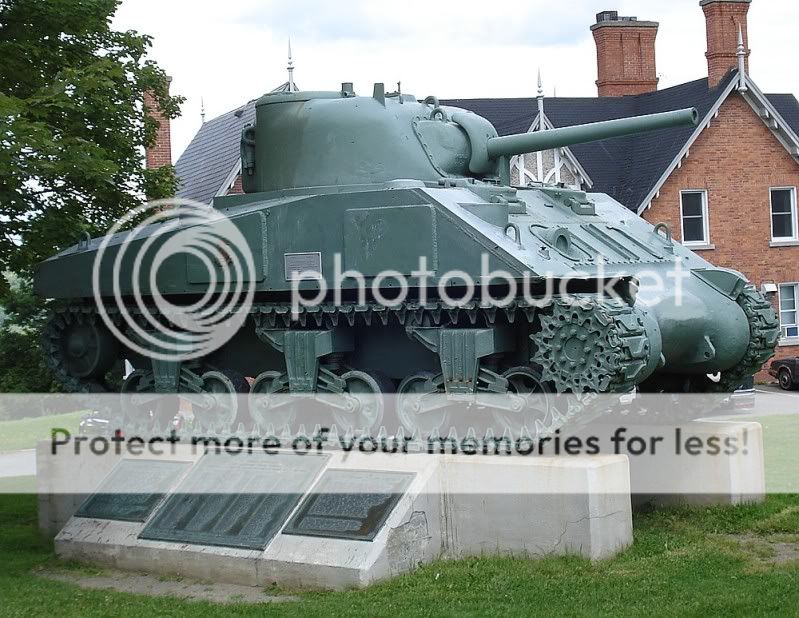
This is how the guys in the Bomb did their jobs. I know this. If they had not done it like this, Bomb would not exist today.... and nor would any of her crew. Remember, the gasoline-powered Shermans were called "Ronsons" by the Germans as well as by our side, the term coming from the Ronson slogan, "Light every time!". If a gasoline-powered Sherman took a SERIOUS hit, it caught fire about 90% of the time. You had 3 seconds to get out. The Diesel ones were MUCH better: 60% chance of lighting and 5 seconds to get out.
The Co-driver was responsible for running the bow flexible MG in its ball mount, another M1919A4 in .3 calibre. There was a Co-driver as part of every crew because driving one of these brutes was immensely tiring. It was a lot of fun for half an hour, but spend a morning herding one of these monsters around and you were BEAT. Steering, any steering at all, was by skid-brake levers operating on the track brakes; it took a LOT of physical effort. The Co-driver was VERY necessary. When the Tank took a break and the crew bailed out, everybody checked his own equipment. The Co-driver had only to check the starboard track and starboard water, oil and fuel tanks. Then he made tea for the rest of the crew while they finished their work.... and it was appreciated. On breaks, the Commander generally stayed 'up top' where he could listen on the Troop and Company Nets while the Operator policed up all that damned linkbelt and dumped it over the side with the brass from the Co-ax and from the Master Weapon, which was inconvenient and took up a lot of space. And the Gunner was allowed to unwind.... literally.
There is NO job in this WORLD as claustrophobic as that of Gunner on one of these Tanks. The Gunner rode in the bottom of the Turret with the breech of the Master Weapon to the left of his head and slightly above. His only view of the world was through his sighting telescope and he had almost ZERO room to move. He was in charge of the Master Weapon and had, as his controls, a most rudimentary gun stabiliser (which spent most of its time turned off or out of service, anyway), a power traverse footplate (toe down to swing right, heel down to swing left) and two buttons by his left foot, one for the MW itself, the other for the Co-ax. With his left foot in the right position, he could poop off a few from the Browning, let loose a shot from the Master and poop off another burst from the MG without even moving his heel. He also had handwheels for traverse and elevation for manual gun-laying, and these were used most of the time by experienced Gunners, partly because they were more precise, partly because there was no dithering about as there would have been had the gun stabiliser been relied upon. IF the Gunner wasn't very big, he could move his shoulders to the right about 5 inches, 4 to the left, and he could sit back a bit, almost straight but not quite. He had the Commander's feet at his own ear levels because the Commander stood on the back of the Gunner's seat. If the Commander was hit, he fell down inside, on top of the Gunner. There were lots of Gunners trained. There had to be. If the Tank took a serious hit, the Gunner fried.
When the Master Weapon fired, it came back in the turret faster than you could see it move, opened up and dumped its empty in mid-air, then the recuperators took over and ran it back forward again where it stayed, breech open, awaiting the next round. Yes, it was a semi-automatic single-shot. The casing, literally glowing, fell to the floor of the turret and you left it alone, along with all the other hot brass, until you stopped for a break. THEN you used asbestos mitts to unload the fired rounds: 12 pounds or so of brass can soak up a LOT of heat, especially at the head.
And here is a sobering thought: with the technology they had, firing on the move was simply a waste of ammunition. It looked good in the propaganda films but, if you wanted to HIT your target rather than scare something in the next township, you STOPPED the Tank, fired your 1 or 2 rounds and got underway again FAST, before The Other Guy could get a round off at YOU.
Now think about fighting a war like this... against an enemy who was well dug-in and who knew his ranges to the metre.
The Bomb, and her crew, had angels looking over their shoulders.... all the way from D-Day to the end of the war, 11 months later.
We should be a lot more proud of them than we are.