












































You are using an out of date browser. It may not display this or other websites correctly.
You should upgrade or use an alternative browser.
You should upgrade or use an alternative browser.
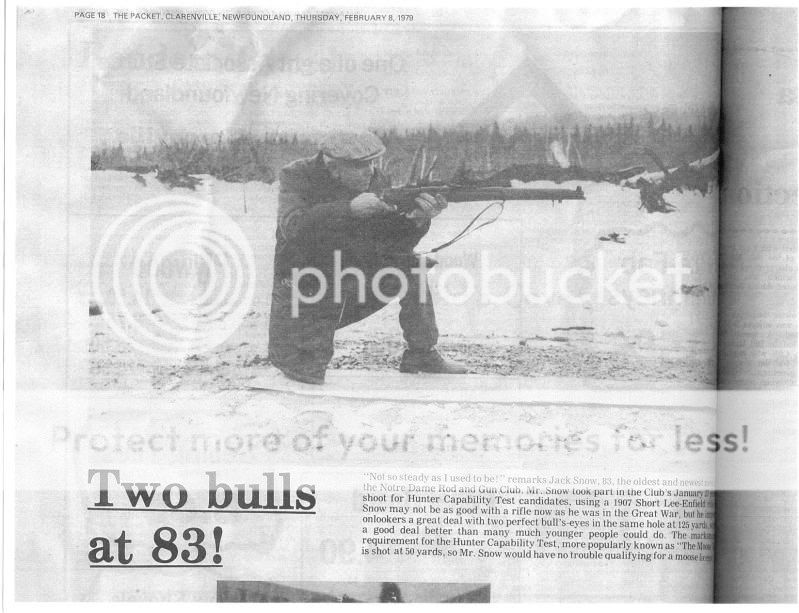
WWI vet using his SMLE for target practice
- Thread starter superbee
- Start date


MapleSugar
CGN Ultra frequent flyer
- Location
- On the loose from NIMH
Cool!
I wonder if he got those two bullseye's at 125 yards from the kneeling position?
I wonder if he got those two bullseye's at 125 yards from the kneeling position?


Stories
Heck, I remember SMELLIE telling me this story last month.
He was fondling a 1905 Ross Mark II** that I had just bought. Maybe his hands are still sore, as I had to whack his fingers a few times with my shoe so he would let go of it and I could get it back.
Where are you, George? I'm sure you can elaborate on this story.
.
I remember Smellie telling me about Jack 25 years ago in NL.
Heck, I remember SMELLIE telling me this story last month.
He was fondling a 1905 Ross Mark II** that I had just bought. Maybe his hands are still sore, as I had to whack his fingers a few times with my shoe so he would let go of it and I could get it back.Where are you, George? I'm sure you can elaborate on this story.
.
Cool story. The old guys sure could tell a story but my granddad would never talk about the war to end all wars. He took shrapnel somewhere in Belgium and was sent home, he never spoke about it, but I expect grandma saw and heard a few things. Putting two rounds in the same place at 125yds is a fine shot if you asked me. Thanks for posting the story, a nice flashback. Cheers.

Got Juice?
CGN Ultra frequent flyer
- Location
- Peoples Republik of Kanukkistan
Cool!
I wonder if he got those two bullseye's at 125 yards from the kneeling position?
Damn.... I could do it... with my scoped .270 prone and on a bipod.
That's just flat out Amazing for that rifle, and the man shooting it.
Credit where it's due, and I know I couldn't match that.
I took the picture and printed it on the front page of THE PILOT out of Lewisporte, Nfld., in early November of 1979. Jack was born on November 10, 1896 and the photo was taken just a few days before his 83rd birthday. I was trying to drum up support for our local rod and gun club and prepare people for the annual Armistice paper, in which I interviewed a Great War veteran on one topic: what happened on the last day of YOUR war?
THE PILOT was and is a part of the Robinson-Blackmore group of papers. Within the group, everybody steals from everyody else; it's one of the conditions of employment. That said, I had no idea that THE PACKET had reprinted this photo until I saw it here.
Jack's father was a merchant skipper and Jack made a voyage to South America on a 3-masted square-rigger before joining the Newfoundland Railroad. Jack joined the Newfoundland Regiment shortly after the beginning of the War. He was a signaller originally because he had experience with both Morse and Telegraph Code (which is different), having worked as a Telegrapher for the Newfoundland Railroad for a couple of years already. He was with the Regiment in England and was with them as they covered the Australian withdrawal from the Dardanelles. That is the reason that he missed The Big Push (first day of he Somme Offensive: July 1, 1916): he was still on his way from the Dardanelles. He rejoined the Regiment as they were being built back up from that slaughter and was in on every action in which the Regiment took part until he was 'killed in action' at Monchy-le-Prueux on 27 April, 1917.
Jack and a few other men had gone up through the town centre, taking fire on the way and taking out a Jerry sniper. Then the artillery started up and Fritz counterattacked. Jack was knocked unconscious by an artillery round (HE) landing nearby; his next memory was somebody kicking him (gently) in the ribs with a jackboot, a Mauser in his face and somebody saying, "Hande hoch, Tommy!". Jack was a prisoner.
The Newfies lost quite a number of men at Monchy-le-Prueux, although it was nowhere nearly as bloody as Beaumont-Hamel. Newfoundland prisoners were paraded before the CO of the German regiment which had captured them, he telling them they they were to be on "Strict Regime" as a protest against reports of German prisoners being mistreated by the British. This meant shackles and bread and water, but you could have all the bread and water you wanted. Jack told me that the Germans were very reasonable otherwise; they simply wanted to make a point.
They went by rail through most of Germany and were taken to the clearing station at Heilsburg. This is not far from Konigsberg in East Prussia; the local paper was the KONIGSBERGER ZEITUNG. This area became Polish following the Great War and now is part of the Kaliningrad Oblast of Russia, an enclave bordering modern Western Europe but still a part of Russia. From the clearing station, they were sent out to work and live on various farms and estates in the district. Under the Hague protocols of the period, enlisted men could be made to work for their keep, but they also had to be paid for their work at a rate of one-half of their Army pay. As Jack was technically in the British Army, his pay was a shilling a day... and a mark was pretty close to a shilling, so he was paid half a mark a day for working on the estate of Baron Gutzeit, who was away on General Staff duties most of the time. In the camp that Jack was in, there was an allotment of 50 workers, so Jack was in with an Irishman who supported the IRA, a Highland Scot and 47 Russians taken in the first part of the War.
It is a long tale, but eventually the three escaped, once the Army discovered that Jack wasn't dead. They sent him his Capture Kit and 26 Red Cross parcels all at once, sort of to get him up to date. This was enormous wealth, so the clothing was pillaged, made into civilian clothes by some of the Russians (who were paid with tins of bully beef and bars of choclate and tobacco, Russians not receiving Red Cross parcels because their government had not signed the protocols).
The three men escaped and wandered for 4 months through what had become the Russian Civil War. They spoke Polish by this time, fairly good German and had learned Russian from their fellow-prisoners..... but there had been no news out of Russia since Tannenberg, so, although they could speak the language, they knew nothing of the conditions there. They had the idea of surrendering to our Russian allies, going across Russia by rail, then crossing the Pacific, crossing Canada by the CPR, getting back to England and into the war again. Ambitious, if not terribly practical! Finally they had seen enough of the actions of the various murderous bands that called themselves armies, Red, White, Black and all the others, gave up just outside of Smolesk to the retreating Germans (this was after Brest-Litovsk). Jack said, "Fritz kept us drunk all the way back to Heilsburg!" At Heilsburg it was 3 weeks in the slam on bread and water for escaping ("We were three to a cell; there were a lot of guys escaping. And we were out in 13 days for good behaviour. But Fritz kept his word on the bread and water!") They then were shipped back to the Gutzeit estate to take in the potato harvest, which is where they were on November 11. And that is another story, just as interesting, believe me.
Jack was long retired from the Railroad when I met him. He was on the Library Board and was very interested in local affairs as well as provincial, national and international. He had an exceedingly curious intellect and absolutely incredible eyesight. If he forgot his glasses, he could only read a newspaper if you held it up for him..... on the other side of the counter...... and took a step or two backwards. One of his projects was to try to get people to mark Memorial Day, which is July 1 in Newfoundland: the anniversary of Beaumont-Hamel. With all the sensitivity of a pork-chop salesman at a Hadassah picnic, the Federal Government was shipping out loads of fireworks so people could celebrate "Canada Day", thus destroying Newfoundland's only truly national holiday at the same time. Together, we did something about that, I am proud to say.
The day this picture was taken, Jack had stopped by the newspaper office to chat. I was in an awful mood, completely stressed-out by the 50 hours I had worked in 3 days. My average week was 105 hours. I told Jack that I had to get out of the office and that I was going to the range.
"What rifle are you taking?"
"Short Lee-Enfield. Would you like to come?"
"When?"
"Right now."
"Then let's go."
The rifle in point was my 1907 Mark I*** Navy rifle with a taper-bored barrel. It was my first restoration projct, starting with a $2 barreled action from Alan Lever. It is not for sale, nor will it ever be for sale. On later occasions, Jack would bring either his P-1839 or his own SMLE Mark III*, a genuine Newfoundland-marked rifle which happened to be on the Armourer's rack when the Regiment turned in their rifles after the March into Cologne in 1919. Jack turned in his rifle and a "spare" which he had acquired mysteriously, traded the "spare" to the Armourer for the "Nfld" rifle, then paid the Armourer $5 for his expertise in removing the butt so the rifle would fit into Jack's barracks-bag. That, or a bottle of rum, was the standard price at that time. Jack shot this rifle regularly until shortly before he died; it went, with 15 drill rounds which I made up, to Jack's son.
We arrived at the range and I set up a couple of targets on a rum box, 125 yards away. Bulls were about 3 inches. We printed the targets on newsprint because the Club had no money to get started. The big Rockwell web press jammed at full-speed for some strange reason (hunters running the thing) and the Club ended up with 8,000 sets of targets for free.
I asked Jack if he would like to try my rifle and he said he would try 2 rounds. I handed him the rifle exactly the wrong way: action closed, safety on, cutoff in.... and I handed him 5 rounds of DI-1944 in a charger. He looked at the rifle, and at the rounds, for about 2 seconds.... and then things started to get very weird.
He flipped the safety off, cutout open, bolt open, stripped in 5 rounds and was down on one knee, bolt closed, first pressure taken, before you could say it. It was as if he had lost 60 years in an instant. First round went off, action slapped back and forth, second round, slap-slap again, third round. On the fourth round, the muzzle wavered a bit; he was tiring. On the fifth round, it wavered a lot. But for about 10 seconds I had been on a rifle range with a genuine sniper from the Great War..... and he was GOOD.
Jack's first 3 rounds were under a quarter, with 2 in a single hole, one over top of the other. His fourth was about 4 inches away and the fifth was off the box.
I had snapped 2 photos during this and ran one in the paper front page, centre, above the fold, the following week. The week after that, I ran Jack's full story of the end of the Great War as he saw it.
But this is the first I knew that THE PACKET had run the picture a few months later.
By the way, Jack's story has been run in the former Newfoundland vets' paper and also was in "The Legionary" at one time. We spent 2 whole days together to re-create those final days of the Great War.... as it was for him.
RIP, Private John E. Snow, Newfoundland Regiment 1914-1919, aet. 87anno.
.
THE PILOT was and is a part of the Robinson-Blackmore group of papers. Within the group, everybody steals from everyody else; it's one of the conditions of employment. That said, I had no idea that THE PACKET had reprinted this photo until I saw it here.
Jack's father was a merchant skipper and Jack made a voyage to South America on a 3-masted square-rigger before joining the Newfoundland Railroad. Jack joined the Newfoundland Regiment shortly after the beginning of the War. He was a signaller originally because he had experience with both Morse and Telegraph Code (which is different), having worked as a Telegrapher for the Newfoundland Railroad for a couple of years already. He was with the Regiment in England and was with them as they covered the Australian withdrawal from the Dardanelles. That is the reason that he missed The Big Push (first day of he Somme Offensive: July 1, 1916): he was still on his way from the Dardanelles. He rejoined the Regiment as they were being built back up from that slaughter and was in on every action in which the Regiment took part until he was 'killed in action' at Monchy-le-Prueux on 27 April, 1917.
Jack and a few other men had gone up through the town centre, taking fire on the way and taking out a Jerry sniper. Then the artillery started up and Fritz counterattacked. Jack was knocked unconscious by an artillery round (HE) landing nearby; his next memory was somebody kicking him (gently) in the ribs with a jackboot, a Mauser in his face and somebody saying, "Hande hoch, Tommy!". Jack was a prisoner.
The Newfies lost quite a number of men at Monchy-le-Prueux, although it was nowhere nearly as bloody as Beaumont-Hamel. Newfoundland prisoners were paraded before the CO of the German regiment which had captured them, he telling them they they were to be on "Strict Regime" as a protest against reports of German prisoners being mistreated by the British. This meant shackles and bread and water, but you could have all the bread and water you wanted. Jack told me that the Germans were very reasonable otherwise; they simply wanted to make a point.
They went by rail through most of Germany and were taken to the clearing station at Heilsburg. This is not far from Konigsberg in East Prussia; the local paper was the KONIGSBERGER ZEITUNG. This area became Polish following the Great War and now is part of the Kaliningrad Oblast of Russia, an enclave bordering modern Western Europe but still a part of Russia. From the clearing station, they were sent out to work and live on various farms and estates in the district. Under the Hague protocols of the period, enlisted men could be made to work for their keep, but they also had to be paid for their work at a rate of one-half of their Army pay. As Jack was technically in the British Army, his pay was a shilling a day... and a mark was pretty close to a shilling, so he was paid half a mark a day for working on the estate of Baron Gutzeit, who was away on General Staff duties most of the time. In the camp that Jack was in, there was an allotment of 50 workers, so Jack was in with an Irishman who supported the IRA, a Highland Scot and 47 Russians taken in the first part of the War.
It is a long tale, but eventually the three escaped, once the Army discovered that Jack wasn't dead. They sent him his Capture Kit and 26 Red Cross parcels all at once, sort of to get him up to date. This was enormous wealth, so the clothing was pillaged, made into civilian clothes by some of the Russians (who were paid with tins of bully beef and bars of choclate and tobacco, Russians not receiving Red Cross parcels because their government had not signed the protocols).
The three men escaped and wandered for 4 months through what had become the Russian Civil War. They spoke Polish by this time, fairly good German and had learned Russian from their fellow-prisoners..... but there had been no news out of Russia since Tannenberg, so, although they could speak the language, they knew nothing of the conditions there. They had the idea of surrendering to our Russian allies, going across Russia by rail, then crossing the Pacific, crossing Canada by the CPR, getting back to England and into the war again. Ambitious, if not terribly practical! Finally they had seen enough of the actions of the various murderous bands that called themselves armies, Red, White, Black and all the others, gave up just outside of Smolesk to the retreating Germans (this was after Brest-Litovsk). Jack said, "Fritz kept us drunk all the way back to Heilsburg!" At Heilsburg it was 3 weeks in the slam on bread and water for escaping ("We were three to a cell; there were a lot of guys escaping. And we were out in 13 days for good behaviour. But Fritz kept his word on the bread and water!") They then were shipped back to the Gutzeit estate to take in the potato harvest, which is where they were on November 11. And that is another story, just as interesting, believe me.
Jack was long retired from the Railroad when I met him. He was on the Library Board and was very interested in local affairs as well as provincial, national and international. He had an exceedingly curious intellect and absolutely incredible eyesight. If he forgot his glasses, he could only read a newspaper if you held it up for him..... on the other side of the counter...... and took a step or two backwards. One of his projects was to try to get people to mark Memorial Day, which is July 1 in Newfoundland: the anniversary of Beaumont-Hamel. With all the sensitivity of a pork-chop salesman at a Hadassah picnic, the Federal Government was shipping out loads of fireworks so people could celebrate "Canada Day", thus destroying Newfoundland's only truly national holiday at the same time. Together, we did something about that, I am proud to say.
The day this picture was taken, Jack had stopped by the newspaper office to chat. I was in an awful mood, completely stressed-out by the 50 hours I had worked in 3 days. My average week was 105 hours. I told Jack that I had to get out of the office and that I was going to the range.
"What rifle are you taking?"
"Short Lee-Enfield. Would you like to come?"
"When?"
"Right now."
"Then let's go."
The rifle in point was my 1907 Mark I*** Navy rifle with a taper-bored barrel. It was my first restoration projct, starting with a $2 barreled action from Alan Lever. It is not for sale, nor will it ever be for sale. On later occasions, Jack would bring either his P-1839 or his own SMLE Mark III*, a genuine Newfoundland-marked rifle which happened to be on the Armourer's rack when the Regiment turned in their rifles after the March into Cologne in 1919. Jack turned in his rifle and a "spare" which he had acquired mysteriously, traded the "spare" to the Armourer for the "Nfld" rifle, then paid the Armourer $5 for his expertise in removing the butt so the rifle would fit into Jack's barracks-bag. That, or a bottle of rum, was the standard price at that time. Jack shot this rifle regularly until shortly before he died; it went, with 15 drill rounds which I made up, to Jack's son.
We arrived at the range and I set up a couple of targets on a rum box, 125 yards away. Bulls were about 3 inches. We printed the targets on newsprint because the Club had no money to get started. The big Rockwell web press jammed at full-speed for some strange reason (hunters running the thing) and the Club ended up with 8,000 sets of targets for free.
I asked Jack if he would like to try my rifle and he said he would try 2 rounds. I handed him the rifle exactly the wrong way: action closed, safety on, cutoff in.... and I handed him 5 rounds of DI-1944 in a charger. He looked at the rifle, and at the rounds, for about 2 seconds.... and then things started to get very weird.
He flipped the safety off, cutout open, bolt open, stripped in 5 rounds and was down on one knee, bolt closed, first pressure taken, before you could say it. It was as if he had lost 60 years in an instant. First round went off, action slapped back and forth, second round, slap-slap again, third round. On the fourth round, the muzzle wavered a bit; he was tiring. On the fifth round, it wavered a lot. But for about 10 seconds I had been on a rifle range with a genuine sniper from the Great War..... and he was GOOD.
Jack's first 3 rounds were under a quarter, with 2 in a single hole, one over top of the other. His fourth was about 4 inches away and the fifth was off the box.
I had snapped 2 photos during this and ran one in the paper front page, centre, above the fold, the following week. The week after that, I ran Jack's full story of the end of the Great War as he saw it.
But this is the first I knew that THE PACKET had run the picture a few months later.
By the way, Jack's story has been run in the former Newfoundland vets' paper and also was in "The Legionary" at one time. We spent 2 whole days together to re-create those final days of the Great War.... as it was for him.
RIP, Private John E. Snow, Newfoundland Regiment 1914-1919, aet. 87anno.
.
Last edited:
MapleSugar
CGN Ultra frequent flyer
- Location
- On the loose from NIMH
That is one cool story, Smellie.
You sure are lucky to have known a fellow like Jack.
BTW, was he really a sniper in the war?
You sure are lucky to have known a fellow like Jack.
BTW, was he really a sniper in the war?

- Location
- Tucson, Arizona
Years ago I met a WW1 vet. He lived on the Isle of Wight. Didn't know there was a war on until months later. I handed him a No1Mk3, but he said that wasn't what he was issued, Then I handed him a Long Lee and that's what he had! Funny story about that as he was wounded in 1915. He was living here and went to the hospital as his wound in the leg still bothered him at times. The doctor asked him when he was wounded and he said 1915. the doctor replied, "My father wasn't even born then!"
when He emigrated to the U.S.,he never got his WW1 medals and I was able to give him the address of the medals office in the U.K., so many years later he did recieve them and now the family has them
when He emigrated to the U.S.,he never got his WW1 medals and I was able to give him the address of the medals office in the U.K., so many years later he did recieve them and now the family has them


- Location
- Manitoulin Island
These stories are too good to die. I hope that anyone who knows of stories like these passes them on to the the Legion magazine, or somewhere they will be preserved.

Yup.
With eysight like that, what else could he have done?
Helluvva nice guy, too.
It was a very real privilege to have known him.
I like that he was still using an SMLE
, not the peep-sighted No.4......

MauserMike
CGN Ultra frequent flyer
- Location
- SW Ontario
smellie,
I wish there were more storytellers like you writing the papers these days than the 2nd rate sound bite regurgitaters that pass for journalists in this day and age!
I wish there were more storytellers like you writing the papers these days than the 2nd rate sound bite regurgitaters that pass for journalists in this day and age!





















