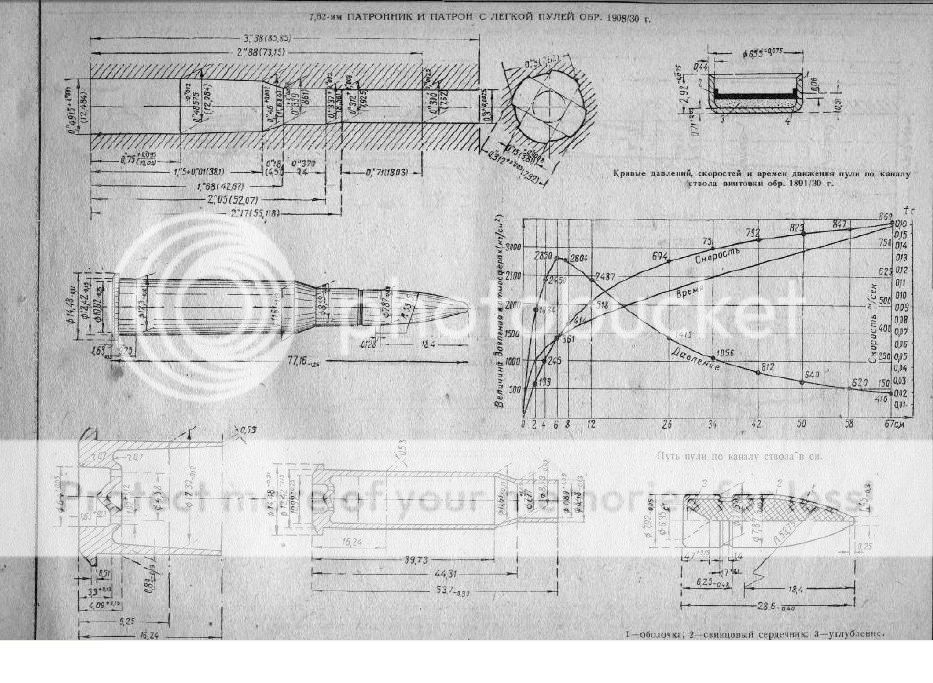
@Ganderite: actually, there are FOUR different bullet weights for the German 8mm, FIVE for the.30-'06 and at least THREE for the 3-line Moisin-Nagant cartridge.
In the case of the German round, here is what hppened:
1888: cartridge is adopted with a 227 RNFB slug
1904: cartridge is modernised with the 154 PFB
1916/17: in reply to Tanks, an AT load is invented, a 196 PBT but 154 continued as regular standard.
1935: Mr. Hitler liked the 196 so it became the new standard
BUT..... lead shortages led to SmE with an IRON core (lighter than lead) and the AP version, the SmK AP with hardened core, which were most of WW2 production.
Story with the '06 very similar: adopted 1903 with a 220 RN, changed to shorter case and 150 pointed FB in 1906. But BASE DRAG had not been calculated properly and so the MG tables for indirect fire were all wonky and the guns were shooting half mile short of what they should have been. Experiments with Swiss GP-11 slugs ensued and so the M-1 round was adopted with a 173, which gave the long-range performance desired. After the Great War, the M-1 became the new standard and the M1906 continued for practice until it ran out. They started using M-1 on short ranges but it was too hot, so they mfd more M1906 but with a gilding-metal jacket rather than a cupronickel jacket, and using a scrap-lead core which came in at 152. This was the M2 Ball of WW2, Korea and Viet-Nam use. AP and Tracer very much followed the M1 SHAPE but the cores were lighter, so the WW2 AP was 168, Tracer was even lighter..... and I am told (but cannot confirm) that the last batches of '06 were loaded with the NATO 145 SBT. And they were ALL "the" standard.
I imagine something of that ilk happened with the 3-line round: a heavy RN at first followed by the light bullet in 1908/09 which was cheap and zippy but had a lot of base drag. A special MG load would hve wanted more range for indirect-fire applications and so new loads had a BT bullet to reduce dag... which also added weight..... and the special-purpose slugs followed along as with the '06.
It all makes sense when you understand (1) the order in which things happened, (2) base drag, and (3) indirect fire. The light bullet in every case was fine as a combat round at 600 and below, but HMG fire demanded longer ranges which were not possible with the light bullet. The light bullet could have had its velocity increased, but not at safe pressures, so a more aerodynamic bullet (heavier and better shape) was substituted at lower velocity....... and gave longer ranges with safe pressures.
Hope this helps.
.