WWII Mosin ammo weight?

Until the Angels Fall

BANNED
BANNED
BANNED
EE Expired
Rating - 94.2%
49   3   0
Location
London, Ontario
In WWII what weight of 7.62x54R did the Russians use? I ask as I want to buy the ammo I can shoot and moving the sights up/down will be the correct amount to hit targets at that range. Any chance the SVT-40 used the same ammo as well? :)

Thanks, UTAF
 
Regardless, without a scope these guns are not built for any kind of accuracy!

The front post on my Mosin is ####in huge, and beyond 100m you are shooting for minute of man, not groups on paper.

If you just want to hit a gong thats all good, but even a 12 inch gong completely dissappears behind my front post at 200m.
 
You are trying to compare oranges to apples. If you really want to know how your Mosin shoots any given bullet weight at any given range, you just need to buy some and shoot them at those ranges. I would suggest a lot of pracitce is in order, off hand, kneeling, prone and sitting to start with. Then more from various types of rests. Don't forget shooting from above and below your targets.

The reason I'm mentioning the above, is if you are only planning on buying one box of ammo for the hunting season and aren't in tune with your rifle, it won't make the least bit of difference what weight bullet you're shooting. From the sounds of things that may be the case. If I'm wrong, please accept my apologies.

There might be another problem with how your Mosin sights are marked. Some of the older models that didn't go back for FTR or repair, were marked in Arshins, rather than meters or yards. An Arshin is slightly less than a yard from what I can remember. Not that it makes much difference out to 200m. The sights on most Mosins are set to be 12cm/16cm high, at their lowest settings at 100m. That should put you right in the center at appx 300m with 150 grain bullets at factory velocities. Each commercial brand will have different velocities as well. Pick a commercial product and stick with it.

Unlike commercial offerings, milsurps suffer from varying bore diameters. This may effect accuracy as well.

Some Mosins, depending on their bore wear and other conditions are veritable tack drivers. 2inches isn't as uncommon as some people think. Failing eyesight can be a problem as well. If you can shoot open sights well enough at 200m to place capable loads from a capable rifle into 2 inches, my hat is off to you.
 
Well I have a few loads that work well...the thing that annoys me is having the sights set for 150 when I am only shooting at 100...I just want to be able to make adjustments on the fly for 50-300 yards rather then having to find the JUST RGIHT spot to put them at.
 
Arshin is 28 inches IIRC. Yard is 36 inches and that funny French thing is 39.37 inches.

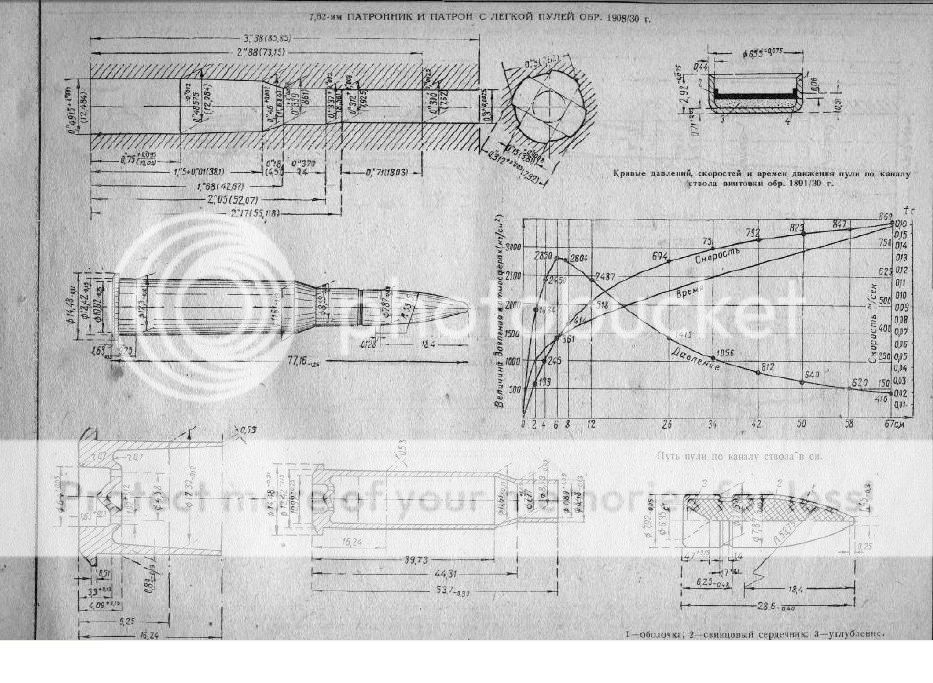
The Russian/Soviet light ball projectile is interesting. It is .310 - .312 in diameter with most coming in at .311, but it is also a pure MINIE bullet. It has a conical hollow base with the core at the base being the thinnest-possible coating of lead over the actual jacket. NO doubt whatever that it was designed to function exactly as a Minie Ball and the powder pressure was to spread the base of the bullet firmly into the rifling.

REALLY wonder why nobody else did this: it makes a lot of sense, especially if you don't have much of an inspectorate division with tons of spare barrels.
.
 
Here are some dimensions:

rus.jpg
 
@Ganderite: actually, there are FOUR different bullet weights for the German 8mm, FIVE for the.30-'06 and at least THREE for the 3-line Moisin-Nagant cartridge.

In the case of the German round, here is what hppened:
1888: cartridge is adopted with a 227 RNFB slug
1904: cartridge is modernised with the 154 PFB
1916/17: in reply to Tanks, an AT load is invented, a 196 PBT but 154 continued as regular standard.
1935: Mr. Hitler liked the 196 so it became the new standard
BUT..... lead shortages led to SmE with an IRON core (lighter than lead) and the AP version, the SmK AP with hardened core, which were most of WW2 production.

Story with the '06 very similar: adopted 1903 with a 220 RN, changed to shorter case and 150 pointed FB in 1906. But BASE DRAG had not been calculated properly and so the MG tables for indirect fire were all wonky and the guns were shooting half mile short of what they should have been. Experiments with Swiss GP-11 slugs ensued and so the M-1 round was adopted with a 173, which gave the long-range performance desired. After the Great War, the M-1 became the new standard and the M1906 continued for practice until it ran out. They started using M-1 on short ranges but it was too hot, so they mfd more M1906 but with a gilding-metal jacket rather than a cupronickel jacket, and using a scrap-lead core which came in at 152. This was the M2 Ball of WW2, Korea and Viet-Nam use. AP and Tracer very much followed the M1 SHAPE but the cores were lighter, so the WW2 AP was 168, Tracer was even lighter..... and I am told (but cannot confirm) that the last batches of '06 were loaded with the NATO 145 SBT. And they were ALL "the" standard.

I imagine something of that ilk happened with the 3-line round: a heavy RN at first followed by the light bullet in 1908/09 which was cheap and zippy but had a lot of base drag. A special MG load would hve wanted more range for indirect-fire applications and so new loads had a BT bullet to reduce dag... which also added weight..... and the special-purpose slugs followed along as with the '06.

It all makes sense when you understand (1) the order in which things happened, (2) base drag, and (3) indirect fire. The light bullet in every case was fine as a combat round at 600 and below, but HMG fire demanded longer ranges which were not possible with the light bullet. The light bullet could have had its velocity increased, but not at safe pressures, so a more aerodynamic bullet (heavier and better shape) was substituted at lower velocity....... and gave longer ranges with safe pressures.

Hope this helps.
.

 
Regardless, without a scope these guns are not built for any kind of accuracy!

The front post on my Mosin is f**kin huge, and beyond 100m you are shooting for minute of man, not groups on paper.

If you just want to hit a gong thats all good, but even a 12 inch gong completely dissappears behind my front post at 200m.

Not true! I have found my 91/30(with irons) to be more accurate than some modern hunting rifles. My M1 Garand is still my most accurate milsurp, love the lockbar rear sight!
 
Back
Top Bottom