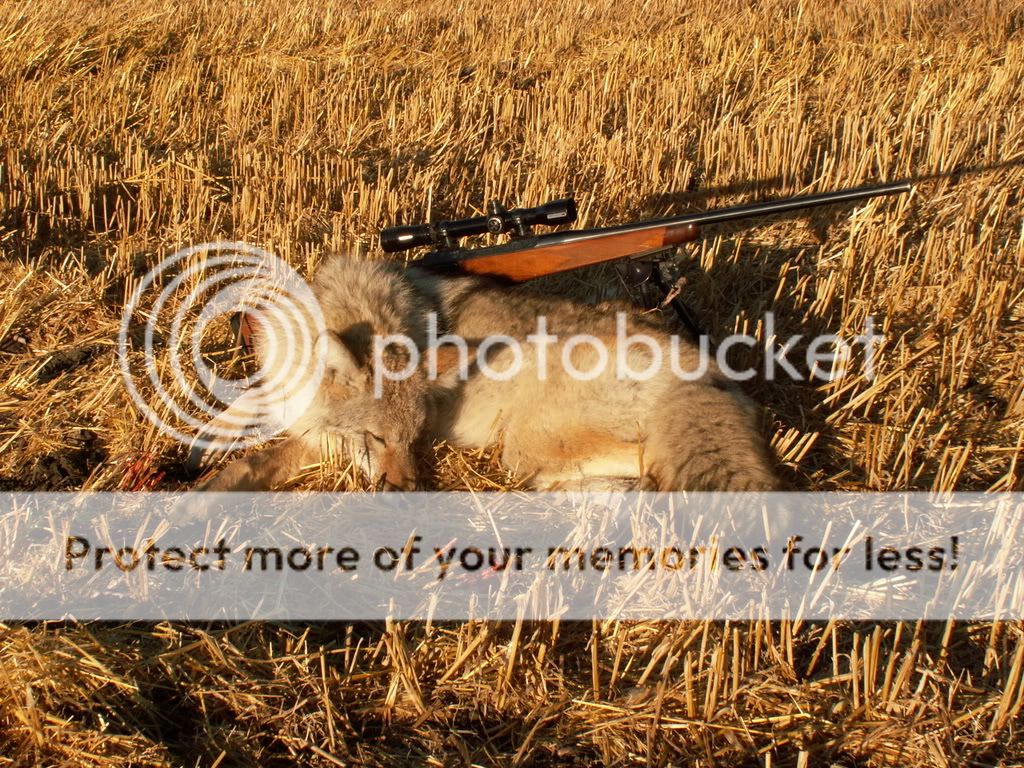
You coyote hunters see these often???

May be just a prairie yarn but my Grampa talked about a bush wolf back in his day in Sask that was part wolf and coyote. He had a neighbour with hounds that used to chase them down. According to him they were bigger and packed up.

My Dad and I seen a big black one with others that had a doe and fawn cornered in Douglas park last fall. Man was it big and carried its tail different.
 
I shot my first black yote last week.....you guys see many of these?
PA240014.jpg
[/IMG]

thats no coyote that a chibacabra:eek: lol
 
Eastern coyotes DO have wolf DNA in them indicating that they crossed at some point. I did a thesis on them. That's why you get the larger size and more color variation with the eastern sub species.

Here's one of two western yotes I dumped while moose hunting this weekend.

PICT0022.jpg

PICT0025.jpg
 
We have shot 3 all black ones, red like a fox, straw yellow, seen one all white, etc, etc, some tipping the scales at 70+ pounds. Another was all black but with the mange it was all bare except for some poodle hair.
 
my buddy seen an 80% black one today. He was deer hunting and when he got out of his truck at 8am after doing morning chores he seen what he thoguht was his mostly black german shepard walking through the field. He whistled to tell it to "come" but it started running looking back at him, thats when he realized it was a coyote, not his dog. First time he's seen a coyote that black in atleast 20 years, he said he never even thought it was a coyote, figured it was his dog the colours were so close. It ran into the bush and his dog was at home when he got there so it was definatly a yote, probably part dog or wolf. He calls them "brush wolves" because of their size.
 
Eastern coyotes DO have wolf DNA in them indicating that they crossed at some point. I did a thesis on them. That's why you get the larger size and more color variation with the eastern sub species.

Am I correct that it's red wolf DNA and not grey wolf that you are refering to?
 
probably part dog or wolf. He calls them "brush wolves" because of their size.

wolf/coyote or coyote/domestic dog crosses are rare in nature. Likely just a colour variation.
 
Am I correct that it's red wolf DNA and not grey wolf that you are refering to?


No you would be incorrect. The mitichondrial DNA isolated originates from grey wolves from northern Ontario and Quebec. Likely small, isolated groups of wolves encountered by coyotes as they spread eastward. The introgression lessened or stopped once the yotes built up a big enough population to solely breed with their own. The coyotes of the northeast are larger, have more color variation, are much less vocal, and have a greater ability to take down big game due to this natural genetic enhancement. Interbreeding with wolves essentially created a new subspecies that is ideally adapted to the deeper snows and thicker forests of the east.

Coyotes in the south and southeast of the US have some red wolf DNA.
 
No you would be incorrect. The mitichondrial DNA isolated originates from grey wolves from northern Ontario and Quebec. Likely small, isolated groups of wolves encountered by coyotes as they spread eastward. The introgression lessened or stopped once the yotes built up a big enough population to solely breed with their own. The coyotes of the northeast are larger, have more color variation, are much less vocal, and have a greater ability to take down big game due to this natural genetic enhancement. Interbreeding with wolves essentially created a new subspecies that is ideally adapted to the deeper snows and thicker forests of the east.

Coyotes in the south and southeast of the US have some red wolf DNA.

I just finished reading a paper on red wolves with coyote DNA but couldn't find any reference to grey wolves and coyotes sharing blood. Have you got any suggested references for this? All the reading I've done suggests that the eastern coyote has red wolf or at least a close but possibly extinct relative of the red wolf DNA in it. There's some facinating research from Algonquin Park.
 
Last edited:
Wolves
By L. David Mech, Luigi Boitani

Contains lots of info on wolf biology and references hundreds of peer reviewed journal articles including info on wolf coyote hybridization.

There are opinions by some of these researchers that the red wolf itself originated from early grey wolf coyote hybridization.
 
Last edited:
Wolves
By L. David Mech, Luigi Boitani

Contains lots of info on wolf biology and references hundreds of peer reviewed journal articles including info on wolf coyote hybridization.

There are opinions by some of these researchers that the red wolf itself originated from early grey wolf coyote hybridization.

Thanks!
 
sjemac, what do you make of the animal in the original picture? It looks so wolfish, as has been pointed out, and just looks too beefy for a coyote.
 
The very first picture? That is definitely a coyote and about average size for what we were shooting on PEI and probably weighed between 35 and 40 lbs.

I weighed and took samples from hundreds of the buggers submitted by trappers and hunters over a two year period and most way overestimated the weights on them. Average was about 35lbs with a couple of truly huge monsters getting into the 50 lb plus range. Those 60 -70 lbers we always hear about are either a bit of an exaggeration or are true hawgs.
 
Average was about 35lbs with a couple of truly huge monsters getting into the 50 lb plus range. Those 60 -70 lbers we always hear about are either a bit of an exaggeration or are true hawgs.

Absolutely. There is a tendency to overestimate their weight and size. Though it is equally true that eastern coyotes tend to be larger. Government biologists have collared coyotes here in Newfoundland that were in the mid 50 lb range, but those yotes are eating caribou.
 
Absolutely. There is a tendency to overestimate their weight and size. Though it is equally true that eastern coyotes tend to be larger. Government biologists have collared coyotes here in Newfoundland that were in the mid 50 lb range, but those yotes are eating caribou.

Even the Island yotes I was working with were much larger than the ones out here and their three main food items in order of frequency found in the stomach of fall/winter harvested coyotes were voles, showshoe hare and apples -- yes apples -- they hunted the old orchards that cover PEI and catch the mice and hare feeding off the dropped apples and then have a few themselves.

I've got two western yotes in the freezer that I'm skinning this week. I'll have to weigh them before I do.
 
sjemac, your right I figured mine was 40lbs ish......no question it was a yote. Stopped in to see a buddy's deer hunting gang, he shot a black one last night probably 2 miles from where I shot mine. He said it had some white on it's belly though, not totally black like mine.
 
Based on pics and stories from a pred hunting site I frequent,it seems that black yotes are "relatively' common in the south-east USA,or at least more common than elsewhere?That said,I stopped and looked at a large black roadkilled yote in NB this summer.Had to stop,it was so big I was thinking maybe wolf...but no,just a big yote.

Sjemac,regarding DNA,isn't it true that ALL canines are descended from wolves and share DNA?
 
Back
Top Bottom