












































You are using an out of date browser. It may not display this or other websites correctly.
You should upgrade or use an alternative browser.
You should upgrade or use an alternative browser.
Yugo M48 w/ Zrak ON-M76B "Bosnian Sniper"
- Thread starter Frioletdj01
- Start date
- Location
- On a sand bar in the Atlantic Ocean.
The following pictures are of the manual for the M-69 rifle system that was used by the Yugo army. While the rifle and mount is different from the ZRAK rings used on the M-48, it's as close as I can find online.
I believe the ON2 scopes that have been popping up on ebay were later used on the Dragonov .
 [/URL]01 by PEI Rifleman, on Flickr[/IMG]
 [/URL]02 by PEI Rifleman, on Flickr[/IMG]
 [/URL]03 by PEI Rifleman, on Flickr[/IMG]
 [/URL]04 by PEI Rifleman, on Flickr[/IMG]
 [/URL]05 by PEI Rifleman, on Flickr[/IMG]
 [/URL]06 by PEI Rifleman, on Flickr[/IMG]
 [/URL]07 by PEI Rifleman, on Flickr[/IMG]
 [/URL]7_92mm_m69_01 by PEI Rifleman, on Flickr[/IMG]
 [/URL]7_92mm_m69_02 by PEI Rifleman, on Flickr[/IMG]
 [/URL]7_92mm_m69_03 by PEI Rifleman, on Flickr[/IMG]
 [/URL]08 by PEI Rifleman, on Flickr[/IMG]
 [/URL]09 by PEI Rifleman, on Flickr[/IMG]
 [/URL]10 by PEI Rifleman, on Flickr[/IMG]
 [/URL]11 by PEI Rifleman, on Flickr[/IMG]
 [/URL]12 by PEI Rifleman, on Flickr[/IMG]
 [/URL]13 by PEI Rifleman, on Flickr[/IMG]
 [/URL]14 by PEI Rifleman, on Flickr[/IMG]
 [/URL]15 by PEI Rifleman, on Flickr[/IMG]
 [/URL]16 by PEI Rifleman, on Flickr[/IMG]
 [/URL]17 by PEI Rifleman, on Flickr[/IMG]
 [/URL]18 by PEI Rifleman, on Flickr[/IMG]
I believe the ON2 scopes that have been popping up on ebay were later used on the Dragonov .
Last edited:


BeaverMeat
CGN Ultra frequent flyer
- Location
- Nanaimo, B.C.
Interestingly the ON-2, ON-3, and ON-M76 scopes are an evolution of the Russian PU scope.
Okay, i'll give my best to transcribe.
First two pages say the same:
Sniper Rifle
7,9mm M-69
(Description and Instructions)
- Temporary Edition -
1975 Edition
PAGE 3
United Department of National Defense
General Staff of JNA (Jugoslav National Army)
Infantry Administration
Number 243
29th of April, 1975
As per section 28, subsection F: Instructions for creation and use of military items - 1974 Edition, i'm creating a temporary manual,
Sniper Rifle 7,9mm M69
(Description and Instructions)
Which becomes effective immediately
Temporary manual to be used in training of corporals and soldiers until final release of manuals "Sniper Rifle 7,9mm - M69"
Chief of Staff
General - Major *not sure what rank that translates to in US or CAD equivalent rank
Milan Bjelogrlic (LOL, literal translation of his last name is White Neck!!)
PERSONAL NOTE: Basically it seems this manual you have a copy of was supposed to be a temporary interim manual until a finalized solution was to become available sometime down the line.
PAGE 4
INTO
Temporary manual "Sniper Rifle 7,9mm M69" is created on the foundation notes of technical lieutenant colonel Dinic Obrada and in essence contains:
Purpose, Fighting characteristics, description and handling. (Heading I);
Care and Maintenance of Rifle and Ammunition (Heading II);
and verification of accuracy and rectification of aim (Heading III)
This manual has a temporary function and is intended for use by units (institutions) which use sniper rifle 7,9mm M69. Its content is not meant to be the final edition, but basic instructions whos aim is to introduce the characteristics of this device, its proper use, and its proper maintenance
Final manual for Sniper Rifle 7,9mm M69 will be issued by the end of 1975
PAGE 5
Heading I
Purpose, Description, and Handling of Sniper Rifle and Ammunition
1. Purpose and fighting characteristics of sniper rifle
1. Sniper rifle 7,9mm M69 (picture 1) is used to destroy various individual live targets (momentary, moving, detected or masked)
Fire from Sniper Rifle is most effective up to 800 meters. Aiming distance with optical sights (ON-2 M69) is 1000 meters, and with mechanical sights (i guess they mean irons), 2000 meters. Maximum distance of the rifle is 5000 meters
For targets whose height is 30cm (head size), accuracy range is 320 meters, for chest size (height 50cm) 400 meters and for running figure (150cm) 620 meters
2. For shooting from sniper rifle use of regular rifle ammunition with standard bullet, tracer bullet or sniper ammunition is to be used.
PAGE 6
The rifle is reloaded without a frame (i think they are referring to the clip since the scope would be in the way) (in the magazine, which has a capacity of 5 rounds, the rounds are inserted individually)
The speed of firing during fighting is around 8 rounds a minute.
3. The weight of the sniper rifle (with optical sights) without ammo in the magazine is 4.8 kg
2. Basic Parts and Mechanism of sniper rifle
4. Sniper rifle 7,9mm M69 is comprised of a rifle (in a condensed form) and optical sights
Rifle has the following main components
- barrel
- iron sights
- rifle stock
- *closer I'm sure they mean the bolt
- magazine
- mechanism for feeding the round
- mechanism for firing the round
- kundak No clue....i think thats the butt plate but not 100% sure.
3. Disassembly and Reassembly of sniper rifle
5. Sniper rifle is disassembled only for cleaning, lubing and inspection. Frequent disassembly and reassembly is damaging because it increases the wear and tear of the parts.
Before disassembly it must be verified that the rifle is empty. Instructions in disassembly and assembly of sniper rifle is permitted in remarkable circumstances, so extreme care in handling of the parts is required.
Instead use the rifle 7,9mm M48 because its essentially the same construction.
The rifle must be disassembled on a desk, board or clean work area.
With the assembly and disassembly of the rifle....Continued on next page
OK!!! Thats it for today. I'll continue tommorow, if you guys desire.
First two pages say the same:
Sniper Rifle
7,9mm M-69
(Description and Instructions)
- Temporary Edition -
1975 Edition
PAGE 3
United Department of National Defense
General Staff of JNA (Jugoslav National Army)
Infantry Administration
Number 243
29th of April, 1975
As per section 28, subsection F: Instructions for creation and use of military items - 1974 Edition, i'm creating a temporary manual,
Sniper Rifle 7,9mm M69
(Description and Instructions)
Which becomes effective immediately
Temporary manual to be used in training of corporals and soldiers until final release of manuals "Sniper Rifle 7,9mm - M69"
Chief of Staff
General - Major *not sure what rank that translates to in US or CAD equivalent rank
Milan Bjelogrlic (LOL, literal translation of his last name is White Neck!!)
PERSONAL NOTE: Basically it seems this manual you have a copy of was supposed to be a temporary interim manual until a finalized solution was to become available sometime down the line.
PAGE 4
INTO
Temporary manual "Sniper Rifle 7,9mm M69" is created on the foundation notes of technical lieutenant colonel Dinic Obrada and in essence contains:
Purpose, Fighting characteristics, description and handling. (Heading I);
Care and Maintenance of Rifle and Ammunition (Heading II);
and verification of accuracy and rectification of aim (Heading III)
This manual has a temporary function and is intended for use by units (institutions) which use sniper rifle 7,9mm M69. Its content is not meant to be the final edition, but basic instructions whos aim is to introduce the characteristics of this device, its proper use, and its proper maintenance
Final manual for Sniper Rifle 7,9mm M69 will be issued by the end of 1975
PAGE 5
Heading I
Purpose, Description, and Handling of Sniper Rifle and Ammunition
1. Purpose and fighting characteristics of sniper rifle
1. Sniper rifle 7,9mm M69 (picture 1) is used to destroy various individual live targets (momentary, moving, detected or masked)
Fire from Sniper Rifle is most effective up to 800 meters. Aiming distance with optical sights (ON-2 M69) is 1000 meters, and with mechanical sights (i guess they mean irons), 2000 meters. Maximum distance of the rifle is 5000 meters
For targets whose height is 30cm (head size), accuracy range is 320 meters, for chest size (height 50cm) 400 meters and for running figure (150cm) 620 meters
2. For shooting from sniper rifle use of regular rifle ammunition with standard bullet, tracer bullet or sniper ammunition is to be used.
PAGE 6
The rifle is reloaded without a frame (i think they are referring to the clip since the scope would be in the way) (in the magazine, which has a capacity of 5 rounds, the rounds are inserted individually)
The speed of firing during fighting is around 8 rounds a minute.
3. The weight of the sniper rifle (with optical sights) without ammo in the magazine is 4.8 kg
2. Basic Parts and Mechanism of sniper rifle
4. Sniper rifle 7,9mm M69 is comprised of a rifle (in a condensed form) and optical sights
Rifle has the following main components
- barrel
- iron sights
- rifle stock
- *closer I'm sure they mean the bolt
- magazine
- mechanism for feeding the round
- mechanism for firing the round
- kundak No clue....i think thats the butt plate but not 100% sure.
3. Disassembly and Reassembly of sniper rifle
5. Sniper rifle is disassembled only for cleaning, lubing and inspection. Frequent disassembly and reassembly is damaging because it increases the wear and tear of the parts.
Before disassembly it must be verified that the rifle is empty. Instructions in disassembly and assembly of sniper rifle is permitted in remarkable circumstances, so extreme care in handling of the parts is required.
Instead use the rifle 7,9mm M48 because its essentially the same construction.
The rifle must be disassembled on a desk, board or clean work area.
With the assembly and disassembly of the rifle....Continued on next page
OK!!! Thats it for today. I'll continue tommorow, if you guys desire.
Nothing remarkable about it. After WW2 with creation of a SOCIALIST Yugoslavia the ties with our Russian "friends" became very strong. We were given Tanks, arms, etc by the Soviets. I believe we severed all ties with Soviets in 1954ish when they demanded we become part of the Soviet Pact but Tito refused.
This 15 or so years of heavy Soviet interaction led to a lot of soviet designs being adapted, and then subsequently designed built and improved on by the Yugoslavian arms manufacturer. We made our own Tanks, small arms, aircraft based off of soviet design for most. Hence the no surprise when our ZRAK (which means air btw) optics are direct descendants of Russian designs
This 15 or so years of heavy Soviet interaction led to a lot of soviet designs being adapted, and then subsequently designed built and improved on by the Yugoslavian arms manufacturer. We made our own Tanks, small arms, aircraft based off of soviet design for most. Hence the no surprise when our ZRAK (which means air btw) optics are direct descendants of Russian designs
Interestingly the ON-2, ON-3, and ON-M76 scopes are an evolution of the Russian PU scope.
BeaverMeat
CGN Ultra frequent flyer
- Location
- Nanaimo, B.C.
Nothing remarkable about it. After WW2 with creation of a SOCIALIST Yugoslavia the ties with our Russian "friends" became very strong. We were given Tanks, arms, etc by the Soviets. I believe we severed all ties with Soviets in 1954ish when they demanded we become part of the Soviet Pact but Tito refused.
This 15 or so years of heavy Soviet interaction led to a lot of soviet designs being adapted, and then subsequently designed built and improved on by the Yugoslavian arms manufacturer. We made our own Tanks, small arms, aircraft based off of soviet design for most. Hence the no surprise when our ZRAK (which means air btw) optics are direct descendants of Russian designs
Some unique guns came out of it namely the M76. Somthing about an AK action pumping out 196gr 8x57 bullets floats my boat.

Some unique guns came out of it namely the M76. Somthing about an AK action pumping out 196gr 8x57 bullets floats my boat.
Me too!
I'd even go for a normal AK from Zastava. Thicker receiver, fold-away night sights, and a cool grenade launcher adapter thingy.
CONTINUATION OF TRANSLATION
Page 7
With the assembly and disassembly of the rifle....do not use excessive force or blows. Parts should be placed next to each other in order they were removed making sure they are not mixed with parts from another rifle.
Optics lenses are not to be touched with fingers
When assembling, once again, make note of serial numbers so as to avoid interchanging parts with another rifle.
6. Sniper rifle, once verified empty is disassembled in the following order.
Removal of optical sight: Unscrew the nuts (serrated screws) until the optic mount is loose (pic3) and can be pulled rearward from its receiver base. The optic is placed in its case.
Bolt removal: Is accomplished by cocking the rifle and placing the safety latch in the vertical position and pulling the bolt back while the latch with your left palm.
Page 9, 10 and 11 deal with disassembly of the bolt and magazine and i'm pretty sure you dont need a Serbian translation of it. I'd also like to point out theres pages missing from the book.
PAGE 12
The sniper rifle is equipped with two types of sights - optical and mechanical (open) sights. Some sniper rifles were supplied with a so-called night sights (passive sight instrument)
17. Optical sights are the primary sights on the sniper rifle. Apart from aiming, the optical sights are used for observation and distance measurement.
Sniper rifle M69 uses the optical sight designation ON-2 M69. Its comprised of a base and optical tube.
Mechanical part of the sights ON2 (pic 18) has: body, mechanism for moving the crosshair height, mechanism for moving the crosshair direction, rubber eye piece and base.
Pic 18
Optical part of the sight ON-2 consists of: Lens, cross hair, turrets and eyepiece.
Turret Mechanism (pic 20) is used to take measurements and side adjustment.
PAGE 14
Lens give a reduced and flipped picture of the target. (this next part i dont understand) The sight picture is obtained in a _____ plain and the cross hair is found here too.
Cross hair (pic 22) is used to aim. It has the shape of a cross whose 3 arms (bottom and two horizontal sides) are marked with a thicker line, which allows for aiming in low light conditions. This distance between the center of cross hair and start of thicker portion is of primary importance.
Pic 22
Horizontal lines allow for holding the rifle in a vertical plane (helps the shooter while aiming to remove any eventual cant of the rifle)
In the upper portion of the cross hair there are numbers used to measure distance.
NOTE: If you wanted to know more about the sight the next page was crucial, Page 29 (book page) is just the beginning of scope sight description. If you could find page 30 that would really help decipher how to use the sights for distance measuring.
PAGE 15
Possible stoppages, causes of stoppages and how to fix them
1. Round enters the chamber stiffly and you have to use force to close the bolt - Bent round, round is squished or the chamber is dirty - round is removed, if the round remains in the chamber upon opening the bolt, you use the rod to eject it, then use a rag wrapped around the rod to clean and lube the chamber.
2 The entire bolt body, upon trying to close the round in the chamber does not pick a round up - Weak or broken lifter(mag spring) - Rifle is sent to repair shop.
3 Hang fire, upon firing the firing pin does not fire - Broken primer, firing pin does not protrude enough from bolt body, firing pin is broken or its tip is worn down, weakened, bent or broken firing pin spring, congealed grease or dirt inside the body of the bolt. - Rifle is reloaded and firing continues; upon frequent stoppage, the bolt is removed and firing pin is inspected. Because of dirt or congealed grease, the bolt is disassembled, cleaned and lubed. If the firing pin or firing pin spring are inoperative, rifle is sent to the work shop.
PAGE 16
4. Upon opening of the bolt, the extractor doesnt pull out the spent case from chamber - Broken extractor (damaged claw) or underneath the extractor is packed dirt (powder residue), congealed grease, brass pieces and similar - Bolt is removed and extractor inspected, if the extractor is fine, attempt with stronger cycling of the bolt to extract the spent case, clean and lube the chamber; if the extractor is broken or a piece of the spent case is stuck in the chamber, the rifle is sent to the workshop.
5. Upon opening of the bolt, front part of the bolt isnt ejecting the spent shell or the round - Internal side of a two sided spring is weak or broken - manually remove the spent shell
NOTE: We once again jump a bunch of pages
PAGE 17
66. After every adjustment of the turret position, its important to re shoot. The rectification of the optical sight is considered compete when all four hits are landed in a circle with diameter of 8 cm, and whose group center is 3cm or less from the aim point.
67. Sniper rifle M69 is to be tested again for accuracy upon either handing it to another sniper or after shooting 500 rounds
Ballistic and construction specifications for sniper rifle caliber 7,9mm M69
Starting bullet speed (muzzle velocity) - 735m/sec
Acceptable accuracy upon firing at a chest size target (50cm) - 400m
Maximum range - 5000m
Battle speed of firing - 5 rounds a minute (which contradicts earlier expectation of 8 rounds a minute)
Length of Rifle - 110.5cm
Length of barrel - 60cm
Number of barrel grooves - 4
Twist of barrel grooves - from left to right
Lenght of ammunition - 80.8mm
Optical zoom - 4x
Optical Sight radius - 0-90
Width of objective lens - 24mm
Width of exit pupil - 6mm
Eye relief - 77mm
Optical sight range - up to 1000m
See if you can get the rest of the pages. There's some really important info missing on the ON-2 sights that would be really handy if someone has one.
Page 7
With the assembly and disassembly of the rifle....do not use excessive force or blows. Parts should be placed next to each other in order they were removed making sure they are not mixed with parts from another rifle.
Optics lenses are not to be touched with fingers
When assembling, once again, make note of serial numbers so as to avoid interchanging parts with another rifle.
6. Sniper rifle, once verified empty is disassembled in the following order.
Removal of optical sight: Unscrew the nuts (serrated screws) until the optic mount is loose (pic3) and can be pulled rearward from its receiver base. The optic is placed in its case.
Bolt removal: Is accomplished by cocking the rifle and placing the safety latch in the vertical position and pulling the bolt back while the latch with your left palm.
Page 9, 10 and 11 deal with disassembly of the bolt and magazine and i'm pretty sure you dont need a Serbian translation of it. I'd also like to point out theres pages missing from the book.
PAGE 12
The sniper rifle is equipped with two types of sights - optical and mechanical (open) sights. Some sniper rifles were supplied with a so-called night sights (passive sight instrument)
17. Optical sights are the primary sights on the sniper rifle. Apart from aiming, the optical sights are used for observation and distance measurement.
Sniper rifle M69 uses the optical sight designation ON-2 M69. Its comprised of a base and optical tube.
Mechanical part of the sights ON2 (pic 18) has: body, mechanism for moving the crosshair height, mechanism for moving the crosshair direction, rubber eye piece and base.
Pic 18
Optical part of the sight ON-2 consists of: Lens, cross hair, turrets and eyepiece.
Turret Mechanism (pic 20) is used to take measurements and side adjustment.
PAGE 14
Lens give a reduced and flipped picture of the target. (this next part i dont understand) The sight picture is obtained in a _____ plain and the cross hair is found here too.
Cross hair (pic 22) is used to aim. It has the shape of a cross whose 3 arms (bottom and two horizontal sides) are marked with a thicker line, which allows for aiming in low light conditions. This distance between the center of cross hair and start of thicker portion is of primary importance.
Pic 22
Horizontal lines allow for holding the rifle in a vertical plane (helps the shooter while aiming to remove any eventual cant of the rifle)
In the upper portion of the cross hair there are numbers used to measure distance.
NOTE: If you wanted to know more about the sight the next page was crucial, Page 29 (book page) is just the beginning of scope sight description. If you could find page 30 that would really help decipher how to use the sights for distance measuring.
PAGE 15
Possible stoppages, causes of stoppages and how to fix them
1. Round enters the chamber stiffly and you have to use force to close the bolt - Bent round, round is squished or the chamber is dirty - round is removed, if the round remains in the chamber upon opening the bolt, you use the rod to eject it, then use a rag wrapped around the rod to clean and lube the chamber.
2 The entire bolt body, upon trying to close the round in the chamber does not pick a round up - Weak or broken lifter(mag spring) - Rifle is sent to repair shop.
3 Hang fire, upon firing the firing pin does not fire - Broken primer, firing pin does not protrude enough from bolt body, firing pin is broken or its tip is worn down, weakened, bent or broken firing pin spring, congealed grease or dirt inside the body of the bolt. - Rifle is reloaded and firing continues; upon frequent stoppage, the bolt is removed and firing pin is inspected. Because of dirt or congealed grease, the bolt is disassembled, cleaned and lubed. If the firing pin or firing pin spring are inoperative, rifle is sent to the work shop.
PAGE 16
4. Upon opening of the bolt, the extractor doesnt pull out the spent case from chamber - Broken extractor (damaged claw) or underneath the extractor is packed dirt (powder residue), congealed grease, brass pieces and similar - Bolt is removed and extractor inspected, if the extractor is fine, attempt with stronger cycling of the bolt to extract the spent case, clean and lube the chamber; if the extractor is broken or a piece of the spent case is stuck in the chamber, the rifle is sent to the workshop.
5. Upon opening of the bolt, front part of the bolt isnt ejecting the spent shell or the round - Internal side of a two sided spring is weak or broken - manually remove the spent shell
NOTE: We once again jump a bunch of pages
PAGE 17
66. After every adjustment of the turret position, its important to re shoot. The rectification of the optical sight is considered compete when all four hits are landed in a circle with diameter of 8 cm, and whose group center is 3cm or less from the aim point.
67. Sniper rifle M69 is to be tested again for accuracy upon either handing it to another sniper or after shooting 500 rounds
Ballistic and construction specifications for sniper rifle caliber 7,9mm M69
Starting bullet speed (muzzle velocity) - 735m/sec
Acceptable accuracy upon firing at a chest size target (50cm) - 400m
Maximum range - 5000m
Battle speed of firing - 5 rounds a minute (which contradicts earlier expectation of 8 rounds a minute)
Length of Rifle - 110.5cm
Length of barrel - 60cm
Number of barrel grooves - 4
Twist of barrel grooves - from left to right
Lenght of ammunition - 80.8mm
Optical zoom - 4x
Optical Sight radius - 0-90
Width of objective lens - 24mm
Width of exit pupil - 6mm
Eye relief - 77mm
Optical sight range - up to 1000m
See if you can get the rest of the pages. There's some really important info missing on the ON-2 sights that would be really handy if someone has one.
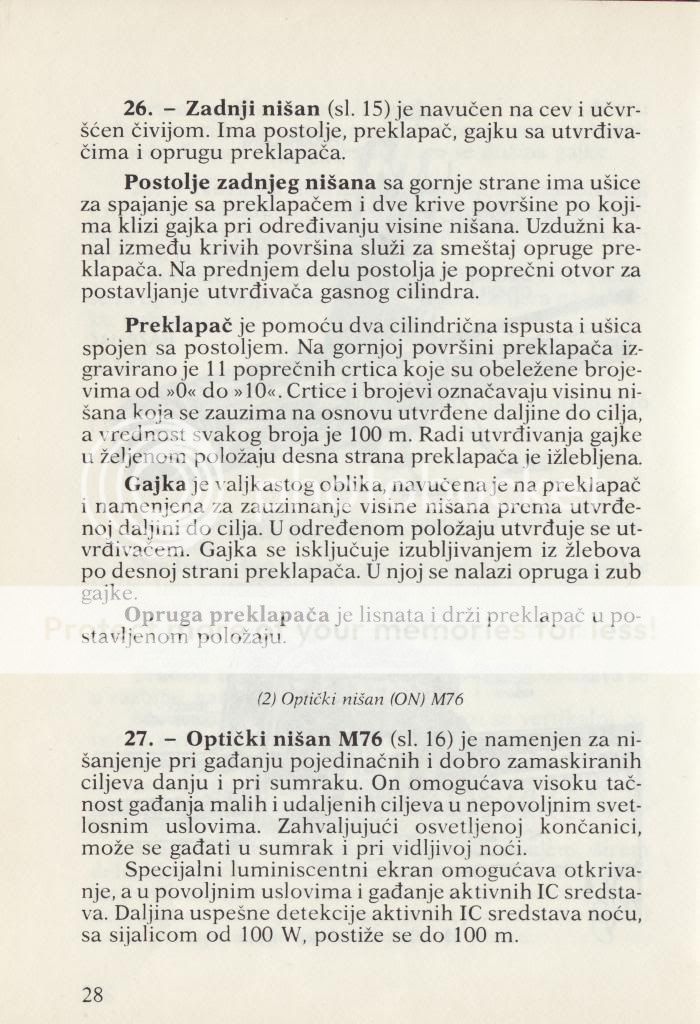
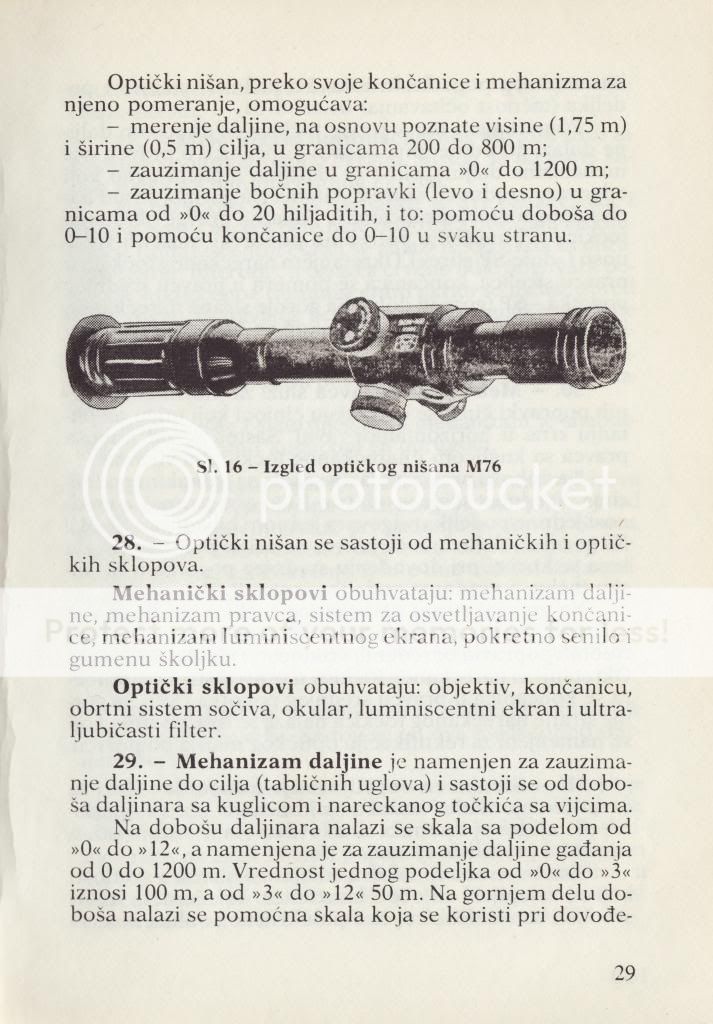
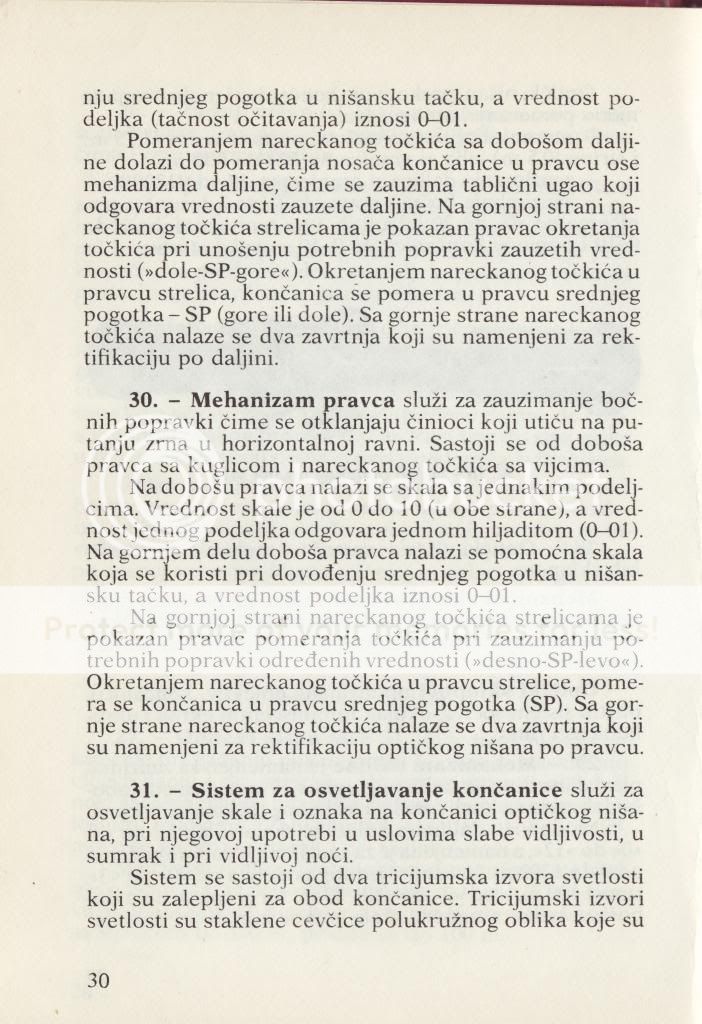
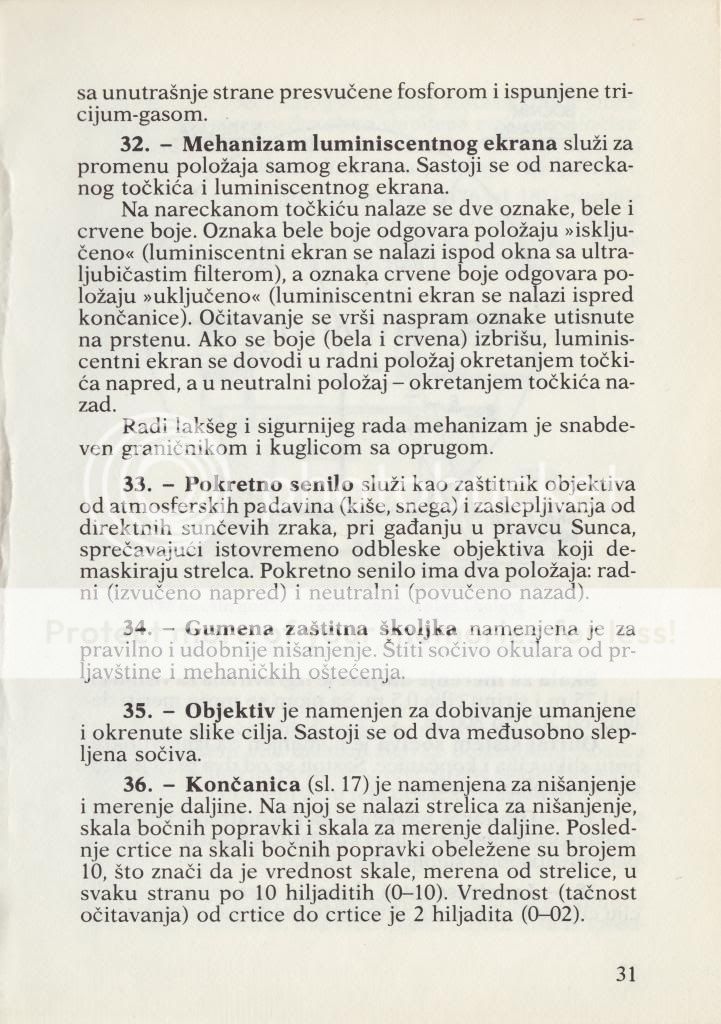
So I did some more digging around and I found the manual for the m76 rifle, its pretty huge so I'm only posting the photos of the areas related to the scope. But I will link it for anyone who wants to see the rest. Hilariously, near the end there seems to be instructions on what looks like anti aircraft fighting positions.
http://s190.photobucket.com/user/billreid1/library/M76/M76%20Military%20Field%20Manual?sort=9&page=1
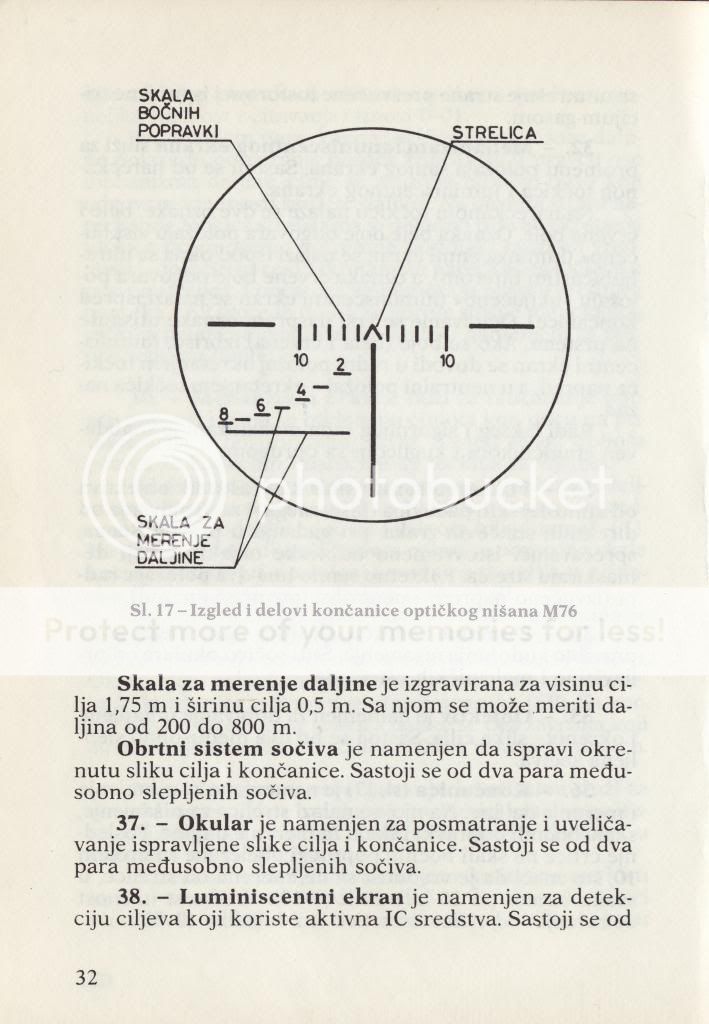
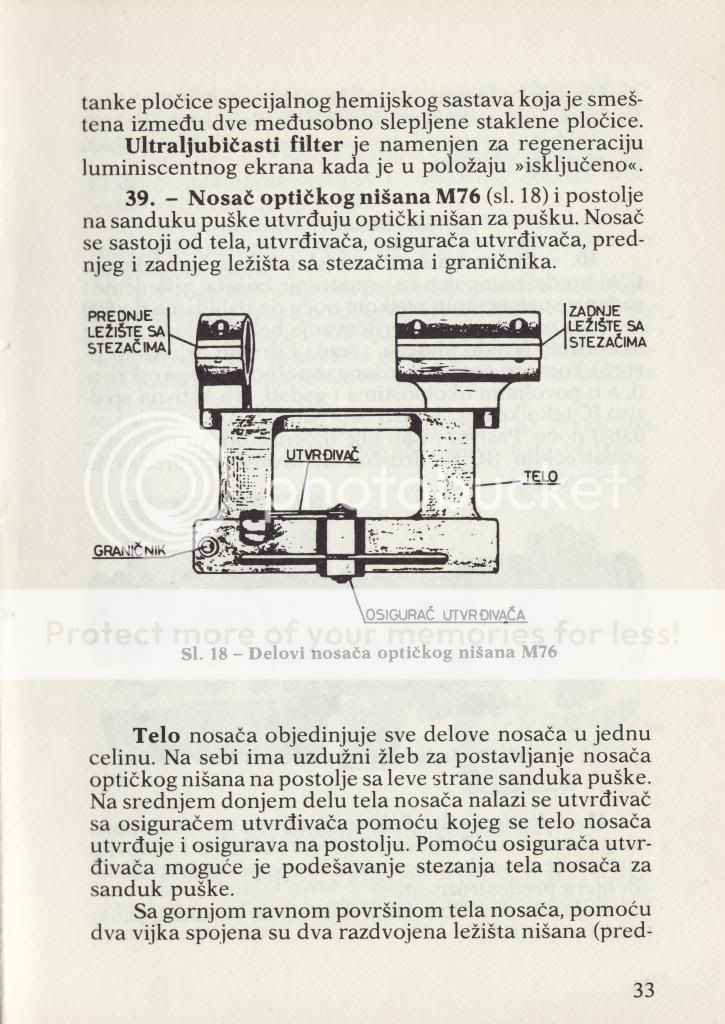
http://s190.photobucket.com/user/billreid1/library/M76/M76%20Military%20Field%20Manual?sort=9&page=1
























