subsonic ammo?

grauhanen

CGN Ultra frequent flyer
Super GunNutz
Rating - 100%
178   0   0
When referring to "subsonic" .22 ammo, is the reference to ammo that is designed to be "quieter" than other .22 ammo? Or is the reference to ammo that shoots at a velocity that is less than the speed of sound? Is .22LR "match" ammo referred to as "subsonic"? Or does the term simply apply to the quiet ammo that must be low velocity in order to be quiet?
 
Low velocity.
Ideally it stays below the speed of sound, bypassing the "crack" as it breaks the sound barrier.
850 fps is hardly audible, bullet hitting the target is often louder than the gun.
 
I recently shot a box of Rem SubSonics out of my 981T…..they consistently outperformed comparable HV ammo (quality wise) in accuracy inside 75yrds.
I gotta find some more….
 
SUB... sonic....

pretty self explanatory I think.

Not really, but thanks for the help.

Subsonic is the counterpart to Supersonic. Sub and Super are opposite prefixes meaning Less Than and More Than respectively. Sonic is derived from the Latin word Sonus, meaning sound. When the the prefixes Sub or Super are combined with Sonic, they act to define the speed of sound within a sound propagating medium. In dry air at 20 °C (68 °F), the speed of sound is 343 metres per second (1,125 ft/s). This is 1,234 kilometres per hour (767 mph). Any object travelling above this velocity is considered Supersonic and anything travelling below this velocity is considered Subsonic. Having said that, the speed of sound varies depending on the medium through which the sound must travel. For example the speed of sound through steel is approximately 20000 fps, while rubber is 130 - 492 fps. Having said that very few objects would be able to pass through the given solids at a sustained supersonic velocity. Radiation and electrons are the only two I can think of.

 
In general Supersonic or "High Velocity" .22 will be above 1200 fps at the muzzle and Subsonic (Standard Velocity) will be below 1050 fps at the muzzle. All quality target ammunition is less than 1100 fps.
 
Not really, but thanks for the help.

Subsonic is the counterpart to Supersonic. Sub and Super are opposite prefixes meaning Less Than and More Than respectively. Sonic is derived from the Latin word Sonus, meaning sound. When the the prefixes Sub or Super are combined with Sonic, they act to define the speed of sound within a sound propagating medium. In dry air at 20 °C (68 °F), the speed of sound is 343 metres per second (1,125 ft/s). This is 1,234 kilometres per hour (767 mph). Any object travelling above this velocity is considered Supersonic and anything travelling below this velocity is considered Subsonic. Having said that, the speed of sound varies depending on the medium through which the sound must travel. For example the speed of sound through steel is approximately 20000 fps, while rubber is 130 - 492 fps. Having said that very few objects would be able to pass through the given solids at a sustained supersonic velocity. Radiation and electrons are the only two I can think of.


+1. Great job!
 
Its not always completely about the sound, although there has been a distinction made of what bullet is faster or slower than sound.


150 years ago they used to shoot indoors (parlor/saloon shooting) and not only was it quieter, it was less dangerous to people and property. .22 BB Cap, 22 CB Cap, 22 short, and 6mm Flobert were a few Sub-Sonic rounds to mention. Aside from social gatherings, low-velocity bullets were popular for disposing small pests and rodents indoors and in barns without exiting or damaging the building. They also made a .22 cal shotgun shell with very small shot ( #9 ?) for shooting mice and rats indoors, also sub-sonic and low damage effects to the structure.
 
Its not always completely about the sound, although there has been a distinction made of what bullet is faster or slower than sound.


150 years ago they used to shoot indoors (parlor/saloon shooting) and not only was it quieter, it was less dangerous to people and property. .22 BB Cap, 22 CB Cap, 22 short, and 6mm Flobert were a few Sub-Sonic rounds to mention. Aside from social gatherings, low-velocity bullets were popular for disposing small pests and rodents indoors and in barns without exiting or damaging the building. They also made a .22 cal shotgun shell with very small shot ( #9 ?) for shooting mice and rats indoors, also sub-sonic and low damage effects to the structure.


A picture to show the might of the Flobert(beside a .22lr). As stated, from an era when "gallery" shooting was popular.
 
Thanks, Blastattack, for an explanation that makes sense. Is it fair to say that not all ammunition that is sold as "subsonic" is meant for target shooting? Take Remington Subsonic, for example. Is it more of a "quiet" .22LR round than a "target" round?
 
Thanks, Blastattack, for an explanation that makes sense. Is it fair to say that not all ammunition that is sold as "subsonic" is meant for target shooting? Take Remington Subsonic, for example. Is it more of a "quiet" .22LR round than a "target" round?

Not much difference in sound between target rounds. What you want to achieve will affect what ammo you buy. Being "subsonic" doesn't really mean "quieter" (although it is). It is labeled as such to demonstrate the ball doesn't pass through sonic barrier (either speeding up in your barrel, or decelerating downrange).

If you're looking for "quiet" ammo it's a different thing. CB's tend to be very quiet. I've slung CBshort, and CBlong out of a rifle and it was quieter than my airgun (click of hammer thwack of projectile hitting). Fun to play with, and certainly troublesome to garden pests. They won't cycle in any of my semi's. Sub-Sonic Remington are louder than CB's but quieter than hyper velocity, and have enough ummph to cycle a semi. I don't play with "target ammo" too much, due cost, but so far they've all cycled in a semi.
 
the ball doesn't pass through sonic barrier (either speeding up in your barrel, or decelerating downrange).
I could be wrong but is this the reason why sub-sonic ammo may be more accurate than HV? e.g. less tumbling of the projectile when it slows down below the sonic barrier

If you're looking for "quiet" ammo it's a different thing. CB's tend to be very quiet.
I shot a few of these Rem CeeBee's out of my 22"bbl bolt rifle and as camster mentioned….the impact at the target was louder than the round going off. However, I found accuracy was good out to about 25yrds. I didn't try them in a semi but don't think they will cycle the action.
……..
 
I could be wrong but is this the reason why sub-sonic ammo may be more accurate than HV? e.g. less tumbling of the projectile when it slows down below the sonic barrier

This is tricky, because I don't want the "stinger" fanboys to get jaded...Some folks report awesome accuracy with Hyper Velocity ammo. In theory, if your ball hits target before suffering the turbulence induced by slowing down through sonic barrier, you could achieve similar accuracy as expected from sub sonic stuff.

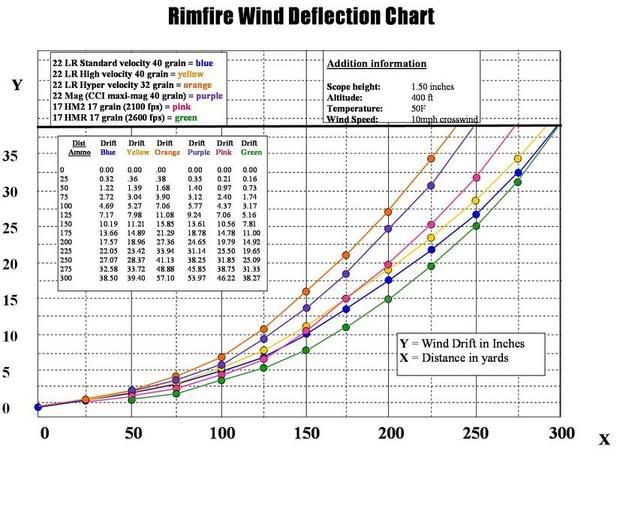
Generally speaking, sub sonic ammo should be more accurate because it doesn't suffer the turblence. Crosswinds effects are also different on either projectile. (I can't find the cool charts that were stickied showing deflection vs bullet's velocity, but recall being surprised that slower ammo deflected less)**

One more important point regarding accuracy in rimfire ammo. The manufacturers of ammo give "target" ammo more scrutiny at the production line. The tolerances are closer than "bulk"ammo. More consistent ammo should provide more consistent groups. The cost is reflected in this too, which is why I tend to sling way more bulk than target grade stuff.

**EDIT: Found the chart...wasn't in reading the wind, but in the ballistics charts

RimfireBallisticswindchart-1.jpg
 
Last edited:
In theory, if your ball hits target before suffering the turbulence induced by slowing down through sonic barrier, you could achieve similar accuracy as expected from sub sonic stuff.

Now this makes sense to me. I'm sure there are a lot of factors involved (design/weight of projectile, temp, etc.) but any idea of the distance HV ammo starts to fall from sonic speed were it may affect accuracy? I'm cheap….so bulk HV ammo is what I shoot.
 
Thanks, Blastattack, for an explanation that makes sense. Is it fair to say that not all ammunition that is sold as "subsonic" is meant for target shooting? Take Remington Subsonic, for example. Is it more of a "quiet" .22LR round than a "target" round?

That is correct. Ammunition sold as Subsonic is generally sold as a quieter round. Target ammunition is subsonic, not because of noise concerns, but because the tiny bullets don't have to transcend the sound barrier and deal with the resulting de-stabilization associated with that. As per the above, Remington Subsonic is being marketed as a quiet round, and not as a target round.
 
I picked up some CCI Quiet rounds Friday, have 710FPS listed on the label. I'm guessing I can fart louder than those. Also found some Rem. S'S and Winchester S'S rounds, no difficulty in finding a variety of 22LR around here, just not much selection at any one place.
 
Not really, but thanks for the help.

Subsonic is the counterpart to Supersonic. Sub and Super are opposite prefixes meaning Less Than and More Than respectively. Sonic is derived from the Latin word Sonus, meaning sound. When the the prefixes Sub or Super are combined with Sonic, they act to define the speed of sound within a sound propagating medium. In dry air at 20 °C (68 °F), the speed of sound is 343 metres per second (1,125 ft/s). This is 1,234 kilometres per hour (767 mph). Any object travelling above this velocity is considered Supersonic and anything travelling below this velocity is considered Subsonic. Having said that, the speed of sound varies depending on the medium through which the sound must travel. For example the speed of sound through steel is approximately 20000 fps, while rubber is 130 - 492 fps. Having said that very few objects would be able to pass through the given solids at a sustained supersonic velocity. Radiation and electrons are the only two I can think of.

stop reading more into it than it really is...

 
I picked up some CCI Quiet rounds Friday, have 710FPS listed on the label. I'm guessing I can fart louder than those. Also found some Rem. S'S and Winchester S'S rounds, no difficulty in finding a variety of 22LR around here, just not much selection at any one place.

From a heavy barrelled rifle you'll be surprised at how quiet they will be. If it's a tapered "pencil" barrel they'll still be quiet but not as quiet as a heavy "bull" barrel.

I've shot some .22shorts and CB cap load from my heavy barrel BSA martini rifle. The shorts were quiet enough that there simply isn't a need for hearing protection even indoors. The CB's were so quiet that it was literally the case where the snap of the firing pin was louder and the "thwap" of the little conical hitting the paper and foam backer was heard separately.
 
Back
Top Bottom